Undergrad Trouble with infinity and complex numbers

Click For Summary
SUMMARY

The discussion centers on the complexities of infinity and complex numbers, specifically addressing the representation of complex numbers and their dimensions. It clarifies that while the set of real numbers is represented as <-∞, ∞>, complex numbers are expressed as a + bi, where both a and b are real numbers. The conversation highlights that for complex functions, one typically requires two dimensions for the domain and can utilize the Riemann sphere for compactification. Additionally, it notes that while complex numbers have one imaginary axis, quaternions and octonions expand this to three and seven axes, respectively.

PREREQUISITES
  • Understanding of complex numbers and their notation (a + bi)
  • Familiarity with the concept of dimensions in mathematics
  • Knowledge of the Riemann sphere and its application in complex analysis
  • Basic grasp of higher-dimensional spaces, including quaternions and octonions
NEXT STEPS
  • Research the Riemann sphere and its role in complex analysis
  • Explore the properties and applications of quaternions and octonions
  • Study the concept of compactification in topology
  • Learn about visualizing complex functions in higher dimensions
USEFUL FOR

Mathematicians, physics students, and anyone interested in advanced mathematical concepts involving complex numbers and higher-dimensional spaces.
Troxx
Messages
2
Reaction score
0
TL;DR
Trouble with infinity and complex numbers, just curious.
Summary: Trouble with infinity and complex numbers, just curious.

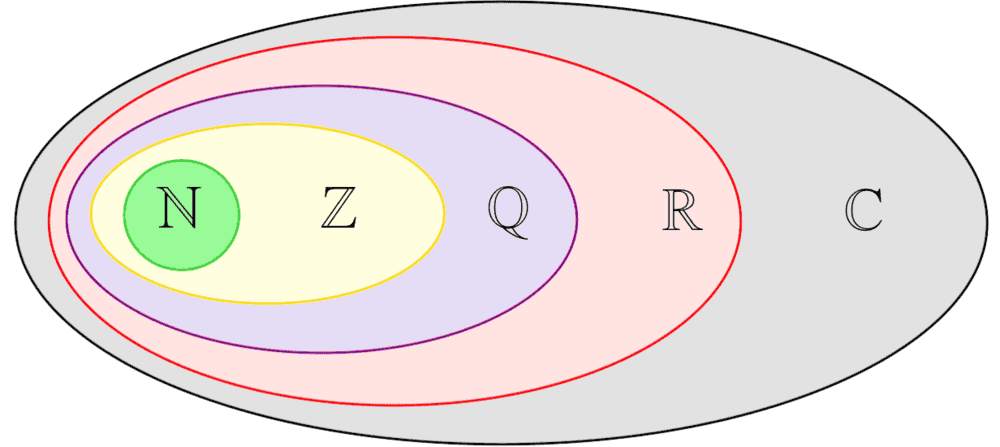
I'm not too familiar with set theory ... but <-∞, ∞> contains just real numbers?
Does something similar to <-∞, ∞> exist in Complex numbers?
My question, is it "wrong"?
1568033300436.png
 
Mathematics news on Phys.org
Yup, using your nomenclature, it would be (<-∞, ∞>, <-∞, ∞>).
Or a+bi where a and b are real numbers.

But one item of caution: ∞ is not a number - real or otherwise.
 
  • Like
Likes Troxx
Thanks...
And further.. when plotting functions with a imaginary axis... there can be more imaginary axis' than one I guess..
 
Troxx said:
Thanks...
And further.. when plotting functions with a imaginary axis... there can be more imaginary axis' than one I guess..
If you are plotting a function with both a complex range and domain, you would need four dimensions: a+bi=f(c+di) - one each for a, b, c, and d with b and d being imaginary axis. Of course, drawing in four dimensions requires some creativity.
 
  • Like
Likes Troxx
Troxx said:
Thanks...
And further.. when plotting functions with a imaginary axis... there can be more imaginary axis' than one I guess..
For complex numbers there is only one imaginary axis, for quarternions there are three and for octonions there are seven.
https://en.m.wikipedia.org/wiki/Octonion
 
.Scott said:
If you are plotting a function with both a complex range and domain, you would need four dimensions: a+bi=f(c+di) - one each for a, b, c, and d with b and d being imaginary axis. Of course, drawing in four dimensions requires some creativity.
If you are going to build a graph, you need four dimensions for the domain and another two for the range.
 
The thing is that there is a different way of "Approaching Infinity" as you have additional dimensions. In ##\mathbb R## , as you pointed out, you go along the +, - x-axis far right or left respectively. In , e.g., ## \mathbb R^2 ##, your set is unbounded if it is not contained in a ball of finite radius r. Similar in higher dimensions, where being contained in a ball of finite radius is equivalent to being bounded, while you "Go to infinity" by not being contained in balls of finite radius.
 
Last edited:
jbriggs444 said:
If you are going to build a graph, you need four dimensions for the domain and another two for the range.
Is this really what you meant? For a function ##f : \mathbb C \to \mathbb C##? You have an extra two dimensions. For the domain you need only two dimensions, not four.
 
  • Like
Likes jbriggs444
  • #10
There is a lot of material on compactifications of 1,2, etc points.
 
  • #11
There is a way to "graph" a complex valued function similar to the way we graph a 2D vector field in just 2 dimensions. That is at every point of the domain (x,y) we plot an arrow which represents a vector that has its y-component equal to the Imaginary part of f(x+iy) and its x-component equal to the Real part of f(x+iy). I know this is not exactly a graph as we usually mean it but anyway..

Alternatively we can use 3 dimensions (where the z axis represent the real or the imaginary part of f(x+iy) )and do two graphs, one for the imaginary part and one for the real part.
 
  • #12
Mark44 said:
Is this really what you meant? For a function ##f : \mathbb C \to \mathbb C##? You have an extra two dimensions. For the domain you need only two dimensions, not four.
Oops. I'd misread a function of two complex arguments.
 
  • #13
jbriggs444 said:
Oops. I'd misread a function of two complex arguments.
I thought that might be it.
 

Similar threads

  • · Replies 2 ·
Replies
2
Views
2K
  • · Replies 7 ·
Replies
7
Views
2K
  • · Replies 40 ·
2
Replies
40
Views
6K
  • · Replies 31 ·
2
Replies
31
Views
3K
  • · Replies 3 ·
Replies
3
Views
2K
  • · Replies 13 ·
Replies
13
Views
6K
  • · Replies 24 ·
Replies
24
Views
4K
  • · Replies 2 ·
Replies
2
Views
2K
  • · Replies 5 ·
Replies
5
Views
3K
  • · Replies 2 ·
Replies
2
Views
2K