Trouble with units for Spring Constant

Join the discussion
Ask a follow-up here, or get your own question answered by working scientists, mathematicians and engineers — people, not an autocomplete.
Real named experts · corrections over time · the nuance an AI answer skips
4 replies · 3K views
guyvsdcsniper
Messages
264
Reaction score
37
Homework Statement
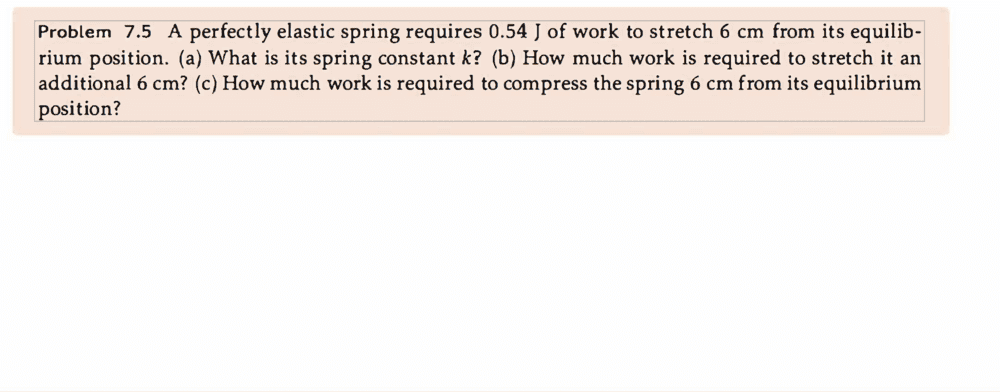
A perfectly elastic spring requires 0.54 J of work to stretch 6 cm from its equilibrium position. (a) What is its spring constant k? (b) How much work is required to stretch it an additional 6 cm? (c) How much work is required to compress the spring 6 cm from its equilibrium position?
Relevant Equations
W=1/2kx^2
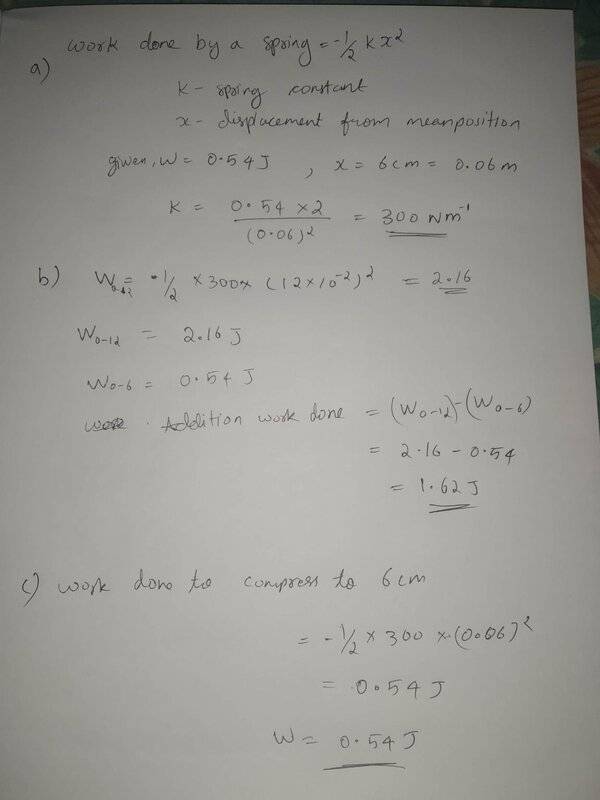
I do not understand how in part a, the units for K can be N/m. If Work is in joules which is kg*m^2/s^2 and we are diving by x^2 which is m^2, then m^2 should cancel out and we should be left with kg/s^2.

Kg/s^2 makes more sense because in part b when you find the work done you are multiplying kg/s^2 * m^2 which gives you a joule.

Are the units in the work below incorrect? Or am I wrong in my explanation?
Screen Shot 2021-03-17 at 9.50.19 PM.png


1616037117567_IMG_20210318_084108.jpeg
 
Physics news on Phys.org
kuruman said:
1 Newton = 1 kg m / s2 (from F = m a)
1 Newton/m = 1 kg / s2

What's your problem? Using N/m for the spring constant units conveys a more intuitive understanding of force per unit length than kg/s2.
That helps. I am not sure I just didnt correlate kg/s^2 to N/m for some reason. Your explanation makes sense. Thank you.
 
Reply
  • Like
Likes   Reactions: kuruman
quittingthecult said:
That helps. I am not sure I just didnt correlate kg/s^2 to N/m for some reason. Your explanation makes sense. Thank you.
This crops up in all sorts of combinations, but quite often there are ways of thinking of it that make sense of the variant representations.
Surface tension is force per unit length, or energy per unit area (surface energy).

In the present case, if you were to hang a mass from the spring and let it oscillate, the square of the period would be proportional to the mass, so you could express the spring constant as mass per period squared - though this would differ from the usual definition by a constant factor.
 
There are only 7 SI base units. All other units are derived units, only existing to simplify things, like 1 Pa is 1 kg/m/s² in SI base units. Similarly, it is a much simpler notation when I say that I have a 1 TB drive compared to a 1000000000000 B drive.

I know that I prefer to buy an electrical outlet rated at 120 V for my house rather than one rated at 120 kg.m²/s³/A (yes, this is equivalent to a volt). It makes life much easier at my local hardware store!