Troubleshooting (b), (c) & (e): Seeking Assistance

Join the discussion
Ask a follow-up here, or get your own question answered by working scientists, mathematicians and engineers — people, not an autocomplete.
Real named experts · corrections over time · the nuance an AI answer skips
3 replies · 2K views
Joe20
Messages
53
Reaction score
1
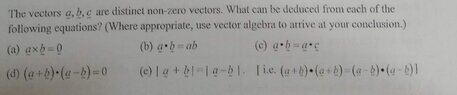
I have some difficulties answering part (b), (c) and (e).

Help is appreciated.
 

Attachments

  • Picture4.jpg
    Picture4.jpg
    23.6 KB · Views: 123
Mathematics news on Phys.org
(b) If you write out the formula for the dot product, what do you get? Now compare that with the RHS. What can you conclude?

(c) Again, I would write out the formulae for the dot products. What can you conclude?

(e) I would think about this one geometrically. Try drawing a few examples and see what you come up with.
 
Ackbach said:
(b) If you write out the formula for the dot product, what do you get? Now compare that with the RHS. What can you conclude?

(c) Again, I would write out the formulae for the dot products. What can you conclude?

(e) I would think about this one geometrically. Try drawing a few examples and see what you come up with.
Hi Ackbach,

Thanks for the advice. I am not very sure what is meant by thinking it geometrically and drawing a few examples in part (e). Would further advice on this. Thanks.
 
Alexis87 said:
Hi Ackbach,

Thanks for the advice. I am not very sure what is meant by thinking it geometrically and drawing a few examples in part (e). Would further advice on this. Thanks.

Well, here's another hint: $\mathbf{a}-\mathbf{b}=\mathbf{a}+(-\mathbf{b})$. So, comparing $\mathbf{a}+\mathbf{b}$ with $\mathbf{a}+(-\mathbf{b})$ gives you some information about what's going on. Geometrically, how does $\mathbf{b}$ compare with $-\mathbf{b}?$