Troubleshooting Tachometer Circuit for 80's Honda Accord | Expert Help Available

  • Thread starter Thread starter neen
  • Start date Start date
  • Tags Tags
    Board Circuit
Click For Summary
SUMMARY

The discussion focuses on troubleshooting a tachometer circuit from an early 80's Honda Accord. The user successfully connected the yellow and blue leads to the negative coil but encountered overheating issues with a pink resistor, damaging the PCB. Experts suggest that one of the leads should connect to a switched 12V power source and recommend checking the zener diode for failure, which may have caused the resistor to overheat. Replacing the zener diode and resoldering the resistor are definitive steps to resolve the issue.

PREREQUISITES
  • Basic understanding of automotive electrical systems
  • Familiarity with circuit board components and their functions
  • Knowledge of zener diodes and voltage regulation
  • Experience with soldering and PCB repair techniques
NEXT STEPS
  • Learn about automotive tachometer circuit design and components
  • Research zener diode specifications and replacement procedures
  • Study PCB repair techniques for damaged traces and components
  • Explore voltage regulation methods in automotive applications
USEFUL FOR

Automotive electricians, hobbyists retrofitting older vehicles, and anyone involved in troubleshooting automotive electronic circuits.

neen
Messages
10
Reaction score
0
This is a tachometer circuit from an early 80's Honda accord.
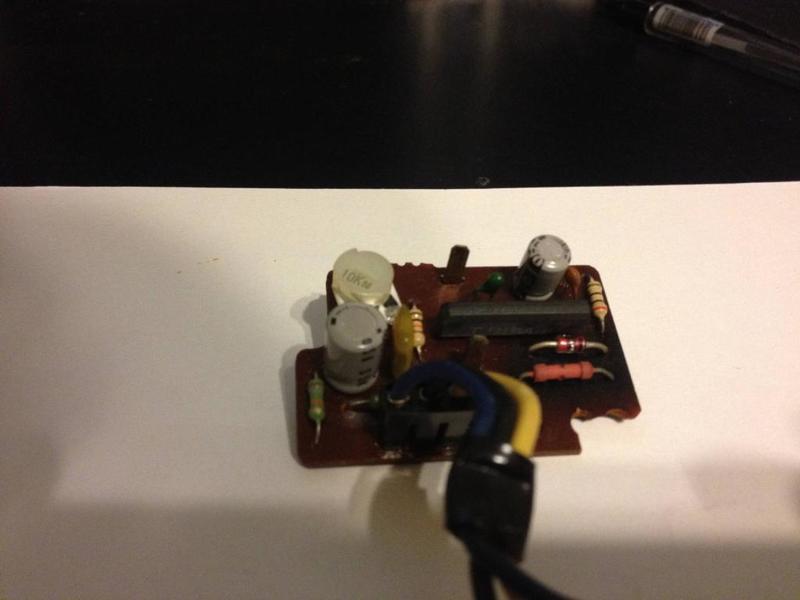
IMG_1245_zpsdc1c97da.jpg


I twisted the yellow and blue leads together and was able to get the tach to work (retrofitted into another older Honda that only came with a mechanical tach option). The twisted pair was ran off of the negative of the coil and the black was sent to ground. This caused the pink (resistor?) to overheat to the point that it partially burnt the PCB and melted the solder off. I can easily enough re-solder the circuit but I want to know where I screwed up at...I'm thinking that either the blue or yellow lead needs to be the switched 12v power source. Can you guys point me in the right direction?

Here is the reverse side.
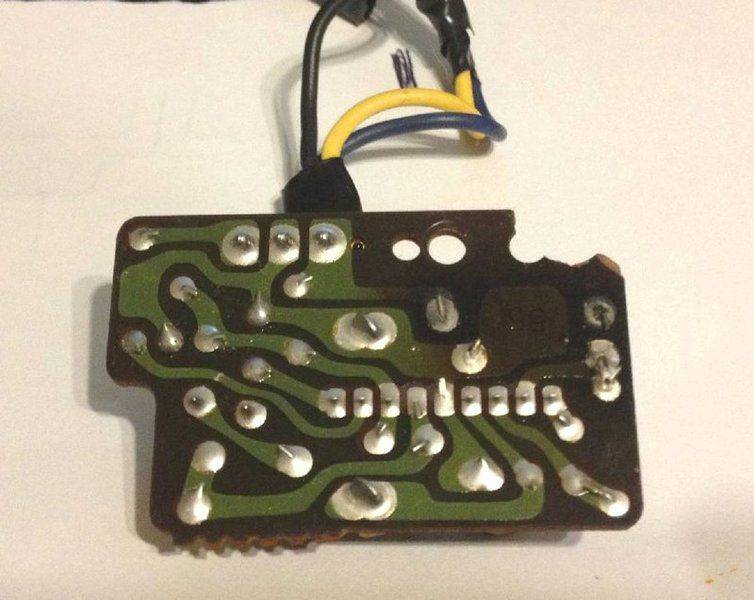
IMG_1244_zps8dfd28b6.jpg
 
Engineering news on Phys.org
It would be really useful if you would make a circuit diagram out of that, it is hard to impossible to see where the individual parts are connected, or what exactly they are.
I expect that one of the inputs (yellow or blue) should come from a voltage source (you need some reliable way to power the IC, for example).
 
The heated area of the circuit board is under the pink coloured power resistor. My guess is that the adjacent component is a zener diode, and that together they form a crude voltage regulator. Zener diodes tend to fail short circuit, if that happens the resistor gets the full voltage and overheats. It is unusual for the resistor to fail immediately the diode shorts, but you should check the resistor anyhow.

Check the resistance of the zener diode. If very low in both directions replace the zener with the same part number, (probably between 5 and 9 volts). Resolder the resistor and you should be out of trouble. (I have crossed my fingers for you).