Troubleshooting Vectors: Finding Errors in Vector Problems | Help Requested

  • Thread starter Thread starter elpermic
  • Start date Start date
  • Tags Tags
    Vectors
Click For Summary
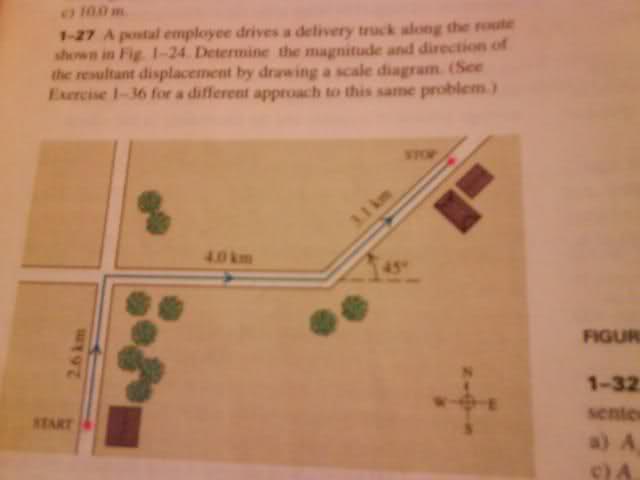
The discussion centers on troubleshooting vector problems, specifically the calculation of resultant vectors. The user initially calculated a resultant vector of 7.9 km at 45 degrees NE, but the book indicates it should be 7.8 km at 38 degrees NE. Participants clarify that the user incorrectly added vectors that are not aligned in the same direction, emphasizing the need to find the angle between them. They also point out that for a 45-degree angle, the north and east components must be equal, which they are not in this case. A scale diagram is recommended for better visualization and verification of the vectors involved.
elpermic
Messages
29
Reaction score
0
vectors problem, help please

Homework Statement


zkqp78.jpg


Homework Equations


The Attempt at a Solution


I used the pythagorem theorem on the first two vectors and named it vector x. It turned out to be 4.8km and I used vector x plus 3.1km of the other vector. I got 7.9km at 45 degrees NE. The book says it should be 7.8km at 38 degrees NE. What did I do wrong? OR is it the book>
 
Physics news on Phys.org


Is the resultant vector from 2.6km north and 4.0km east at a 45 degree angle from east?

If not you can't simply add 4.8km to 3.1km because they won't be in the same direction.


4.8 km and 3.1 km are not in the same line.
Find the angle between them.
It is equal to (45 degrees - angle between 4 km and 4.8 km.)


Aren't both lines( vector x and the 3.1km vector both going north east?


No. It is not. Draw the scale diagram and verify.


elpermic said:
Aren't both lines( vector x and the 3.1km vector both going north east?

Well, you went north 2.6 km, then east 4 km. To have a 45-degree angle, those two values have to be equal, which they aren't.
 
Thread 'Correct statement about size of wire to produce larger extension'
The answer is (B) but I don't really understand why. Based on formula of Young Modulus: $$x=\frac{FL}{AE}$$ The second wire made of the same material so it means they have same Young Modulus. Larger extension means larger value of ##x## so to get larger value of ##x## we can increase ##F## and ##L## and decrease ##A## I am not sure whether there is change in ##F## for first and second wire so I will just assume ##F## does not change. It leaves (B) and (C) as possible options so why is (C)...

Similar threads

  • · Replies 3 ·
Replies
3
Views
1K
  • · Replies 3 ·
Replies
3
Views
830
Replies
13
Views
2K
  • · Replies 3 ·
Replies
3
Views
1K
Replies
8
Views
2K
  • · Replies 1 ·
Replies
1
Views
2K
Replies
2
Views
3K
  • · Replies 2 ·
Replies
2
Views
3K
  • · Replies 13 ·
Replies
13
Views
2K
Replies
14
Views
2K