Undergrad Trying to obtain a 2nd order ODE

  • Thread starter Thread starter AAli
  • Start date Start date
  • Tags Tags
    2nd order Ode
Click For Summary
SUMMARY

The discussion focuses on obtaining a second-order ordinary differential equation (ODE) through implicit differentiation. Participants suggest an alternative approach by isolating dy/dx and solving algebraically, leading to a separable equation. The correct formulation of dy/dx is provided as ##\frac {dy}{dx} = \frac{y^{1/2}(1 - y^{1/2} - y)}{y^{1/2}(y^{-1/2} + 1 - y)}##. The conversation emphasizes clarity in terminology, particularly the distinction between "2nd ODE" and "second-order differential equation."

PREREQUISITES
  • Understanding of ordinary differential equations (ODEs)
  • Familiarity with implicit differentiation techniques
  • Knowledge of algebraic manipulation of equations
  • Ability to identify separable differential equations
NEXT STEPS
  • Study the method of implicit differentiation in detail
  • Learn about separable differential equations and their solutions
  • Explore the conversion of higher-order ODEs to systems of first-order ODEs
  • Investigate the role of coefficients in differential equations and their impact on solutions
USEFUL FOR

Mathematicians, physics students, and anyone involved in solving differential equations, particularly those interested in transitioning from second-order to first-order systems.
AAli
Messages
3
Reaction score
0
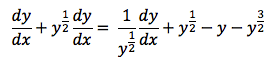
Hi I'm having a slight issue trying to obtain a 2nd order ODE with respect to x (so involves implicit differentiation in this case) from the equation below. I would greatly appreciate any help or tips to solve this problem.
Screen Shot 2018-01-06 at 17.06.57.png

I've removed the coefficients to make things a litter easier. Thank you.
 

Attachments

  • Screen Shot 2018-01-06 at 17.06.57.png
    Screen Shot 2018-01-06 at 17.06.57.png
    1.7 KB · Views: 955
Last edited by a moderator:
Physics news on Phys.org
AAli said:
Hi I'm having a slight issue trying to obtain a 2nd ODE with respect to x (so involves implicit differentiation in this case) from the equation below. I would greatly appreciate any help or tips to solve this problem.

I've removed the coefficients to make things a litter easier. Thank you.
Your question isn't clear to me. Are you trying to obtain a 2nd order ODE? If so, I'm not sure that will lead to anything productive. A different approach would be to move all the terms involving dy/dx to one side, and then solve for dy/dx in terms of everything else. The resulting equation is separable, so it's possible a solution could be found without resorting to the implicit differentiation you're talking about.
 
Mark44 said:
Your question isn't clear to me. Are you trying to obtain a 2nd order ODE? If so, I'm not sure that will lead to anything productive. A different approach would be to move all the terms involving dy/dx to one side, and then solve for dy/dx in terms of everything else. The resulting equation is separable, so it's possible a solution could be found without resorting to the implicit differentiation you're talking about.

Hi, my goal was to eventually obtain a set of coupled first order differential equations from the 2nd order ODE, so I'm happy to try a quicker approach to solve this problem. Could you please elaborate on the highlighted bit. Thank you.

Edit: order
 
AAli said:
Hi, my goal was to eventually obtain a set of coupled first order differential equations from the 2nd ODE, so I'm happy to try a quicker approach to solve this problem. Could you please elaborate on the highlighted bit. Thank you.
"2nd ODE" does not mean "second order differential equation." Please try to be more clear in what you write. Edit: I see that you have edited your post to include the word "order."

The strategy you're describing won't work, as far as I can tell. It does no good to convert a 1st-order DE to 2nd order for the purpose obtaining two first-order DEs.
What I'm suggesting is to move all the terms in dy/dx to one side, and then solve algebraically for dy/dx.
I get ##\frac {dy}{dx} = \frac{y^{1/2}(1 - y^{1/2} - y)}{y^{1/2}(y^{-1/2} + 1 - y)}##.
This is separable, and would be very simple to solve except for one sign in the fraction on the right.
 
  • Like
Likes AAli
Mark44 said:
"2nd ODE" does not mean "second order differential equation." Please try to be more clear in what you write. Edit: I see that you have edited your post to include the word "order."

The strategy you're describing won't work, as far as I can tell. It does no good to convert a 1st-order DE to 2nd order for the purpose obtaining two first-order DEs.
What I'm suggesting is to move all the terms in dy/dx to one side, and then solve algebraically for dy/dx.
I get ##\frac {dy}{dx} = \frac{y^{1/2}(1 - y^{1/2} - y)}{y^{1/2}(y^{-1/2} + 1 - y)}##.
This is separable, and would be very simple to solve except for one sign in the fraction on the right.

I did as you advised but I got something slightly different:

##\frac {dy}{dx} = \frac{y^{1/2}(1 - y^{1/2} - y)}{y^{1/2}(y^{-1/2} + 1 - y^{-3/2})}##.
 
AAli said:
I did as you advised but I got something slightly different:

##\frac {dy}{dx} = \frac{y^{1/2}(1 - y^{1/2} - y)}{y^{1/2}(y^{-1/2} + 1 - y^{-3/2})}##.
Yes, I made a mistake on the last term in the denominator.

You mentioned earlier that you removed the coefficients. You should put them back in, as both numerator and denominator might be further factorable.
 
:olduhh: Isn't it just dy/dx = - y. ?
 

Similar threads

  • · Replies 7 ·
Replies
7
Views
3K
  • · Replies 7 ·
Replies
7
Views
2K
  • · Replies 9 ·
Replies
9
Views
3K
Replies
1
Views
2K
  • · Replies 1 ·
Replies
1
Views
2K
  • · Replies 2 ·
Replies
2
Views
2K
Replies
3
Views
3K
Replies
5
Views
2K
  • · Replies 2 ·
Replies
2
Views
3K
  • · Replies 3 ·
Replies
3
Views
5K