Turbine Work - Can I assume ideal gas?

Click For Summary

Discussion Overview

The discussion revolves around estimating the mechanical work recoverable from expanding hot air through a gas turbine, specifically examining the validity of assuming ideal gas behavior under high temperature and pressure conditions. The inquiry includes considerations of isentropic efficiency and the implications of using ideal gas assumptions in calculations.

Discussion Character

  • Technical explanation
  • Debate/contested
  • Experimental/applied

Main Points Raised

  • One participant seeks to estimate work using an equation derived under the assumption of ideal gas behavior, questioning its validity at high temperatures (600 K) and pressures (250 bars).
  • Another participant expresses skepticism about the plausibility of the inlet conditions and overall pressure ratio, questioning whether this reflects a real engineering problem.
  • A different participant suggests that at high temperatures, air should behave like an ideal gas, but recommends calculating the compressibility factor to assess the impact of deviations from ideal gas behavior.
  • One participant acknowledges uncertainty regarding the outlet temperature used in calculations and discusses the implications of having multiple turbine stages on the pressure ratio.
  • Another participant points out that properties of air at various pressures and temperatures can be sourced from published data, and notes that a large number of turbine stages would be necessary to manage the significant pressure drop.
  • A participant provides context on typical pressure ratios for gas turbines, suggesting that the participant should consider lower pressures for their energy storage and recovery system.

Areas of Agreement / Disagreement

Participants express differing views on the validity of the ideal gas assumption under the specified conditions, with some supporting its use while others raise concerns about the practicality and accuracy of the assumptions made. The discussion remains unresolved regarding the implications of these assumptions on the work estimations.

Contextual Notes

Participants note limitations related to the assumptions of ideal gas behavior, the need for accurate outlet temperature data, and the practical challenges of constructing turbines capable of handling high pressure ratios.

Sorade
Messages
53
Reaction score
1
Hi all,

I need to estimate the mechanical work I can recover from expanding hot air through a gas turbine.

So far I am using the equation below, where Wrev is my ideal isentropic work, s the number of stages, n = k = ratio of specific heats, R gas constant, T1 is the inlet Temperature, Pin the inlet pressure, Pout the outlet pressure.
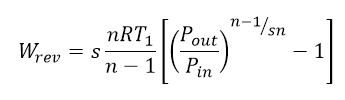
work_eq.PNG


This equation was derived assuming an ideal gas was used. I would like to know how valid this is when the inlet conditions are T = 600 K and P = 250 bars, and outlet conditions T = 350 K and P = 1 bar.

I am asking because I saw this simplification used in many papers and I want to know what impact that might have on my estimations. I assume an isentropic efficiency between 0.66 and 0.88 and calculated all the work outcomes for the values in this range.
 
Engineering news on Phys.org
Your inlet conditions and overall pressure ratio are not very plausible - is this a real engineering problem ?
 
I would imagine the effect of the gas compression would be negligible. Theoretically, air should behave like an ideal gas in this case because it is under high temperatures.

If you want to verify, you could always determine the compressibility factor of air at the inlet condition and outlet condition and apply those to the formula. Then calculate a percentage difference between what you originally calculated vs. what you calculated when accounting for the compressiblity of the gas. You could then determine if the difference is negligible for your application.
 
Thanks. I suspected it would be okay with high temperatures, but I wasn't sure that the high pressure wouldn't counter act that.

Nidium, I am not sure I used the correct outlet temperature, it is not needed for the equation and I usually work it out separately once I worked out the amount of work to extract. I terms of the pressure ratio being massive, this is because I actually have 2 or 3 stages, represented by s in the equation.
 
Properties of air over a wide range of pressures and temperatures can be obtained from published data .

Properties of air mixed with combustion products are also available .

You would need a large number of turbine stages to handle that pressure drop . Certainly many more than 2 or 3 .

The number of stages is a bit academic though because such a turbine would be impractical both for thermodynamic reasons and because of practical difficulties of construction .

You can find large amounts of useful information on this subject from books and websites dealing with gas turbine design .
 
Thank you Nidum,

Apologies if it sounds a bit academic, I'm not a mechanical or electrical engineer, so I had to start from scratch.

Do you have any example of good starting points to look at maximum inlet pressures of gas turbines ? I am looking at a system where the compression of the gas is decoupled in time, so that might remove some of the limitations ?? I basically consider the combustion chamber + expander part of the turbine.
 
Pressure ratios for land based power generator gas turbines are typically in the range 10:1 to 20:1 . Some advanced technology jet engines have pressure ratios up to 25:1 .

So turbine inlet pressures are in range 10 bar to 25 bar .

For the energy storage and recovery system that you are exploring it would probably be best to use a pressure at the lower end of this range .
 
Last edited:

Similar threads

  • · Replies 20 ·
Replies
20
Views
5K
  • · Replies 10 ·
Replies
10
Views
3K
  • · Replies 3 ·
Replies
3
Views
3K
  • · Replies 9 ·
Replies
9
Views
3K
  • · Replies 10 ·
Replies
10
Views
5K
  • · Replies 1 ·
Replies
1
Views
2K
  • · Replies 12 ·
Replies
12
Views
3K
  • · Replies 1 ·
Replies
1
Views
3K
  • · Replies 7 ·
Replies
7
Views
4K
  • · Replies 1 ·
Replies
1
Views
2K