Twin turbo intercooler pipe merge using air ejector design

  • Thread starter Thread starter V8KILR
  • Start date Start date
  • Tags Tags
    Air Design Pipe
Click For Summary
SUMMARY

The discussion focuses on the design of a twin turbo intercooler pipe merge using an air ejector to prevent reverse airflow from the second turbo in a sequential twin turbo system. The proposed solution aims to eliminate the need for a swing check valve by mixing high-pressure air from the first turbo with atmospheric air in the second turbo's intercooler pipe, thereby maintaining forward velocity and preventing backflow. The user seeks mathematical validation for this design and mentions the importance of achieving maximum air mixing to ensure optimal performance.

PREREQUISITES
  • Understanding of sequential twin turbo systems
  • Knowledge of air ejector design principles
  • Familiarity with intercooler pipe configurations
  • Basic principles of fluid dynamics and airflow
NEXT STEPS
  • Research the principles of air ejector design for automotive applications
  • Study the effects of airflow dynamics in twin turbo systems
  • Investigate the mathematical modeling of airflow mixing in intercooler pipes
  • Explore alternative designs for intercooler pipe merging without check valves
USEFUL FOR

Automotive engineers, turbo system designers, and performance enthusiasts looking to optimize twin turbo setups and enhance intercooler efficiency.

V8KILR
Messages
4
Reaction score
0
I'm converting my turbo system from a single turbo to a sequential twin turbo system. Where the two turbos intercooler pipes join, the flow from the first turbo to spool can easily reverse back through the second turbo to spool, unless you have a one way valve like a swing check valve to stop this happening.

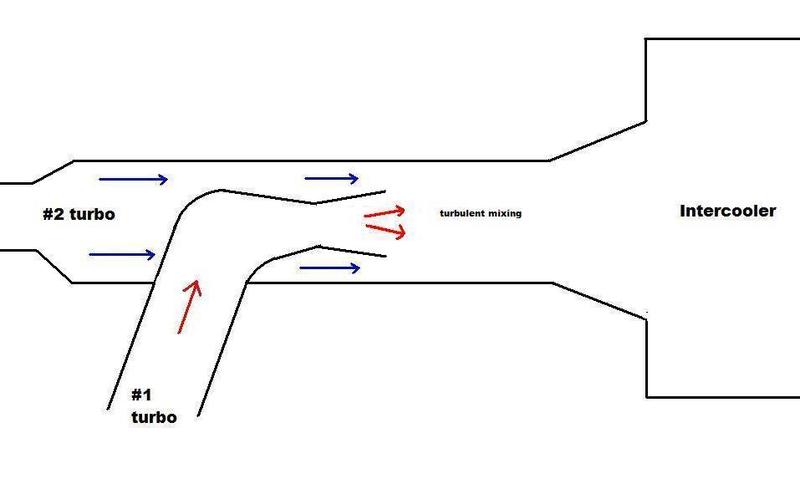
What I would like to do is eliminate the swing check valve by using an air ejector design with the first turbo's intercooler pipe to stop the flow reversing back through the second turbo's intercooler pipe. Here is a diagram I have done.
pipes.jpg


Could this design work such that at all stages of both turbos boost from vacuum to full boost, there would be no flow backwards to the second turbo?
 
Last edited:
Engineering news on Phys.org
Google "twin turbo merger" and you will see plenty of smooth transitions into the throttle/carb. If you have similar turbos being fed by equal banks of exhaust the rest of it "will work itself out".

MergePipe003_zpsf501868d.jpg


580879700_A7anx-M.jpg
 
This is a sequential twin turbo setup I am doing which means one turbo makes boost first while the other one is making no boost. The pic you show is one of the better designs, but I still don't think that I can merge the intercooler pipes like your pic shows otherwise the boost from the first turbo will still partly flow back out the second turbo (as it is making no flow or boost) instead of it all going out through the intercooler. This is because the flow path back out through the second turbo presents less resistance to the first turbos boosted air then going through the intercooler does.

What the air ejector method should do is turbulently mix the air from the first turbo (which is at high speed and pressure) with the atmospheric pressure air in the second turbo intercooler pipe. This mixing should impart forward velocity to the second turbos static air resulting in it also moving towards the intercooler, albeit at a slower speed. The more mixing that occurs, the better this idea will work and the less chance that any air will flow backwards out the second turbo.

That's why I'm hoping someone with more maths skills then me can help work out (or point me in the right direction) if my idea of using an air ejector design for the pipe merging will achieve maximum mixing of the air and result in no air ever flowing backwards out the second turbo.
 
Last edited:
A check valve should work for the intake.
draw_disc_check_valve.jpg


This should solve the exhaust part.
power_cut_out_trimmed.jpg
 
The EGCV (exhaust gas control valve) design I like the best is this one as it is boost activated, but unfortunately they are out of stock at the moment.

ATP-ACS-010_450.jpg


The intake check valve design I like the best is this one. It is a swing check valve so should have very little flow resistance.

seq9.jpg


I'd still like to be able to have the intercooler pipe merging done so that there is no need for the swing check valve though, and I still think that the air ejector design should be able to achieve that.
 
Last edited:
Hi,

I am not sure if this will help at all but there is a company that manufacture diesel engine charge air coolers, you should try Vestas aircoil A/S in Denmark (www.vestas-aircoil.com)
 

Similar threads

Replies
1
Views
914
Replies
13
Views
6K
  • · Replies 26 ·
Replies
26
Views
21K
  • · Replies 15 ·
Replies
15
Views
4K
  • · Replies 6 ·
Replies
6
Views
18K
Replies
13
Views
4K
Replies
26
Views
10K
Replies
48
Views
12K
  • · Replies 7 ·
Replies
7
Views
9K
  • · Replies 8 ·
Replies
8
Views
2K