Booze
- 2
- 0
New user is reminded to show their work on schoolwork problems at PF
- Homework Statement
- The particle of mass M collapses with the body of two point-like particles of mass m.
- Relevant Equations
- Help needed
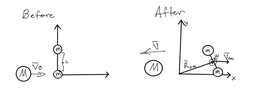
Two point-like particles of mass m. The particles are rigidly connected to each other with a mass-less rod of length L. The particles are initially at rest in such a way that one particle is at the origin and the other is at the point (0, L). A point-like particle of mass M collides with a particle located at the origin with a speed 𝑣⃗0.
a) After the collision, a particle of mass M bounces straight back to its direction of entry. Show that two m-the center of mass of the body formed by the particle must then move so that 𝑉𝑐𝑚 = 𝑀(𝑣0+𝑣)/2𝑚 .
b) Determine the orbital angular momentum 𝐿⃗⃗ 𝑡𝑟𝑎𝑛𝑠 and the rotation rate 𝐿⃗⃗ 𝑟𝑜𝑡 of the given
using quantities (relative to the origin) before and after the collision. What can you say about the total angular momentum value?
c) Show that after the collision, the body of two m-particles rotates counterclockwise with angular velocity 𝜔 = 𝑀(𝑣0+𝑣)/𝑚𝐿.
a) After the collision, a particle of mass M bounces straight back to its direction of entry. Show that two m-the center of mass of the body formed by the particle must then move so that 𝑉𝑐𝑚 = 𝑀(𝑣0+𝑣)/2𝑚 .
b) Determine the orbital angular momentum 𝐿⃗⃗ 𝑡𝑟𝑎𝑛𝑠 and the rotation rate 𝐿⃗⃗ 𝑟𝑜𝑡 of the given
using quantities (relative to the origin) before and after the collision. What can you say about the total angular momentum value?
c) Show that after the collision, the body of two m-particles rotates counterclockwise with angular velocity 𝜔 = 𝑀(𝑣0+𝑣)/𝑚𝐿.
Attachments
 ##\qquad ## !