Two questions about Black body radiation

Click For Summary
SUMMARY

This discussion centers on the concepts of black body radiation, specifically addressing spectral radiance and photon flux. It clarifies that spectral radiance is defined as the radiated energy per square meter, per unit wavelength interval, and per unit solid angle, rather than a direct count of photons. The conversation emphasizes the importance of using Planck's formulas for calculating spectral radiance and photon flux, highlighting that photon flux is an expectation value rather than a definitive count of photons due to the quantum nature of electromagnetic fields.

PREREQUISITES
  • Understanding of black body radiation principles
  • Familiarity with Planck's law and its formulas
  • Knowledge of quantum mechanics, specifically photon behavior
  • Concept of gauge invariance in physics
NEXT STEPS
  • Study Planck's law and its application in calculating spectral radiance
  • Learn about the Poynting vector and its role in electromagnetic theory
  • Explore the concept of gauge invariance and its implications in quantum mechanics
  • Investigate the relationship between energy density and photon flux in electromagnetic fields
USEFUL FOR

Physicists, students of quantum mechanics, and anyone interested in the principles of black body radiation and its applications in modern physics.

vijayantv
Messages
23
Reaction score
1
TL;DR
questions about Black body radiation
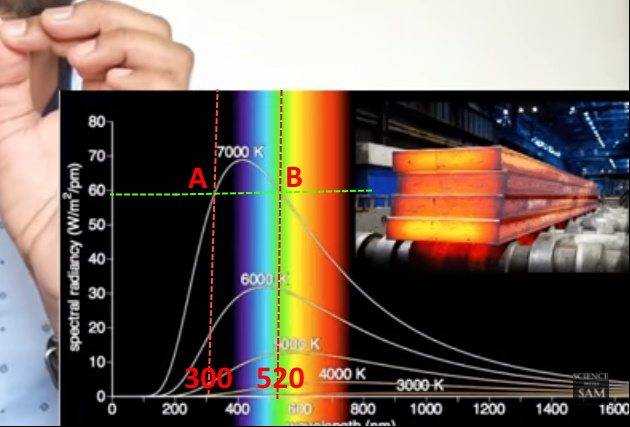
I have questions about Black body radiation. see the attached image

1). It explains that the Spectral radiance measurement of 7000K temperature is the same as both 300 and 520 nm wavelength light.
See here both A and B shows 60.
Is my understanding correct?

2). Is spectral radiance the number of photons? If not, what exactly it is?

UVC.jpg

Please clarify.
 
Physics news on Phys.org
1) Yes.

2) Looking at the units, I'd say the area under the curve denotes a power emitted per area. That's a number of photons per second per area.
 
vijayantv said:
2). Is spectral radiance the number of photons? If not, what exactly it is?
No, it is the radiated energy per square meter, per unit wavelength interval, and per unit of solid angle. At optical wavelengths it is rather unusual to express a wavelength interval in picometers. But you can write ## 60 \rm W m^{-2} pm^{-1} sr^{-1} ## also as ## 60 \rm kW m^{-2} nm^{-1} sr^{-1} ##, or ## 6 \rm W cm^{-2} nm^{-1} sr^{-1} ##.

The photon flux is different at the two wavelengths. Because 520 nm photons have lower energy than 300 nm photons, there must be more of them if the radiance is the same.
 
  • Like
Likes   Reactions: vanhees71
WernerQH said:
No, it is the radiated energy per square meter, per unit wavelength interval, and per unit of solid angle. At optical wavelengths it is rather unusual to express a wavelength interval in picometers. But you can write ## 60 \rm W m^{-2} pm^{-1} sr^{-1} ## also as ## 60 \rm kW m^{-2} nm^{-1} sr^{-1} ##, or ## 6 \rm W cm^{-2} nm^{-1} sr^{-1} ##.

The photon flux is different at the two wavelengths. Because 520 nm photons have lower energy than 300 nm photons, there must be more of them if the radiance is the same.
Thanks for the reply.

When compare with 400 nm and 300 nm we get Spectral-radiance 70 and 60 respectively.

Here, the 300 nm photon has more energy than the 400 nm photon. how about the number of photons, in this scenario?
 
vijayan_t said:
how about the number of photons, in this scenario?
You simply divide the spectral radiance by ## h \nu (= hc / \lambda) ##, the energy per photon, to get the flux of photons. You get a different curve because the factor is different for different wavelengths.

You have seen Planck's famous formula, haven't you? You can work out all numbers yourself using $$
I_\lambda = \frac {2 h c^2} {\lambda^5} \left(e^{hc/\lambda kT} - 1\right)^{-1}
$$ for the spectral radiance, and $$
\Phi_\lambda = \frac {2 c^2} {\lambda^4} \left(e^{hc/\lambda kT} - 1\right)^{-1}
$$ for the photon flux.
 
  • Like
Likes   Reactions: vijayan_t
WernerQH said:
You simply divide the spectral radiance by ## h \nu (= hc / \lambda) ##, the energy per photon, to get the flux of photons. You get a different curve because the factor is different for different wavelengths.

You have seen Planck's famous formula, haven't you? You can work out all numbers yourself using $$
I_\lambda = \frac {2 h c^2} {\lambda^5} \left(e^{hc/\lambda kT} - 1\right)^{-1}
$$ for the spectral radiance, and $$
\Phi_\lambda = \frac {2 c^2} {\lambda^4} \left(e^{hc/\lambda kT} - 1\right)^{-1}
$$ for the photon flux.
Got it. very clear ! .
Thanks .
 
WernerQH said:
You simply divide the spectral radiance by ## h \nu (= hc / \lambda) ##, the energy per photon, to get the flux of photons. You get a different curve because the factor is different for different wavelengths.

You have seen Planck's famous formula, haven't you? You can work out all numbers yourself using $$
I_\lambda = \frac {2 h c^2} {\lambda^5} \left(e^{hc/\lambda kT} - 1\right)^{-1}
$$ for the spectral radiance, and $$
\Phi_\lambda = \frac {2 c^2} {\lambda^4} \left(e^{hc/\lambda kT} - 1\right)^{-1}
$$ for the photon flux.
That's an important point, because that's indeed the only way to make physical sense of something like an average "photon number". One should be aware that what's physically measurable must be related to gauge independent local observables, and in the case of photons the measure related to intensity is energy density, which is both gauge invariant and a local observable, i.e., obeying the microcausality principle. That's not the case for a naive photon number density using the annihilation and creation operators of the mode decomposition of the free vector potential, because this is a gauge-dependent quantity, which does not fulfill the microcausality condition (in the radiation gauge).
 
vanhees71 said:
That's an important point, because that's indeed the only way to make physical sense of something like an average "photon number". One should be aware that what's physically measurable must be related to gauge independent local observables, and in the case of photons the measure related to intensity is energy density, which is both gauge invariant and a local observable, i.e., obeying the microcausality principle. That's not the case for a naive photon number density using the annihilation and creation operators of the mode decomposition of the free vector potential, because this is a gauge-dependent quantity, which does not fulfill the microcausality condition (in the radiation gauge).

Please explain in detail what is not correct in his explanation.
And Please provide your answer to my question.

Thanks
 
vijayantv said:
see the attached image
Where is this image from? Please give a reference.
 
  • #10
vijayan_t said:
Please explain in detail what is not correct in his explanation.
The "photon flux" in post #5 is not an actual number of photons. The state of the quantum electromagnetic field in this scenario is not even an eigenstate of photon number, so there is no definite "number of photons" at any frequency. At best the "photon flux" can be thought of as an expectation value of photon number for a given frequency.

Similar remarks apply to the "energy per photon" at a given frequency; this can't possibly be an actual energy per photon since there isn't even a definite number of photons present.
 
  • Like
Likes   Reactions: vanhees71
  • #11
vijayan_t said:
Please provide your answer to my question.
What question of yours has not been answered?
 
  • Like
Likes   Reactions: vanhees71
  • #12
Only gauge-invariant quantities from local observables have a physical interpretation. In the case of the electromagnetic field the photon-number operators do not fufill this criterion, because the field operators ##\hat{\vec{A}}## in the radiation gauge do not fulfill the microcausality condition, because of the constraint ##\vec{\nabla} \cdot \hat{\vec{A}}=0##.

Observable are indeed intensities, i.e., the components of the energy-momentum tensor (particularly energy density and energy-current density/momentum density aka "Poynting vector"), because they derive from the physical field components ##\vec{E}## and ##\vec{B}## which fulfill microcausality conditions and are gauge invariant. So indeed "the flux", derived from the energy-current density of the em. field (Poynting vector) is an observable, but that must not be confused with a "photon-number current", which is not an observable. What you can define of course is the energy-current density divided by the energy and call this "photon-number current".

In the above quoted book by Zombeck it's of course done correctly, using the energy density ("radiance") as it must be.
 
Last edited by a moderator:
  • Like
Likes   Reactions: gentzen
  • #13
Everybody understands "photon flux" as I said, namely as a count rate which is really measured. It's indeed defined via the Poynting vector and not some non-physical photon number, which indeed is a purely theoretical construct without any physically interpretible meaning.
 

Similar threads

  • · Replies 18 ·
Replies
18
Views
2K
  • · Replies 7 ·
Replies
7
Views
2K
Replies
5
Views
1K
  • · Replies 13 ·
Replies
13
Views
5K
  • · Replies 9 ·
Replies
9
Views
3K
  • · Replies 1 ·
Replies
1
Views
1K
  • · Replies 1 ·
Replies
1
Views
3K
  • · Replies 2 ·
Replies
2
Views
9K
  • · Replies 29 ·
Replies
29
Views
4K
  • · Replies 23 ·
Replies
23
Views
3K