Ultimate stress vs Temperature in glass

Click For Summary
SUMMARY

The discussion focuses on the ultimate tensile and compressive stress of various types of glass, including quartz, fused silica, borosilicate, and soda lime, at elevated temperatures of 500-600°C. It is established that while glass can theoretically have an ultimate strength of approximately 2 million psi, manufacturing imperfections significantly reduce its practical tensile strength. Additionally, the strength of glass remains relatively stable at high temperatures, with potential for slight increases. Caution is advised regarding the use of glass in pressurized environments due to the risks associated with differential pressure.

PREREQUISITES
  • Understanding of material science principles, particularly related to glass properties
  • Familiarity with stress-strain relationships in materials
  • Knowledge of high-temperature testing methods
  • Experience with pressure vessel design and safety considerations
NEXT STEPS
  • Research the ultimate tensile strength of quartz and fused silica at high temperatures
  • Study the effects of temperature on the mechanical properties of borosilicate glass
  • Explore differential pressure considerations in glass applications
  • Review relevant literature on glass manufacturing flaws and their impact on strength
USEFUL FOR

Material scientists, mechanical engineers, researchers in high-temperature applications, and professionals involved in the design of pressurized glass structures.

Alexis B
Messages
1
Reaction score
0
Hello all,
I've got stuck with building a test rig for my PhD. I'd like to design a pressurised chamber with a window on. The temperature of the chamber and window will rise up to 500-600 C deg. I can calculate the stress in the window but I can not find any info on the ultimate tensile/compressive stress of glass (quartz, fused silica, borosilicate or soda lime) as function of temperature anywhere.

I'm getting desperate! Is there anyone out there who knows the book or paper that has the curve in it? Please!

The net and the databases are full up with info on metals, I attached an example for aluminium, I need a similar chart for glass.

Thanks very much,
Alex
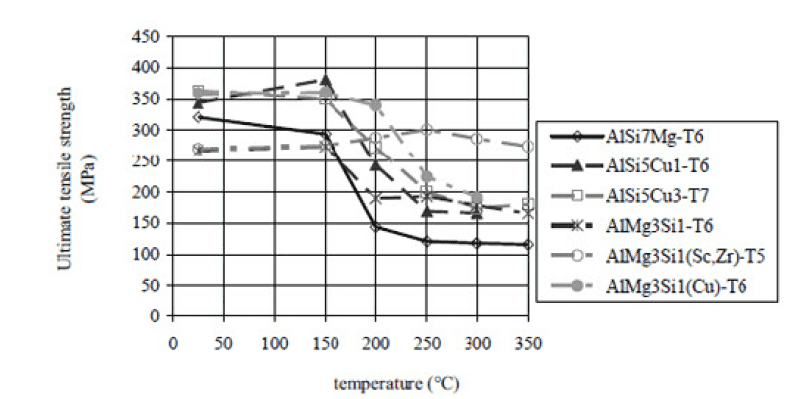
Al temp.png
 
Engineering news on Phys.org
Glass has a ridiculously high ultimate strength on the order of 2 million psi in USA units...IF perfect. But glass has microscopic cracks and notch flaws in the manufacturing process, reducing its actual tensile strength by a factor of 100 or more. But whatever it is, there is little reduction in its strength at high temperatures...might even get a bit stronger if anything. Caution on differential pressure...you don't see pressurized airplanes using glass windows with high pressure differences at high altitudes. But I am certainly no expert on this, it is my best understanding.