Unable to Understand How X2^2 Gets Canceled Out

  • Thread starter Thread starter adams_695
  • Start date Start date
Click For Summary

Homework Help Overview

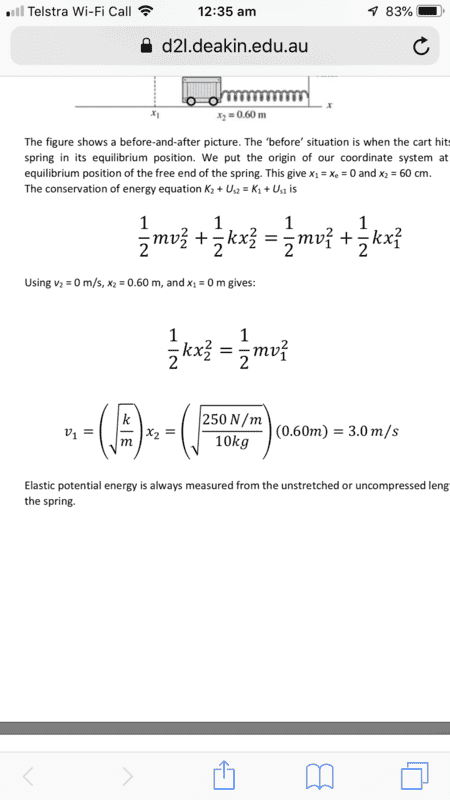
The discussion revolves around the cancellation of \(x_2^2\) in the context of an equation related to elastic potential energy and kinetic energy, specifically the equation \(\frac{1}{2}kx_2^2=\frac{1}{2}mv_1^2\). Participants are exploring the implications of this cancellation and its effect on the final expression for \(v_1\).

Discussion Character

  • Conceptual clarification, Assumption checking

Approaches and Questions Raised

  • Participants are questioning why \(x_2^2\) is left outside the radical in the final expression for \(v_1\) and discussing the reasoning behind simplifying expressions for readability. There are also inquiries about the implications of this simplification on the physical interpretation of the problem.

Discussion Status

The discussion is ongoing, with participants providing insights into the simplification process and its impact on clarity. Some have suggested that leaving \(x_2\) outside the radical enhances readability, while others are examining the potential consequences of this approach on the interpretation of results.

Contextual Notes

There is a mention of the importance of selecting the correct solution based on physical context, particularly regarding the direction of velocity in relation to the spring system. Additionally, there is a note about the reference point for potential energy, which may affect the analysis of the problem.

adams_695
Messages
16
Reaction score
1
Homework Statement
Unable to solve for solution.
Relevant Equations
Kinematic energy and spring energy
Am unable to understand how in the final answer the X2^2 gets canceled out without being inside the radical. It doesn’t make sense to me.

Any help explaining would be much appreciated as I am stuck.

Also am happy to provide more information if needed.
1F3542BE-362C-461B-A0DC-AFD5FD619DFC.png
 
Last edited by a moderator:
Physics news on Phys.org
2A555E61-7BE8-47EB-B8E2-58154607E046.png

Full visibility
 
Can you solve the equation$$\frac{1}{2}kx_2^2=\frac{1}{2}mv_1^2$$for ##v_1## in terms of the other quantities? What do you get?
 
kuruman said:
Can you solve the equation$$\frac{1}{2}kx_2^2=\frac{1}{2}mv_1^2$$for ##v_1## in terms of the other quantities? What do you get?

Yes it’s just x2 to take out the 1/2 after factoring on both sides then divide by M.

I’m more trying to understand why the x is left outside and isn’t inside the radical also. In this one here it’s left outside when usually it’s left inside.

Is there a particular reason?
 
The only reason I can think of is "simplify as much as you can to enhance readability and ease of calculation". Remember that $$\omega=\sqrt{\frac{k}{m}}$$ so that$$v_1=\sqrt{\frac{k}{m}}x_2=\omega \ x_2$$ The last result is simpler and more readable. Besides, if you want to find a number for ##v_1## and you put ##x_2^2## under the radical, you will have to square ##x_2## and then take its square root.
 
kuruman said:
The only reason I can think of is "simplify as much as you can to enhance readability and ease of calculation". Remember that $$\omega=\sqrt{\frac{k}{m}}$$ so that$$v_1=\sqrt{\frac{k}{m}}x_2=\omega \ x_2$$ The last result is simpler and more readable. Besides, if you want to find a number for ##v_1## and you put ##x_2^2## under the radical, you will have to square ##x_2## and then take its square root.
Note that ##v^2=x^2##, simplifies to ##v=\pm x##. Be careful not to simplify one of the two solutions out of existence.
 
jbriggs444 said:
Note that ##v^2=x^2##, simplifies to ##v=\pm x##. Be careful not to simplify one of the two solutions out of existence.
When a numerical answer is required, there should be enough information to select the solution that makes physical sense. The figure shows the cart moving to the right before hitting the spring therefore it is safe to conclude that the velocity is positive. That point should have been clarified in the solution.

I am bothered more by the solution's last pronouncement, "Elastic potential energy is always measured from the unstretched or uncompressed length of the spring." It unnecessarily complicates the analysis of the vertical mass-spring system and undermines the idea that the choice of the reference point of potential energy is arbitrary.
 
  • Like
Likes   Reactions: jbriggs444

Similar threads

  • · Replies 14 ·
Replies
14
Views
2K
Replies
28
Views
3K
  • · Replies 6 ·
Replies
6
Views
1K
Replies
6
Views
1K
Replies
7
Views
3K
Replies
20
Views
3K
  • · Replies 17 ·
Replies
17
Views
3K
Replies
3
Views
2K
  • · Replies 5 ·
Replies
5
Views
2K
  • · Replies 13 ·
Replies
13
Views
2K