Understanding a Homopolar Generator

Click For Summary
SUMMARY

The discussion focuses on the mechanics of a homopolar generator, specifically addressing the derivation and significance of the differential element ##d\mathbf{l}## in relation to electromotive force (emf). Participants clarify that ##d\mathbf{l}## represents the infinitesimal vector along the path between the shaft and the contact point, aligning with the direction of the emf. The conversation highlights the potential confusion arising from the dual use of the symbol ##r## in the integral, suggesting that renaming it to ##\vec{l}## would enhance clarity in the context of the integration process.

PREREQUISITES
  • Understanding of electromotive force (emf) in electrical engineering
  • Familiarity with vector calculus and differential elements
  • Knowledge of integration techniques in physics
  • Basic principles of homopolar generators and their operation
NEXT STEPS
  • Study the mathematical derivation of emf in homopolar generators
  • Learn about vector calculus applications in electrical engineering
  • Explore the role of differential elements in electromagnetic theory
  • Investigate common misconceptions in the integration of physical quantities
USEFUL FOR

Electrical engineers, physics students, and anyone interested in the principles and mathematical foundations of homopolar generators.

jisbon
Messages
475
Reaction score
30
Homework Statement
Give an expression for the induced current in a homopolar generator as a function of angular velocity ##\omega##
Relevant Equations
-
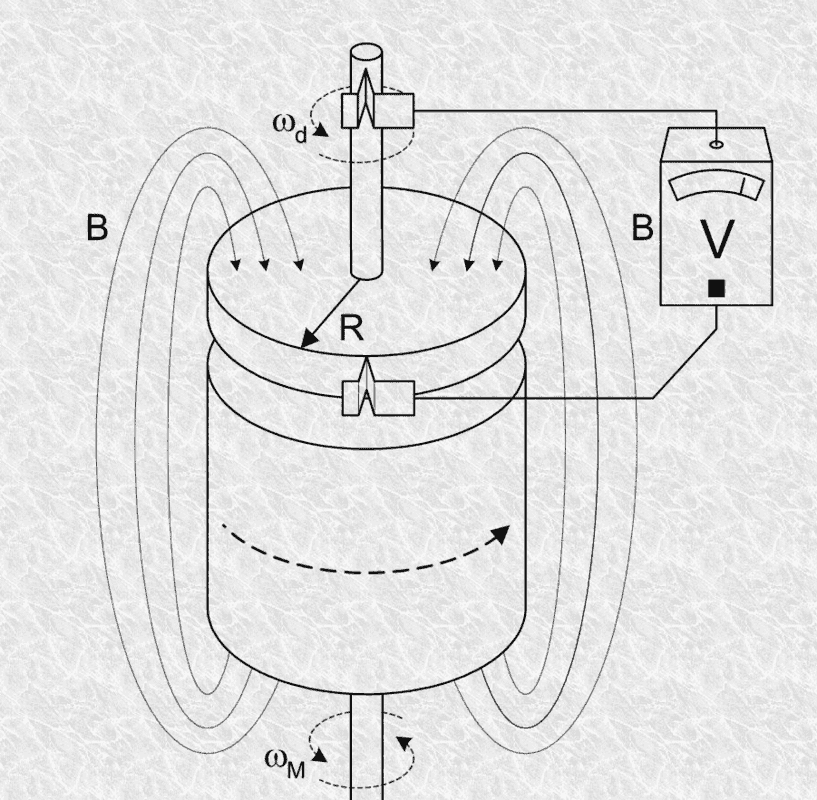
So I was searching up on the homopolar generator and found this explanation for the generator, as well as the proposed solution.

1569639604738.png


1569639629066.png


However, I don't really understand what the solution is trying to do here.

Ok, I understand to find the current, you will need the potential, which is the integration of emf. However, I'm stuck at the last part. How did they exactly derive ##dl ##and what is ##dl## exactly?

Any explanation will be appreciated. Thanks
 
Physics news on Phys.org
Hi.
##d\mathbf{l}## is along the line between shaft and contact point. ##d\mathbf{l}## and emf working on the line have same direction, with plus or minus signature.
 
I think the integral "overloads" the symbol ##r## as it uses it both at the integral boundary (from 0 to r) and to denote the position vector along the path of integration which is along a radius R. I think it would be more proper to denote the ##\vec{r}## as ##\vec{l}## and then everything falls into place cause then ##d\vec{l}## gains its meaning inside the integral.
 

Similar threads

  • · Replies 9 ·
Replies
9
Views
2K
  • · Replies 7 ·
Replies
7
Views
3K
Replies
6
Views
3K
Replies
8
Views
3K
  • · Replies 4 ·
Replies
4
Views
2K
  • · Replies 52 ·
2
Replies
52
Views
9K
  • · Replies 5 ·
Replies
5
Views
1K
  • · Replies 7 ·
Replies
7
Views
4K
  • · Replies 4 ·
Replies
4
Views
3K
  • · Replies 7 ·
Replies
7
Views
3K