High School Understanding A Middle Ordinate In Terms Of Geometry

  • Thread starter Thread starter tomtomtom1
  • Start date Start date
  • Tags Tags
    Geometry Terms
Click For Summary
A middle ordinate in geometry refers to the line segment drawn from the midpoint of a chord to the arc above it. In the discussed scenario, if lines AB and CB are tangents to the arc, point D is the center of the arc, ensuring that lines AD and CD are equal, thus forming an isosceles triangle. The line DB will intersect AC at its midpoint, confirming that EF reaches its maximum length when this intersection occurs. The relationship holds true as long as the arc's length remains less than half the circle's circumference to avoid undefined lengths. This geometric configuration supports the conclusion that EF is longest when DB bisects AC.
tomtomtom1
Messages
160
Reaction score
8
Hello community

I was hoping someone could help me with the following problem.

I am trying to understand what a middle Ordinate is in terms of geometry (I know it has a versine along a chord).Given the diagram below:-
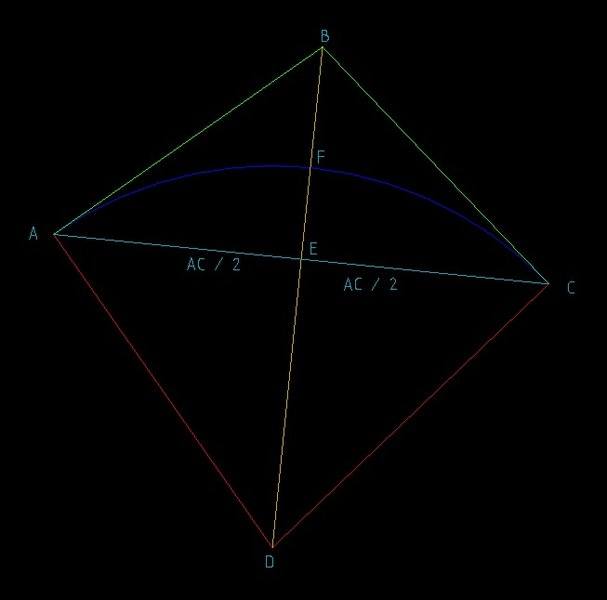
mid ort.jpg


The Blue line is an arc of some radius.

AB & CB are both tangent to the arc and intersect at point B.

AD is 90 Degrees to AB

CB is 90 Degrees to CD


My question is if i drew a line from D to B will that line intersect AC at exactly half its length i.e. at AC/2.

If this is correct then will the length of line EF be its longest when line DB intersects AC at exactly half its length.

I believe that line DB will Always intersect AC at half its distance because AD and CD are the same length making an isosceles triangle.

I also believe that the line EF will be its longest when measured exactly half way along line AC but I cannot prove it.

I was hoping someone could shed some light.

Thank you all.
 

Attachments

  • mid ort.jpg
    mid ort.jpg
    10.5 KB · Views: 905
Mathematics news on Phys.org
Your diagram has some unstated assumptions. Consider the case of a non-square rectangle for example. You can draw an arc "of some radius" through diagonal corners but it won't be symmetric, nor will it be tangent to the sides. Consider the picture below which is clearly a counter example (the brown segments are equal and perpendicular at the corners.

GeomExample.png


However if you add to your listed assumptions that AB and CB are tangent to the arc then necessarily D is the center of the arc's circle (the lines through AD and CD must pass through the center since they are orthogonal to the tangents at points of tangency.) That makes the sides AD and CD radii and thus equal. That gives you the symmetry by which your conclusion can be shown to be true.
 

Attachments

  • GeomExample.png
    GeomExample.png
    3.3 KB · Views: 518
@jambaugh: We know that these are tangents.E will always be in the middle of AC, and D is always the center of the circle, which means DF is the radius of the circle. For a constant radius, EF is maximal if DE is minimal, which means the arc between A and C should be as long as possible (but smaller than half the circle to avoid undefined situations or negative lengths).
 
Here is a little puzzle from the book 100 Geometric Games by Pierre Berloquin. The side of a small square is one meter long and the side of a larger square one and a half meters long. One vertex of the large square is at the center of the small square. The side of the large square cuts two sides of the small square into one- third parts and two-thirds parts. What is the area where the squares overlap?

Similar threads

  • · Replies 13 ·
Replies
13
Views
3K
  • · Replies 4 ·
Replies
4
Views
2K
Replies
1
Views
3K
  • · Replies 6 ·
Replies
6
Views
3K
  • · Replies 1 ·
Replies
1
Views
2K
  • · Replies 2 ·
Replies
2
Views
2K
  • · Replies 13 ·
Replies
13
Views
3K
  • · Replies 14 ·
Replies
14
Views
2K
  • · Replies 1 ·
Replies
1
Views
2K
Replies
1
Views
1K