How Do Basic Capacitor Concepts Affect Voltage in Simple Circuits?

  • Thread starter Thread starter skybox
  • Start date Start date
  • Tags Tags
    Capacitor Concept
Click For Summary
The discussion centers on analyzing a circuit with capacitors and understanding voltage behavior after a switch is closed. Initially, capacitor C1 holds 5V, but after closing the switch, both capacitors measure 3.75V due to charge conservation and energy dissipation through resistance. Measurements taken at 60 seconds show that the voltage drops as energy is lost in the resistor, with the total stored energy decreasing from 37.5 microjoules to 28.1 microjoules. The participants suggest plotting voltage over time to visualize the charge distribution changes. This analysis highlights the fundamental principles of capacitor behavior in simple circuits.
skybox
Messages
37
Reaction score
0
Hi Guys,

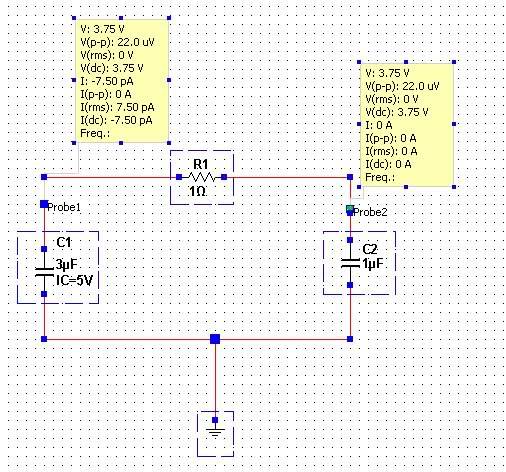
I have the following circuit I want to analyze:
29v0war.jpg


I do not understand by the DC voltage on both capacitors is 3.75V each. The initial charge on capacitor C1 is 5V. I am just trying to understand a basic switched capacitor concept and am stuck here. Any insight would be greatly appreciated!
 
Engineering news on Phys.org
Hello,

Are your measurements at t=0s or some other time? I would suggest adding a switch to your schematic.
 
Yes, you must be measuring at some intermediate time.
The fact that there is dissipation (a resistor) but no source in the circuit means that the voltage will eventually go to zero regardless of the initial state.
 
I am measuring the voltage at t = 60s. I am just wondering how it is 3.75V. I am modeling this circuit after a switch has closed.
 
skybox said:
I am measuring the voltage at t = 60s. I am just wondering how it is 3.75V. I am modeling this circuit after a switch has closed.

You initially had 5V on the left 3uF cap, and after the switch is closed (presumably the 1 Ohm resistor), you have 3.75V on both the 3uF and 1uF caps. Seems pretty straightforward. Do a time plot from 0s to 60s of the voltages on the caps, and you'll see the chage distribution change from initial to final.
 
Before the switch is closed, there is 15 microcoulombs on the capacitor C1 (3 uF), which is charged to 5 V. After the switch is closed, you have 15 microcoulombs on 4 uF (C1 + C2 in parallel), so the voltage should be reduced to 3.75 volts. So charge is conserved. Initially the total stored energy in the circuit is (1/2)CV^2 = 37.5 microjoules, and after the switch is closed, the stored energy is only 28.1 microjoules, so some energy was lost in resistance R1 when the switch was closed.
 
Thread 'I thought it was only Amazon that sold unsafe junk'
I grabbed an under cabinet LED light today at a big box store. Nothing special. 18 inches in length and made to plug several lights together. Here is a pic of the power cord: The drawing on the box led me to believe that it would accept a standard IEC cord which surprised me. But it's a variation of it. I didn't try it, but I would assume you could plug a standard IEC cord into this and have a double male cord AKA suicide cord. And to boot, it's likely going to reverse the hot and...

Similar threads

  • · Replies 32 ·
2
Replies
32
Views
3K
  • · Replies 3 ·
Replies
3
Views
1K
  • · Replies 6 ·
Replies
6
Views
594
  • · Replies 4 ·
Replies
4
Views
2K
  • · Replies 2 ·
Replies
2
Views
2K
  • · Replies 26 ·
Replies
26
Views
7K
  • · Replies 4 ·
Replies
4
Views
2K
  • · Replies 4 ·
Replies
4
Views
2K
  • · Replies 17 ·
Replies
17
Views
3K
  • · Replies 10 ·
Replies
10
Views
2K