SUMMARY
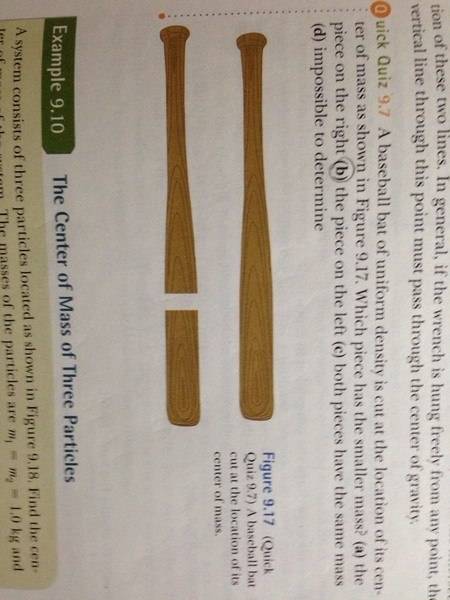
The discussion clarifies the concept of the center of mass (CoM) in relation to rotational equilibrium, specifically addressing misconceptions about mass distribution. It is established that the CoM does not necessarily divide an object into two equal mass segments, particularly in non-uniform objects like a baseball bat. The center of mass is determined by the distribution of mass within the object, and for objects with varying density, such as a bat, the CoM will be closer to the denser end. The discussion emphasizes that torque must be equal on both sides of the CoM for rotational equilibrium, which is not dependent on equal mass distribution.
PREREQUISITES
- Understanding of center of mass (CoM) principles
- Basic knowledge of rotational equilibrium concepts
- Familiarity with torque and its calculations
- Concept of mass distribution in physical objects
NEXT STEPS
- Study the mathematical formulation of center of mass for irregular shapes
- Learn about torque calculations in rotational dynamics
- Explore the implications of mass distribution on stability in physical systems
- Investigate real-world applications of center of mass in engineering and design
USEFUL FOR
Physics students, mechanical engineers, and anyone interested in understanding the principles of rotational dynamics and mass distribution in physical objects.