Understanding Center of Mass Distribution in Rotational Equilibrium

Click For Summary

Homework Help Overview

The discussion revolves around the concept of center of mass (CoM) in the context of rotational equilibrium, specifically examining how mass distribution affects the location of the CoM in objects like a baseball bat.

Discussion Character

  • Conceptual clarification, Assumption checking, Problem interpretation

Approaches and Questions Raised

  • Participants explore the definition of center of mass and question the assumption that it divides an object into two equal mass parts. There are attempts to clarify the relationship between mass distribution and the location of the CoM, particularly in non-uniform objects.

Discussion Status

The conversation is ongoing, with participants sharing differing views on the implications of mass distribution on the CoM. Some guidance has been offered regarding the relationship between torque and mass distribution, but no consensus has been reached.

Contextual Notes

Participants are grappling with the implications of mass distribution in objects of varying shapes and densities, and there is a noted confusion regarding the interpretation of mass equality on either side of the CoM.

omarMihilmy
Messages
31
Reaction score
0
Isn't the point of center of mass is where the masses on both sides are equally distributed?
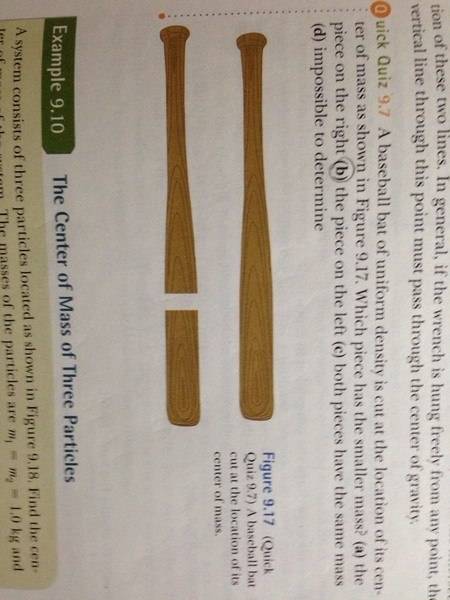
ImageUploadedByPhysics Forums1387907224.217369.jpg


Why is it not the case here?
 
Physics news on Phys.org
What do you mean by 'equally distributed'?
 
I mean that if i have this pencil
ImageUploadedByPhysics Forums1387908360.991547.jpg

The right side's mass is equal to the left hand's side length!
 
omarMihilmy said:
Isn't the point of center of mass is where the masses on both sides are equally distributed?
The bat is wider at the top and thinner at the bottom.So the C.G will not be in the middle of the bat.

I don't understand what yu mean here.Masses on both sides should equal.
The masses on both sides of C.G is same,so your answer is wrong.
 
Okay great my answer is c) both sides are equal the books answer is b) that the right side is greater why is that?
 
omarMihilmy said:
I mean that if i have this pencilView attachment 65062
The right side's mass is equal to the left hand's side length!
Length?

Right side's mass is equal to the left side's mass.I think it's a typo.Please correct it
 
Serway would never have a Typo it clearly is correct for some reason
 
omarMihilmy said:
Serway would never have a Typo it clearly is correct for some reason
All the members of PF would deny that "If i have a pencil,the right side's mass is equal to the left hand's side length!"

http://en.wikipedia.org/wiki/Center_of_mass
 
There is a misunderstanding !
 
  • #10
Okay let's start fresh from the original question

The bat has a center of mass closer the left side and I am asked to see if the masses are equal or if one side is greater than the other?

I have an understanding that the center of mass divides the system into two parts of equal mass. Is this true or not? If not then how do I know from the picture given in my first post that which side has a greater mass?
 
  • #11
omarMihilmy said:
I have an understanding that the center of mass divides the system into two parts of equal mass. Is this true or not? If not then how do I know from the picture given in my first post that which side has a greater mass?

The center of mass most emphatically does not divide a body into two parts having equal mass. The location of the center of mass depends on how the mass is distributed within the body itself.

I understand your confusion, however. With bodies like a pencil or a uniform steel bar, yes, the amount of mass on either side of the c.o.m. will be equal, but this result applies only to such bodies where the mass is distributed uniformly and evenly about an axis of symmetry and is not a general rule.

The baseball bat, unfortunately, does not have its mass distributed evenly over its length.

What the center of mass does, however, is divide a body such that the first moment of mass on either side of the c.o.m. is equal.
 
  • #12
The weight of the baseball bat is not equal in all spots. Since the bat is wider at one end, it weighs more on that end. That's the reason why the center of mass of an object with some density can be represented as an integral as the volume changes.
 
  • #13
iRaid said:
The weight of the baseball bat is not equal in all spots. Since the bat is wider at one end, it weighs more on that end. That's the reason why the center of mass of an object with some density can be represented as an integral as the volume changes.
No, that misses the point. SteamKing's answer is the correct one.
Consider for example two baseball bats joined in a line, the thin end of one being joined to the fat end of the other. By your reasoning, the CoM could be at the join, but it isn't.
 
  • #14
SteamKing is correct about the the torque being equal (but opposite) on both sides of a COM, and not necessarily the masses. Imagine joining the two ends with a massless bar of some sort and placing a triangle underneath that massless bar such that the two halves are in translational and rotational equilibrium. Now imagine the COM of each piece and remember that the clockwise torque has to equal the counter clockwise torque to maintain rotational equilibrium. The COM of the fat end will be closer to the pivot whereas that of the thin end is further from the pivot. For the torques to be equal, the mass on the right (fat end) has to be greater to make up for a shorter length to the pivot as compared to the thin end.
 

Similar threads

  • · Replies 7 ·
Replies
7
Views
1K
  • · Replies 18 ·
Replies
18
Views
2K
  • · Replies 25 ·
Replies
25
Views
2K
  • · Replies 9 ·
Replies
9
Views
1K
  • · Replies 3 ·
Replies
3
Views
2K
Replies
7
Views
2K
  • · Replies 9 ·
Replies
9
Views
3K
  • · Replies 17 ·
Replies
17
Views
2K
Replies
5
Views
2K
Replies
2
Views
2K