Why is the derivative of f not linear at the inflection point in concavity?

  • Context: Undergrad 
  • Thread starter Thread starter 22990atinesh
  • Start date Start date
Click For Summary
SUMMARY

The discussion centers on the misconception that the derivative of a function 'f' represented by a quadratic polynomial must be linear. Participants clarify that while quadratic functions yield linear derivatives, the function in question is a fourth-degree polynomial, resulting in a cubic derivative. The conversation emphasizes the importance of understanding concavity, defined by the sign and value of the second derivative, and distinguishes between true quadratic functions and those that merely resemble them, such as the catenary and the polynomial function f(x) = x^4.

PREREQUISITES
  • Understanding of polynomial functions and their degrees
  • Knowledge of derivatives and their geometric interpretations
  • Familiarity with concavity and the role of second derivatives
  • Ability to differentiate between quadratic functions and other polynomial forms
NEXT STEPS
  • Study the properties of fourth-degree polynomials and their derivatives
  • Learn about the implications of concavity in calculus
  • Explore the characteristics of the catenary function f(x) = cosh(x)
  • Investigate how to determine the nature of a function from its graph
USEFUL FOR

Students of calculus, mathematicians, and educators seeking to clarify concepts of polynomial derivatives and concavity in functions.

22990atinesh
Messages
143
Reaction score
1
Hello friends,
I'm trying to understand Concavity, But I've some doubts. As we know quadratic polynomial on graphing forms a parabola opening upwards or downwards. While understanding concavity we divide graphs into separate region using inflection points and each separate region is a quadratic polynomial in its own. So, its derivative should be linear. Then why the derivative of function ' f ' in the domain (vertical green line) is not linear.
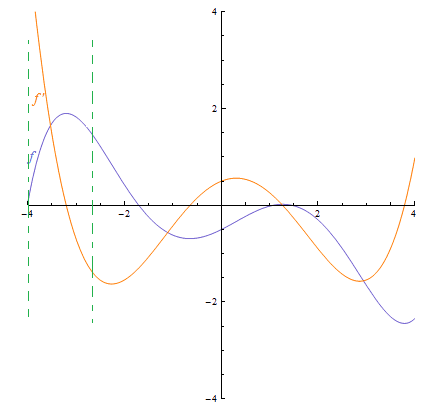
Capture.png
 
Last edited by a moderator:
Physics news on Phys.org
Concavity often has two meanings. First, it is sometimes referred to just as the sign of the second derivative. In the green region, the second derivative is negative, so the function f is "concave down", or we might say the function is concave in that region. In any domain where the second derivative is positive, the function is "concave up", or convex in that region. The concavity also can mean the actual value of the second derivative, so that the quadratic function "a x^2" has a concavity of "2a".

There are also many functions which look like parabolas, but whose real behavior is more complicated, as you see for yourself. Another neat example is the catenary. It is concave up, but its second dervative has different values in different places.
 
Hello jfizzix,
Lets just forget about concavity for a while. the graph of a function f under green vertical lines is a quadratic so its derivative must be linear (a straight line). But as we can see from graph f' its not a straight between green vertical lines.
 
22990atinesh said:
I'm trying to understand Concavity, But I've some doubts. As we know quadratic polynomial on graphing forms a parabola opening upwards or downwards. While understanding concavity we divide graphs into separate region using inflection points and each separate region is a quadratic polynomial in its own.
No.
22990atinesh said:
So, its derivative should be linear.
No.
22990atinesh said:
Then why the derivative of function ' f ' in the domain (vertical green line) is not linear.
Because the separate pieces of your polynomial function (the blue graph) are not quadratic functions. They only appear to be parabolas, but they aren't.
22990atinesh said:
Capture.png

22990atinesh said:
Lets just forget about concavity for a while. the graph of a function f under green vertical lines is a quadratic so its derivative must be linear (a straight line).
You have some misconceptions. The function f appears to be a fourth-degree polynomial, so its derivative is a cubic. On intervals where the graph of f is concave up or concave down, the graph has roughly the same shape as a parabola, but that's where the similarity ends.
22990atinesh said:
But as we can see from graph f' its not a straight between green vertical lines.
 
22990atinesh said:
Hello jfizzix,
Lets just forget about concavity for a while. the graph of a function f under green vertical lines is a quadratic so its derivative must be linear (a straight line). But as we can see from graph f' its not a straight between green vertical lines.

If the function f under green vertical lines were a quadratic, than its derivative would be linear. Since the derivative is not linear as you see, the function under green vertical lines is not quadratic.

If it were a quadratic, it would also be symmetric about the peak (at least the in between the lines). You can see that on the right of the peak, the function bends up more than it does on the left the same distance form the peak.
 
Mark44 said:
No.
No.
Because the separate pieces of your polynomial function (the blue graph) are not quadratic functions. They only appear to be parabolas, but they aren't.You have some misconceptions. The function f appears to be a fourth-degree polynomial, so its derivative is a cubic. On intervals where the graph of f is concave up or concave down, the graph has roughly the same shape as a parabola, but that's where the similarity ends.

Hi Mark44,
You mean every quadratic function is a parabola which is symmetric under the "Axis of Symmetry". If the blue function would have been symmetric then it would have been a quadratic function right.
 
Last edited:
22990atinesh said:
Hi Mark44,
You mean every quadratic function is a parabola which is symmetric under the "Axis of Symmetry". If the blue function would have been symmetric then it would have been a quadratic function right.

##f(x) = x^4## is symmetric, but not a parabola.
 
22990atinesh said:
Hi Mark44,
You mean every quadratic function is a parabola which is symmetric under the "Axis of Symmetry". If the blue function would have been symmetric then it would have been a quadratic function right.

No, it wouldn't. There are many functions which might "look like" a quadratic function, but which aren't.

For example, take ##f(x) = x^4##. This certainly looks like a quadratic function. See https://www.wolframalpha.com/input/?i=f(x)+=+x^4
But it of course isn't a quadratic function.

Another example is the catenary ##f(x) = \textrm{cosh}(x)##. See https://www.wolframalpha.com/input/?i=f(x)+=+cosh(x)&dataset=&equal=Submit This can't even be written as a polynomial, let alone a quadratic function.

Finally, you seem to define a "parabola" as any function which looks like this:

parabola.jpg


This is incorrect. A parabola is the same as a quadratic function. So a function ##f## is a parabola if and only if it has the form ##f(x) = ax^2 + bx + c## for any ##x## (and ##a\neq 0##).
So just because it his concave and symmetric and stuff, doesn't mean that it's a parabola.

In particlar, the catenary and the function ##f(x) = x^4## are not parabolas.
 
pwsnafu said:
##f(x) = x^4## is symmetric, but not a parabola.

pwsnafu Then how can we tell by watching the graph whether it is quadratic or not
 
  • #10
22990atinesh said:
pwsnafu Then how can we tell by watching the graph whether it is quadratic or not

We can't. If I give you a random graph like

parabola.jpg


then you can't deduce whether it's a parabola or not. You need more information.
 
  • #11
micromass said:
We can't. If I give you a random graph like

parabola.jpg


then you can't deduce whether it's a parabola or not. You need more information.

what information would be suffice to tell by watching the graph it is a parabola.
 
  • #12
22990atinesh said:
what information would be suffice to tell by watching the graph it is a parabola.

You need to be given the definition of the function (or enough information so that you can derive the function definition).

So if I give you the following graph

parabola.jpg


then that tells you nothing.

But if I tell you that this is the graph of ##f(x) = \textrm{cosh}(x)##, then you can deduce that the above graph is not a parabola since the function ##f## is not quadratic.

On the other hand, if I tell you that this is the graph of ##f(x) = x^2 +34##, then you can see that the above graph is a parabola since ##f## is quadratic.

Without the function definition (or enough equivalent information), you don't know anything about the function being a parabola or not.

So in order to prove the function being a parabola, you need the function definition (or similar). But in order to disprove the function being a parabola, you need less. For example, the following function

http://3-ps.googleusercontent.com/x/www.intmath.com/intmstat.com/trigonometric-graphs/328x207xsinx.gif.pagespeed.ic.UxyaheL0qO.png

can never be a parabola, whatever its function definition is. Likewise, if you are given enough input-output pairs, then you can also easily disprove that the function is a parabola.

So disproving something is a parabola is easy, proving it is a parabola is difficult and needs more information.
 
Last edited by a moderator:
  • Like
Likes   Reactions: 1 person
  • #13
Thanx friends I get it now
 

Similar threads

  • · Replies 1 ·
Replies
1
Views
2K
  • · Replies 13 ·
Replies
13
Views
3K
  • · Replies 2 ·
Replies
2
Views
3K
  • · Replies 5 ·
Replies
5
Views
3K
Replies
3
Views
2K
  • · Replies 4 ·
Replies
4
Views
2K
  • · Replies 5 ·
Replies
5
Views
2K
  • · Replies 4 ·
Replies
4
Views
2K
  • · Replies 9 ·
Replies
9
Views
3K
  • · Replies 22 ·
Replies
22
Views
6K