Understanding Derivations and Tangent Spaces on Manifolds

Click For Summary

Discussion Overview

The discussion revolves around the isomorphism between the space of derivations on a ##C^\infty## manifold and the tangent space at a point on that manifold. Participants explore the implications of certain propositions regarding derivations, the significance of smooth functions, and the role of local versus global definitions in the context of differentiability and tangent spaces.

Discussion Character

  • Exploratory
  • Technical explanation
  • Conceptual clarification
  • Debate/contested

Main Points Raised

  • Some participants question the necessity of the ##C^\infty## condition, suggesting that it simplifies the proof but may not be strictly required.
  • There is a discussion about the importance of the ##h##-function in proofs, with some arguing that it allows derivations to act on globally defined functions, while others express confusion about its necessity.
  • Some participants propose that the behavior of functions outside a neighborhood ##U## is crucial for understanding the derivations, raising questions about the completeness of the propositions cited.
  • Concerns are raised about the application of derivations to functions of different smoothness classes, particularly regarding the remainder terms in Taylor's formula.
  • Participants highlight the distinction between local properties of differentiation and the need for global statements about the manifold.
  • There is a mention of the partition of unity as a tool to bridge local and global considerations in the context of differentiability.

Areas of Agreement / Disagreement

Participants express differing views on the necessity of the ##C^\infty## condition and the role of the ##h##-function, indicating that multiple competing perspectives remain. The discussion does not reach a consensus on these points.

Contextual Notes

Participants note that the assumptions in the propositions are not fully clear, particularly regarding the behavior of functions outside specified neighborhoods. The discussion reflects uncertainty about the implications of these assumptions on the validity of the isomorphism between derivations and tangent spaces.

Korybut
Messages
74
Reaction score
4
TL;DR
Need some clarifying commentary on the proof
Hello!
According to the attached proposition on ##C^\infty## manifold space of derivations ##D_m M## is isomorphic to Tangent space ##T_m M##.
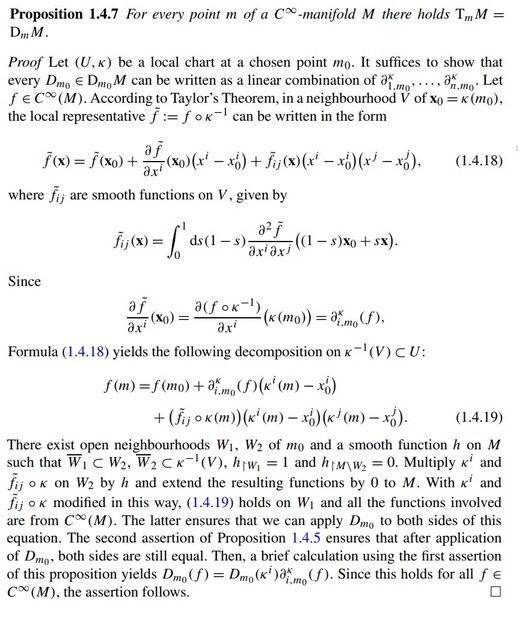
Rudolf1.jpg

Cited here another proposition (1.4.5) states the following
1. For constant function ##D_m(f)=0##
2. If ##f\vert_U=g\vert_U## for some neighborhood ##U## of ##m##, then ##D_m(f)=D_m(g)##.

I don't get the following.
1. Where ##C^\infty## is important? I think that this is important due to algebraic reasons. In Teylor's formula all terms should of the same ##C^k## and this happens only for ##C^\infty##. Am I right?
2. I don't get this ##h##-thing completely. Even without it I can apply derivation ##D_{m_0}## to both sides of (1.4.19) and get statement of the proposition. What am I missing?
 
Physics news on Phys.org
Korybut said:
Summary:: Need some clarifying commentary on the proof

Hello!
According to the attached proposition on ##C^\infty## manifold space of derivations ##D_m M## is isomorphic to Tangent space ##T_m M##.
View attachment 296438
Cited here another proposition (1.4.5) states the following
1. For constant function ##D_m(f)=0##
2. If ##f\vert_U=g\vert_U## for some neighborhood ##U## of ##m##, then ##D_m(f)=D_m(g)##.

I don't get the following.
1. Where ##C^\infty## is important?
This is simply because it is easier to bother with smooth functions than to administrate an additional parameter in a proof that is very technical anyway. What are the assumptions in 1.4.5?

Korybut said:
I think that this is important due to algebraic reasons. In Teylor's formula all terms should of the same ##C^k## and this happens only for ##C^\infty##. Am I right?
2. I don't get this ##h##-thing completely. Even without it I can apply derivation ##D_{m_0}## to both sides of (1.4.19) and get statement of the proposition. What am I missing?
I guess that your quotation of 1.4.5 is incomplete. What do we have outside of ##U##? How can ##f\vert_U=g\vert_U## determine the behaviour of ##D_m(f)## outside of ##U##? Either you have an additional property of ##M##, e.g. a transitive operation, or ##f\vert_{M/U}=g\vert_{M/U}=0.## The latter would explain the role of ##h.##
 
  • Like
Likes   Reactions: Korybut
fresh_42 said:
This is simply because it is easier to bother with smooth functions than to administrate an additional parameter in a proof that is very technical anyway. What are the assumptions in 1.4.5?
Do you mean that one can prove this isomorphism ##T_m M=D_m M## without assuming that manifold is of ##C^\infty##?
fresh_42 said:
This is simply because it is easier to bother with smooth functions than to administrate an additional parameter in a proof that is very technical anyway. What are the assumptions in 1.4.5?


I guess that your quotation of 1.4.5 is incomplete. What do we have outside of ##U##? How can ##f\vert_U=g\vert_U## determine the behaviour of ##D_m(f)## outside of ##U##? Either you have an additional property of ##M##, e.g. a transitive operation, or ##f\vert_{M/U}=g\vert_{M/U}=0.## The latter would explain the role of ##h.##
Indeed. Sorry for that here is the full proposition with the proof
Rudolf2.jpg

Proof of this proposition also uses this ##h##-thing. I used to think that it was made just to make the proof look fancier. Now I believe that I miss something very subtle...

It looks it is very important for derivations to act only on functions that are defined globally on whole manifold. (1.4.19) holds only in some neighbourhood. However while l.h.s. is well-defined for entire manifold, on the other hand r.h.s. is defined only in this neighbourhood and with this ##h##-trick acquires definition on the entire manifold.
Why it is so important for derivation to be applied only on globally defined function? I know that according to the definition ##D_m\, :\, C^k(M)\rightarrow \mathbb{R}##. But this is derivation a point which looks like very local operation... Ahhhh
Please help)
 
Korybut said:
Do you mean that one can prove this isomorphism ##T_m M=D_m M## without assuming that manifold is of ##C^\infty##?
All I can see is, that we need an integrable second derivative. The theorem is probably meant to use for Lie algebras, i.e. Lie groups, i.e. analytic manifolds, i.e. smooth manifolds. Derivations are another point of view for the Leibniz rule or the Jacobi identity, or: how to differentiate a product?

Smooth manifolds are a lot more convenient than tangential spaces on ##C^k(M)## and the most interesting examples are smooth manifolds.

Korybut said:
Indeed. Sorry for that here is the full proposition with the proof0View attachment 296443
Proof of this proposition also uses this ##h##-thing. I used to think that it was made just to make the proof look fancier. Now I believe that I miss something very subtle...

It looks it is very important for derivations to act only on functions that are defined globally on whole manifold. (1.4.19) holds only in some neighbourhood. However while l.h.s. is well-defined for entire manifold, on the other hand r.h.s. is defined only in this neighbourhood and with this ##h##-trick acquires definition on the entire manifold.
Why it is so important for derivation to be applied only on globally defined function? I know that according to the definition ##D_m\, :\, C^k(M)\rightarrow \mathbb{R}##. But this is derivation a point which looks like very local operation... Ahhhh
Please help)
The ##h-##thingy as you call it is the partition of the unity. It bridges the gap between local and global. Differentiation is a local property, but we want to make a statement about the global manifold, and that its tangents at ##m\in M## are derivatives in ##m## for any ##m.## Remember that the derivative of a one-dimensional function is a linear function that obeys the Leibniz rule. Proposition 1.4.7 is simply the multi-dimensional version. In order to get a global statement from a local property, it is useful to expand the local function by zero outside the local neighborhood. For example, the normal field of a submanifold is to be extended to the entire manifold. Or: In order to define the area integral, or to integrate over manifolds in general, coordinates must be chosen, which is only possible locally. The integrand must therefore be broken down in such a way that it remains locally integrable, but becomes zero outside the scope of the coordinate system. That is what ##h## is for. It is the analytical version of Urysohn's Lemma.
 
  • Like
Likes   Reactions: Korybut
fresh_42 said:
All I can see is, that we need an integrable second derivative. The theorem is probably meant to use for Lie algebras, i.e. Lie groups, i.e. analytic manifolds, i.e. smooth manifolds. Derivations are another point of view for the Leibniz rule or the Jacobi identity, or: how to differentiate a product?

Smooth manifolds are a lot more convenient than tangential spaces on Ck(M) and the most interesting examples are smooth manifolds.
I do understand what you are talking about. But I believe the reason is simply formal. If ##f## is of class ##C^k(M)##. Then l.h.s. of (1.4.19) is ##C^k## and I can apply derivation that maps ##C^k## functions to real numbers. However the remainder in Teylor's formula is of class ##C^{k-2}## and it is not clear how one should apply the same derivation to this term.

One more time. Thanks a lot for your help!
 
Last edited:
Korybut said:
Why it is so important for derivation to be applied only on globally defined function?
I am guessing that is how the definitions were given in the book (which one is it?). Otherwise you get something equivalent. The space of derivations at a point of ##C^\infty(M)## and the space of derivations at a point of the algebra of locally defined smooth functions around the point are isomorphic. But they have to be consistent with their definitions.
 
martinbn said:
I am guessing that is how the definitions were given in the book (which one is it?). Otherwise you get something equivalent. The space of derivations at a point of ##C^\infty(M)## and the space of derivations at a point of the algebra of locally defined smooth functions around the point are isomorphic. But they have to be consistent with their definitions.
I also believe that all this machinery is because of this very specific definition that derivation works only on function that are defined globally on the whole manifold. Book is "Differential Geometry and Mathematical Physics" by Rudolph and Schmidt (very hard to read (for me) but rigorous).
 
Korybut said:
I also believe that all this machinery is because of this very specific definition that derivation works only on function that are defined globally on the whole manifold. Book is "Differential Geometry and Mathematical Physics" by Rudolph and Schmidt (very hard to read (for me) but rigorous).
Yes, definition 1.4.4 page 24.
 
  • Like
Likes   Reactions: Korybut

Similar threads

  • · Replies 4 ·
Replies
4
Views
2K
  • · Replies 9 ·
Replies
9
Views
4K
  • · Replies 13 ·
Replies
13
Views
4K
  • · Replies 21 ·
Replies
21
Views
3K
  • · Replies 20 ·
Replies
20
Views
4K
  • · Replies 4 ·
Replies
4
Views
1K
  • · Replies 6 ·
Replies
6
Views
3K
  • · Replies 73 ·
3
Replies
73
Views
8K
  • · Replies 4 ·
Replies
4
Views
4K
  • · Replies 1 ·
Replies
1
Views
2K