Understanding Ecube Routing: XOR Logic Explained | 001 & 010 Destination

  • Thread starter Thread starter zak100
  • Start date Start date
  • Tags Tags
    Works
Click For Summary

Discussion Overview

The discussion centers on the concept of Ecube routing, specifically addressing the routing from a source vertex represented by the binary code 001 to a destination vertex represented by 010. Participants explore the implications of XOR logic in determining routing paths within this context.

Discussion Character

  • Technical explanation
  • Conceptual clarification
  • Debate/contested

Main Points Raised

  • Zulfi expresses confusion regarding why the routing goes to 000 instead of 011, despite the XOR result of 001 and 010 being 011.
  • Mark44 explains that to find a path from the source to the destination, one must first calculate the distance using the XOR result and then determine the routing path based on the least significant nonzero bit in the XOR result.
  • Mark44 details that the first leg of the path goes from 000 to 001, followed by a leg from 000 to 010, based on the coordinates derived from the XOR result.
  • Zulfi acknowledges Mark44's explanation as helpful and expresses gratitude.
  • Another participant mentions that their understanding of Ecube routing is based on the article linked by Mark44, indicating a lack of prior knowledge on the topic.

Areas of Agreement / Disagreement

The discussion reflects a lack of consensus on the initial confusion regarding the routing process, but Mark44's explanation appears to clarify the mechanics for Zulfi. However, the underlying principles of Ecube routing and the interpretation of the XOR logic remain open to further exploration.

Contextual Notes

Participants rely on the XOR operation and its implications for routing without fully resolving the conceptual understanding of why certain paths are chosen over others. The discussion does not delve into potential limitations or assumptions inherent in the routing logic.

Who May Find This Useful

This discussion may be useful for individuals interested in network routing concepts, particularly those exploring Ecube routing and XOR logic in computational contexts.

zak100
Messages
462
Reaction score
11
Homework Statement
Can't Understand Ecube Routing
Relevant Equations
It works using XOR principle
Hi,
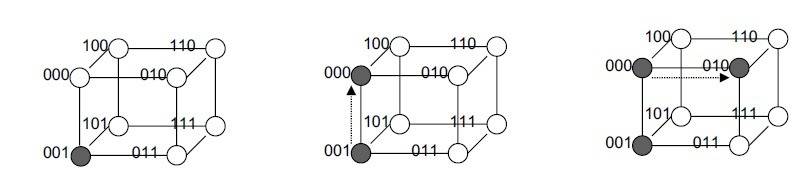
I can’t understand the concept of Ecube routing. Our src = 001 & dest = 010. XOR of 001 and 010 = 011. So why are we going to 000 instead of 011.

Zulfi.
Ecube eg.jpg
 
Physics news on Phys.org
There is an explanation of E-cube routing and a similar figure here: http://parallelcomp.uw.hu/ch02lev1sec6.html
To get from a source vertex to a destination vertex involves two operations: finding the distance between the two vertices, and then determining a path.

In your example, the source point, ##P_s## is at 001. The destination point, ##P_d## is at 010.
001 XOR 010 = 011, which you show. Count the number of 1 bits to get the distance, which is 2. This means that to get from one point to the other, a path of two edges has to be found.

To determine the path, the first leg will be in the direction of the least significant nonzero bit in the XOR result, 011. If you think about this bit pattern as x, y, z coordinates, in that order, the least significant bit is a 1 in the z-coordinate position, so the first leg of the path goes from 000 to 001.

The next leg of the path is determined by the 1 in the middle position of 011, which is the y-coordinate, so that leg goes from 000 to 010.

Here's a drawing of the coordinate system I'm using, based on your attached image. Your starting point is below the origin, on the z-axis. To get to the destination point, you first go to the origin, and then to the point to the right of the origin, on the y-axis.
xyz.png
 
Hi Mark44, Very Good Answer. Thanks for solving my problem.

God bless you.

Zulfi.
 
Everything I now know about E-cube routing I learned from the article I linked to. I had never heard of it before...
 

Similar threads

  • · Replies 5 ·
Replies
5
Views
3K
  • · Replies 3 ·
Replies
3
Views
28K
  • · Replies 3 ·
Replies
3
Views
4K
Replies
10
Views
4K
  • · Replies 2 ·
Replies
2
Views
2K
  • · Replies 13 ·
Replies
13
Views
5K
  • · Replies 1 ·
Replies
1
Views
2K
  • · Replies 2 ·
Replies
2
Views
9K
  • · Replies 7 ·
Replies
7
Views
3K
  • · Replies 5 ·
Replies
5
Views
4K