Understanding Energy and Frequency in Rotation Spectra

Click For Summary

Discussion Overview

The discussion revolves around the interpretation of energy and frequency in rotation spectra, specifically in the context of diatomic molecules like CO. Participants are analyzing the Hamiltonian formulation and energy eigenstates as presented in Binney's text, while attempting to clarify the implications of various parameters and equations related to rotational energy levels.

Discussion Character

  • Technical explanation
  • Debate/contested
  • Conceptual clarification

Main Points Raised

  • One participant expresses confusion regarding the relationship between the eigenvalues of angular momentum operators and the implications for low-lying states, questioning why low states with ##m = 0## and ##j~O(1)## would lead to the assertion that ##j(j+1) >> j##.
  • Another participant clarifies that the original statement was about "significantly larger" rather than ##j(j+1) >> j##, and emphasizes the need for context regarding the system being discussed and specific equations referenced.
  • A participant identifies that the discussion pertains to the energy levels in the rotation spectra of diatomic molecules, specifically mentioning the CO molecule.
  • There is a correction regarding the comparison made, noting that the claim was about being larger than ##j^2##, not ##j##.
  • One participant explains classical methods for determining rotation frequency, contrasting them with quantum mechanical interpretations, and discusses the convergence of values for large ##j##.

Areas of Agreement / Disagreement

Participants do not appear to reach consensus on the interpretation of the statements made in Binney's text, with multiple viewpoints and clarifications being offered. The discussion remains unresolved regarding the implications of the energy and frequency relationships.

Contextual Notes

There are unresolved questions about the definitions and context of terms such as ##\nu_j## and the specifics of Eq.(7.24) from Binney's text, which may affect the understanding of the discussion.

unscientific
Messages
1,728
Reaction score
13
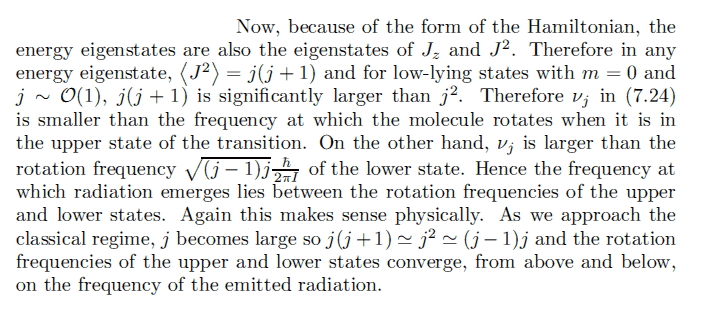
I don't really understand the explanation given in Binney's text about:
htinb4.png


Hamiltonian is given by:

H = \frac{\hbar^2}{2} \left( \frac{J_x^2}{I_x} + \frac{J_y^2}{I_y} + \frac{J_z^2}{I_z} \right)

Orient axes such that ##I_x = I_y = I##.

H = \frac{\hbar^2}{2} \left( \frac{J^2}{I} + J_z^2(\frac{1}{I_z} - \frac{1}{I})\right)

Energy is given by:

E_{jm} = \frac{\hbar^2}{2} \left[ \frac{j(j+1)}{I} + m^2(\frac{1}{I_z} - \frac{1}{I}) \right]

We are only interested in states:

E_{jm} = \frac{\hbar^2}{2I} j(j+1)

Emitted energy and frequency are:

\Delta E_p =\pm (E_j - E_{j-1}) = \pm j\frac{\hbar^2}{I}
v_j = j\frac{\hbar}{2\pi I}
Let's try to analyze the explanation here.

1. Yes, energy, Jz and J2 share the same eigenstates ##|j, m>##.

2. <J2> = j(j+1) : Yes, since that is the eigenvalue and eigenvalue correspond to real observables.

3. Why do low lying states with ##m = 0## and ##j~O(1)## lead to: ## j(j+1) >> j ##? Firstly, doesn't low lying states correspond to a low ##j##? And what does m have to do with anything? ##m## was defined as the eigenvalue of Ji and ##j = m_{max}##

The rest of the argument doesn't make any sense at all..
 
Last edited:
Physics news on Phys.org
He didn't say j(j+1) >> j. He said "significantly larger".

It would help to know what system this discussion is about, what the upper and lower states are, what νj is, and what is contained in Eq.(7.24).
 
Bill_K said:
He didn't say j(j+1) >> j. He said "significantly larger".

It would help to know what system this discussion is about, what the upper and lower states are, what νj is, and what is contained in Eq.(7.24).

It's about the energy levels in rotation spectra of diatomic molecules - specifically CO molecule in this case.

The problem is I'm not sure what he is referring to. This is taken from Binney's book, pg 140:

25tz4hy.png
 
Bill_K said:
He didn't say j(j+1) >> j. He said "significantly larger".

Much more importantly, he said larger than ##j^2##, not j.
 
DrDu said:
Much more importantly, he said larger than ##j^2##, not j.

Ok besides that, I don't get the rest of the argument about rotation frequencies at all!
 
Classically, you have two ways to determine the rotation frequency: Either from the energy of the state using: ##\omega=\sqrt(2IE)## or measuring the frequency of the emitted radiation, ##\omega_\mathrm{transition}##. In QM, the energy is quantized, so ω, as determined from E will depend on J. He is saying ##\omega(j-1)<\omega_\mathrm{transition}<\omega(j)##, where the transition is from j to j-1. In the limit of large j, all thre values will converge to the same classical value.
 

Similar threads

  • · Replies 1 ·
Replies
1
Views
2K
  • · Replies 1 ·
Replies
1
Views
2K
  • · Replies 2 ·
Replies
2
Views
2K
  • · Replies 1 ·
Replies
1
Views
2K
  • · Replies 5 ·
Replies
5
Views
3K
  • · Replies 7 ·
Replies
7
Views
2K
  • · Replies 6 ·
Replies
6
Views
2K
  • · Replies 1 ·
Replies
1
Views
2K
  • · Replies 18 ·
Replies
18
Views
3K
  • · Replies 33 ·
2
Replies
33
Views
7K