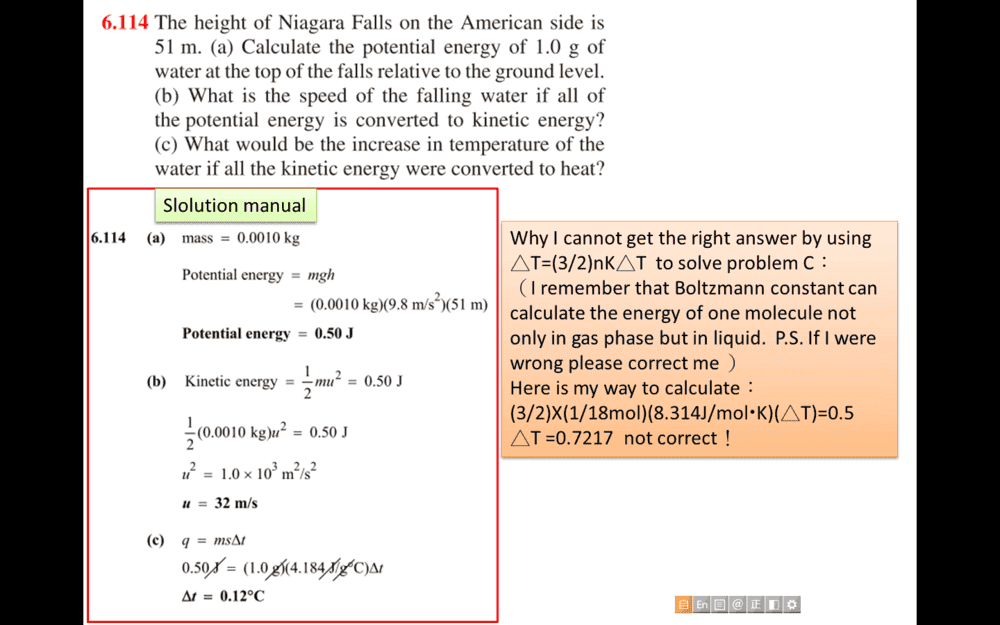
The discussion clarifies why the formula ΔU = (3/2)NkΔT cannot be used for calculating temperature changes in liquid water, as it applies only to ideal monatomic gases. Water, being a complex polar molecule, has additional degrees of freedom that complicate its specific heat calculation, which is approximately 4.184 Joules per gram per degree Celsius. The conversation also addresses the use of the equation W = NKT for solids like graphite and diamond, explaining that work at constant pressure is defined as PΔV. This leads to the relationship ΔH = ΔU + PΔV at constant pressure, reinforcing the distinction between gases and solids in thermodynamic calculations. Understanding these principles is essential for accurately applying thermodynamic equations in various states of matter.
#1
r12214001
24
2
Homework Statement
energy conversion question
Relevant Equations
calculate temperature change
Why I cannot get the right answer by using △T=(3/2)nK△T to solve problem C:
I assume this is a typo and you meant why can you not use ##\Delta U = \frac{3}{2}Nk\Delta T## to determine the temperature change, where ##\Delta U## is the change in internal energy of the water. Essentially you are asking why the heat capacity of liquid water is not ##\frac{3}{2}Nk##
##\Delta U = nC_v\Delta T = \frac{3}{2}Nk\Delta T## applies to an ideal monatomic gas, which has exactly 3 fully active degrees of freedom. Water is not monatomic and it is not an ideal gas. Water is a complicated molecule. It is a polar molecule and it can vibrate and rotate. There are also degrees of freedom associated with the potential energy for each of the translational and vibrational degrees of freedom. To complicate matters some of its degrees of freedom are not fully active at the temperature of liquid water. So it is very difficult to compute the specific heat of liquid water from kinetic theory. But its specific heat at constant volume is certainly not ##\frac{3}{2}Nk##. Its specific heat is 1 calorie or 4.184 Joules per gram degree Celsius.
AM
Last edited:
#3
r12214001
24
2
You help me a lot!
But there is still a problem related! The question seems a little contradicted to your elucidation before.
As you explaned, W=NKT can only be used in ideal gas.
Why the work for solid Graphite and diamond can be calculated by PV? Because NKT=nRT=PV
As you explaned, W=NKT can only be used in ideal gas.
Why the work for solid Graphite and diamond can be calculated by PV? Because NKT=nRT=PV
Work done at constant pressure is always ##P\Delta V##. And since enthalpy is defined as: H = U + PV, it follows that ##\Delta H = \Delta U + P\Delta V + V\Delta P = \Delta U + P\Delta V## at constant pressure.
AM
#5
r12214001
24
2
Andrew Mason said:
Work done at constant pressure is always ##P\Delta V##. And since enthalpy is defined as: H = U + PV, it follows that ##\Delta H = \Delta U + P\Delta V + V\Delta P = \Delta U + P\Delta V## at constant pressure.
The book claims the answer is that all the magnitudes are the same because "the gravitational force on the penguin is the same". I'm having trouble understanding this. I thought the buoyant force was equal to the weight of the fluid displaced. Weight depends on mass which depends on density. Therefore, due to the differing densities the buoyant force will be different in each case? Is this incorrect?