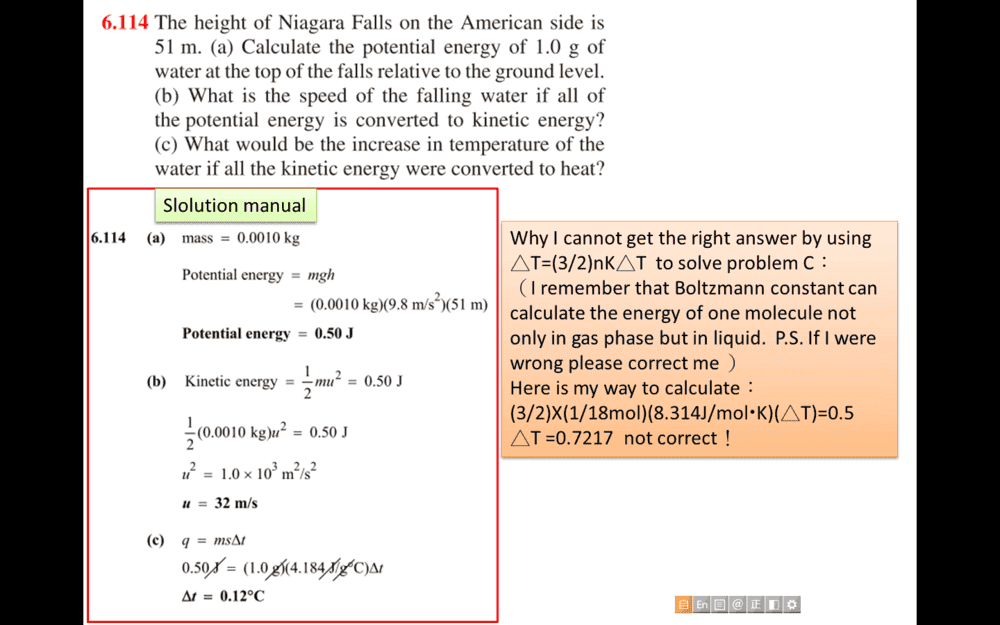
I assume this is a typo and you meant why can you not use ##\Delta U = \frac{3}{2}Nk\Delta T## to determine the temperature change, where ##\Delta U## is the change in internal energy of the water. Essentially you are asking why the heat capacity of liquid water is not ##\frac{3}{2}Nk##
##\Delta U = nC_v\Delta T = \frac{3}{2}Nk\Delta T## applies to an ideal monatomic gas, which has exactly 3 fully active degrees of freedom. Water is not monatomic and it is not an ideal gas. Water is a complicated molecule. It is a polar molecule and it can vibrate and rotate. There are also degrees of freedom associated with the potential energy for each of the translational and vibrational degrees of freedom. To complicate matters some of its degrees of freedom are not fully active at the temperature of liquid water. So it is very difficult to compute the specific heat of liquid water from kinetic theory. But its specific heat at constant volume is certainly not ##\frac{3}{2}Nk##. Its specific heat is 1 calorie or 4.184 Joules per gram degree Celsius.
As you explaned, W=NKT can only be used in ideal gas.
Why the work for solid Graphite and diamond can be calculated by PV? Because NKT=nRT=PV
Work done at constant pressure is always ##P\Delta V##. And since enthalpy is defined as: H = U + PV, it follows that ##\Delta H = \Delta U + P\Delta V + V\Delta P = \Delta U + P\Delta V## at constant pressure.
Work done at constant pressure is always ##P\Delta V##. And since enthalpy is defined as: H = U + PV, it follows that ##\Delta H = \Delta U + P\Delta V + V\Delta P = \Delta U + P\Delta V## at constant pressure.