Understanding head and NPSH in pumps

  • Thread starter Thread starter theBEAST
  • Start date Start date
  • Tags Tags
    Head Pumps
Click For Summary

Homework Help Overview

The discussion revolves around the concepts of head and net positive suction head (NPSH) in the context of pump operation. Participants explore the relationship between head, energy, and the implications for flow within a pipe, as well as the definitions and differences between actual and required NPSH.

Discussion Character

  • Conceptual clarification, Assumption checking, Problem interpretation

Approaches and Questions Raised

  • Participants attempt to understand the implications of head being equal at all points in a pipe and question the relationship between actual and required NPSH. There is discussion about the definitions and equations associated with NPSH, as well as the conditions under which cavitation occurs.

Discussion Status

The discussion is active, with participants seeking clarification on the definitions of actual and required NPSH and their mathematical relationships. Some guidance has been provided regarding the nature of NPSH in relation to pump operation, but confusion remains about the differences between the two types of NPSH.

Contextual Notes

Participants note that the topic was briefly covered in class, and there is uncertainty about its relevance to upcoming assessments. The original poster expresses a desire to understand the concepts despite the lack of formal testing on the material.

theBEAST
Messages
361
Reaction score
0
So I know that head is related to energy. And it is just another way to measure the energy at any given point in the flow (although in units of meters/feet/etc). So does that mean the head is equal at all points of a pipe? Since by conservation of energy and mass, and assuming the flow is steady, then the energy everywhere in the particles must be the same?

Also for NPSH (net positive suction head). It is defined as the head required at pump inlet to prevent cavitation:

NPSH = Pi/(ρg) + Vi2/(2g) - Pv/(ρg)

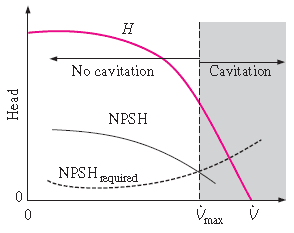
There are two types of NPSH, one is NPSH actual and one is NPSH required. Mathematically how are these different? Do they both follow the same equation above? If so, why would they be different?

See in this plot:
eYojdu8.png


NPSH actual is always larger than NPSH required, why is this?

This was a topic that the professor quickly covered and I don't think we will be tested on it. But out of curiosity I really want to understand the concepts behind it. If anyone could help me it would be greatly appreciated.
 
Physics news on Phys.org
NPSH ... is defined as the head required at pump inlet to prevent cavitation
As I understand it, that's the definition of the required NPSH. The actual NPSH is an attribute of the actual circuit. Cavitation occurs when actual < required. See http://en.wikipedia.org/wiki/NPSH.
 
haruspex said:
As I understand it, that's the definition of the required NPSH. The actual NPSH is an attribute of the actual circuit. Cavitation occurs when actual < required. See http://en.wikipedia.org/wiki/NPSH.

Yes I know that but what is the different between actual and required? Do they both use the same equations? I am very confused...
 
NPSH is a function of where you are along the flow, following the formula you quoted. It's how much spare pressure you have at that point for cavitation not to be occurring there.
Given a pump with an inlet, NPSH interior to the pump is likely to be less at some points than at the inlet. The NPSHR specified for the pump is the NPSH required at inlet. It allows for the maximum difference. It represents how much the NPSH will drop from inlet to the most critical point within the pump. NPSHA is the available NPSH, i.e. the actual value at inlet.
 

Similar threads

  • · Replies 8 ·
Replies
8
Views
4K
Replies
1
Views
1K
Replies
10
Views
8K
  • · Replies 8 ·
Replies
8
Views
4K
  • · Replies 3 ·
Replies
3
Views
3K
  • · Replies 3 ·
Replies
3
Views
2K
  • · Replies 2 ·
Replies
2
Views
2K
  • · Replies 2 ·
Replies
2
Views
2K
Replies
4
Views
3K
Replies
3
Views
7K