Understanding Homogeneous Systems - Expert Answers and Guidance

  • Thread starter Thread starter manal950
  • Start date Start date
  • Tags Tags
    Homogeneous
Click For Summary
The discussion centers on a question regarding homogeneous systems and a specific mathematical error in manipulating expressions. The initial calculation involving (x + y)^2 divided by x^2 is acknowledged as correct up to a certain point. However, the subsequent step incorrectly equates (1 + v)^2 with (1 + v^2), which leads to confusion in the simplification process. The correct expansion of (1 + v^2) should be noted as 1 + 2v + v^2, which affects the cancellation of terms. Accurate understanding of these algebraic manipulations is crucial for solving problems related to homogeneous systems effectively.
manal950
Messages
177
Reaction score
0
Hi all

I have question in homogeneous .

893204297.jpg


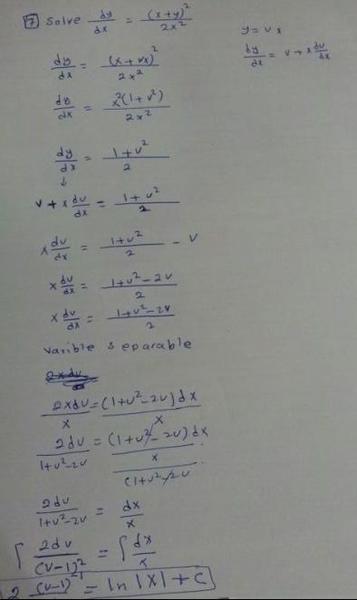
could please check my answer ?
 
Physics news on Phys.org
You have a serious error right at the start. You have, on the right, (x+ y)^2 and you divide that by x^2 to get (1+ y/x)^2= (1+ v)^2

Up to there you are correct. But then your next line has 1+ v^2 which is NOT the same thing. (1+ v^2)= 1+ 2v+ v^2 which works nicely in canceling that "-2v" you will introduce.
 
Question: A clock's minute hand has length 4 and its hour hand has length 3. What is the distance between the tips at the moment when it is increasing most rapidly?(Putnam Exam Question) Answer: Making assumption that both the hands moves at constant angular velocities, the answer is ## \sqrt{7} .## But don't you think this assumption is somewhat doubtful and wrong?

Similar threads

  • · Replies 2 ·
Replies
2
Views
2K
  • · Replies 6 ·
Replies
6
Views
2K
  • · Replies 6 ·
Replies
6
Views
2K
Replies
12
Views
2K
Replies
7
Views
2K
Replies
6
Views
1K
  • · Replies 12 ·
Replies
12
Views
2K
  • · Replies 7 ·
Replies
7
Views
2K
  • · Replies 3 ·
Replies
3
Views
2K
Replies
8
Views
3K