Understanding Inner Product in Infinite Dimensional Bases

Click For Summary

Discussion Overview

The discussion revolves around the concept of inner products in infinite dimensional spaces, particularly in the context of quantum mechanics. Participants explore the differences between finite and infinite dimensional inner products, the reasons for using different definitions, and the implications of these changes in mathematical treatment.

Discussion Character

  • Exploratory
  • Technical explanation
  • Conceptual clarification

Main Points Raised

  • One participant questions why the definition of inner product in finite dimensions cannot be applied directly to infinite dimensions, noting confusion over the transition to integration.
  • Another participant suggests that the division by n in the infinite case allows for the sum to remain finite, leading to the integral formulation.
  • Several participants express curiosity about the reasons for changing definitions in infinite dimensions and the role of Δ in the equations.
  • A participant mentions that understanding these concepts may require deeper knowledge of integration theory, specifically Lebesgue integration, and suggests that rigorous study of Rigged Hilbert Spaces is necessary for a comprehensive understanding.
  • There is a request for resources or books to help clarify the "hand-wavey stuff" related to these concepts.

Areas of Agreement / Disagreement

Participants express varying levels of understanding and curiosity about the transition from finite to infinite dimensional inner products. There is no consensus on the reasons for the changes in definitions, and the discussion remains exploratory with multiple viewpoints presented.

Contextual Notes

Participants acknowledge that a deeper understanding of integration theory and advanced mathematical concepts is required to fully grasp the implications of inner products in infinite dimensions.

amjad-sh
Messages
240
Reaction score
13
While I'm reading a book in quantum mechanics, I reached the part "Generalization to infinite dimension".
We know that at infinite dimension many definitions changes.And that what is confusing me!
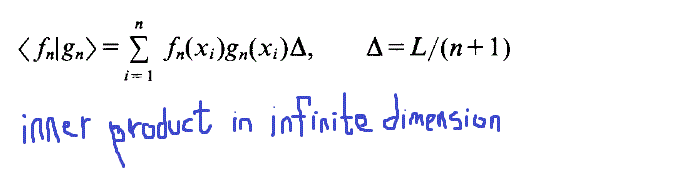
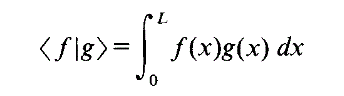
Take for example the inner product.when we are dealing in finite dimension the definition of inner product in orthonormal basis is shown below. If we deal with infinite dimensional basis the definition of inner product
becomes as shown below.
My Question is: why we can't use the first definition for infinite dimensional case?What is the magical trick that the first definition makes the inner product equals to infinity while the other makes it equal to a specific number due to the use of integration?Do I need to go deeper in integration theory to grasp this or the idea is simpler than that?
thanks

Capture.GIF
Capture1.GIF
Capture2.GIF
 
Physics news on Phys.org
The trick is the division by n. I would expect that those f*g can all be of similar size (in particular, not go to zero quickly). Then your sum diverges, but the sum divided by n stays finite and you end up with an integral for the infinite case.
 
OK.
But why we go to the second definition? why in infinite dimension we use the second definition and not the first? what is the reason of inserting Δ in the equation?
I know that the inner product in the first definition diverges, but what permits us to change the first definition to the second definition?why in infinite dimension things change?
 
amjad-sh said:
But why we go to the second definition? why in infinite dimension we use the second definition and not the first? what is the reason of inserting Δ in the equation?I know that the inner product in the first definition diverges, but what permits us to change the first definition to the second definition?why in infinite dimension things change?

It's a hand-wavey thing to see how the usual definition of inner products from finite spaces can become the integral in infinite dimensional spaces.

Why? Its just the way infinite spaces are - they allow it. And yes deeper integration theory is required - you need Lebesque integration - not for the hand-wavey stuff - but to understand Hilbert spaces. Don't worry about it to start with though.

If you really want to get to the bottom of it you need to study Rigged Hilbert Spaces - but a rigorous treatment of that is quite advanced and not recommended for the beginner.

Thanks
Bill
 
Last edited:
  • Like
Likes   Reactions: mfb
bhobba said:
And yes deeper integration theory is required - you need Lebesque integration - not for the hand-wavey stuff - but to understand Hilbert spaces.
.
OK, i will read about this stuff.
bhobba said:
If you really want to get to the bottom of it you need to study Rigged Hilbert Spaces - but a rigorous treatment of that is quite advanced and not recommended for the beginner.
.
You mean to get deeper in the hand-wavey stuff or Hilbert space? If you know a way or book that helps me to understand the "hand-wavey stuff" you will be appreciated.
Thanks.:smile:
 
amjad-sh said:
.You mean to get deeper in the hand-wavey stuff or Hilbert space? If you know a way or book that helps me to understand the "hand-wavey stuff" you will be appreciated.

Yes - Chapter 2 - Ballentine - Quantum Mechanics - A Modern Development:
https://www.amazon.com/dp/9814578584/?tag=pfamazon01-20

Thanks
Bill
 
Last edited by a moderator:
OK.
Thank you.
 

Similar threads

  • · Replies 8 ·
Replies
8
Views
4K
  • · Replies 7 ·
Replies
7
Views
3K
  • · Replies 0 ·
Replies
0
Views
737
  • · Replies 4 ·
Replies
4
Views
1K
  • · Replies 9 ·
Replies
9
Views
2K
  • · Replies 9 ·
Replies
9
Views
3K
  • · Replies 43 ·
2
Replies
43
Views
8K
Replies
16
Views
3K
  • · Replies 3 ·
Replies
3
Views
2K
  • · Replies 2 ·
Replies
2
Views
12K