Why can't values of M for J=2 contain values of M for J=1 in np2 configuration?

  • Thread starter Thread starter proton4ik
  • Start date Start date
Click For Summary
SUMMARY

The discussion centers on the relationship between the quantum numbers M and J in the np2 configuration, specifically addressing why values of M for J=2 cannot include values for J=1. It is established that when J=2 is accounted for, which consists of five states (M=-2, -1, 0, 1, 2), only one state remains (M=0), thus precluding the existence of a J=1 component that would require additional states. The transformation between bases characterized by j1 and j2 to J and M is highlighted as a critical aspect of this analysis, emphasizing the necessity for the two bases to maintain equal size.

PREREQUISITES
  • Understanding of quantum mechanics, specifically angular momentum and quantum states.
  • Familiarity with the concepts of quantum numbers J and M.
  • Knowledge of basis transformations in quantum mechanics.
  • Experience with spin-orbit coupling effects in quantum systems.
NEXT STEPS
  • Study the principles of angular momentum in quantum mechanics.
  • Learn about basis transformations and their applications in quantum state analysis.
  • Explore the implications of spin-orbit coupling on quantum states.
  • Investigate the role of quantum numbers in determining the properties of atomic and subatomic systems.
USEFUL FOR

Students and researchers in quantum mechanics, particularly those focusing on atomic structure, angular momentum, and the behavior of quantum states in multi-electron systems.

proton4ik
Messages
15
Reaction score
0
Hello everyone! I'm trying to understand how to determine states within the different configuration

Homework Statement


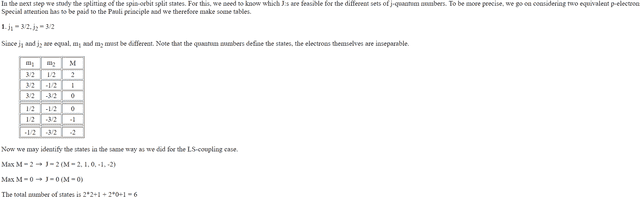
The question is, why we don't consider Max M=1 -> J=1 while identifying the states for np2 configuration? (http://www.nat.vu.nl/~wimu/JJCoup.html)
9b5bd41a9f958754594ab9385cb474ff-full.png


Homework Equations

The Attempt at a Solution


Attachments

  • 9b5bd41a9f958754594ab9385cb474ff-full.png
    9b5bd41a9f958754594ab9385cb474ff-full.png
    8.6 KB · Views: 549
Physics news on Phys.org
proton4ik said:
The question is, why we don't consider Max M=1 -> J=1 while identifying the states for np2 configuration? (http://www.nat.vu.nl/~wimu/JJCoup.html)
Because there is no such state left once those for J=2 have been counted.

There are six possible values of M: 2, 1, 0, 0, -1, -2. The fact that the maximum value of M is 2, there must be a J=2 in there. That J=2 is made up of M=-2,-1,0,1,2, meaning that 5 of those states make up J=2. What you have left is a single state with M=0, hence J=0.

In the hypothetical case where you would have found 9 possible values of M, 2, 1, 1, 0, 0, 0, -1, -1, -2, then after having accounted for J=2, you would be left with
M=1, 0, 0, -1, so now you would have gotten a J=1 as well.
 
  • Like
Likes proton4ik
DrClaude said:
Because there is no such state left once those for J=2 have been counted.

There are six possible values of M: 2, 1, 0, 0, -1, -2. The fact that the maximum value of M is 2, there must be a J=2 in there. That J=2 is made up of M=-2,-1,0,1,2, meaning that 5 of those states make up J=2. What you have left is a single state with M=0, hence J=0.

In the hypothetical case where you would have found 9 possible values of M, 2, 1, 1, 0, 0, 0, -1, -1, -2, then after having accounted for J=2, you would be left with
M=1, 0, 0, -1, so now you would have gotten a J=1 as well.
Thank you very much for your answer! But still I have a very stupid question left. Why can't values of M for J=2 contain values of M for J=1? What are the properties of M, J that don't allow this?
 
proton4ik said:
Thank you very much for your answer! But still I have a very stupid question left. Why can't values of M for J=2 contain values of M for J=1? What are the properties of M, J that don't allow this?
I'm not sure I understand your question.

The procedure used here is an accounting procedure, and the books must balance. If you have 6 states and can determine that there is a J=2 component, that component accounts for 5 of the states. You are left with 1 state, which mean you can't have a J=1 component, since that would require an additional 3 states.

More technically, this is a basis transformation: you are going from a basis of states characterised by ##j_1## and ##j_2## and transforming to a basis of states characterised by ##J## and ##M##, and this is done because the latter are eigenstates in the presence of spin-orbit coupling. The two bases must be the same size.
 

Similar threads

  • · Replies 11 ·
Replies
11
Views
3K
  • · Replies 4 ·
Replies
4
Views
2K
  • · Replies 3 ·
Replies
3
Views
2K
  • · Replies 1 ·
Replies
1
Views
2K
  • · Replies 2 ·
Replies
2
Views
1K
  • · Replies 5 ·
Replies
5
Views
4K
  • · Replies 9 ·
Replies
9
Views
7K
  • · Replies 5 ·
Replies
5
Views
5K
  • · Replies 2 ·
Replies
2
Views
2K
  • · Replies 2 ·
Replies
2
Views
2K