Jey
- 1
- 0
Hello,
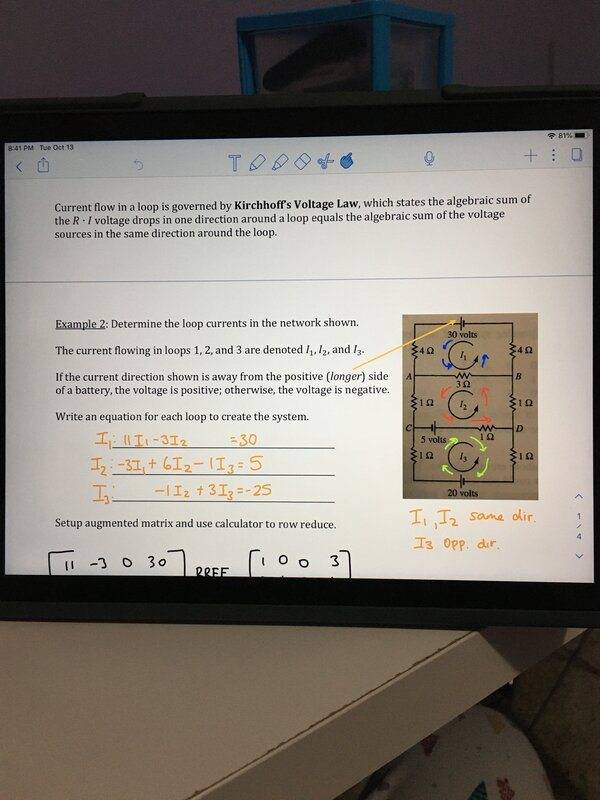
In the following problem, when finding the equation for I2 I don’t understand why I3 is negative. Although I2 and I3 are going in different directions (clockwise and counterclockwise), at that ohm they are both going from left to right. When finding the equation of I1, I1 goes from left to right and I2 right to left, because of that one of the directions is considered negative. Does this mean there are two different reasons for why it is negative? Also, is there a scenario in which it would be positive? I haven’t learned about loop currents before (this is an applications problem), however I tried asking my friends, teacher and searching the internet and I couldn’t find any answers. If you understand how this problem was solved using this method please explain that as well. Thank you!
In the following problem, when finding the equation for I2 I don’t understand why I3 is negative. Although I2 and I3 are going in different directions (clockwise and counterclockwise), at that ohm they are both going from left to right. When finding the equation of I1, I1 goes from left to right and I2 right to left, because of that one of the directions is considered negative. Does this mean there are two different reasons for why it is negative? Also, is there a scenario in which it would be positive? I haven’t learned about loop currents before (this is an applications problem), however I tried asking my friends, teacher and searching the internet and I couldn’t find any answers. If you understand how this problem was solved using this method please explain that as well. Thank you!
Last edited by a moderator: