Understanding Momentum Conservation in Simple Harmonic Motion

Click For Summary
SUMMARY

The discussion centers on the application of momentum conservation in simple harmonic motion (SHM) when two masses coalesce. The velocity of the combined mass is expressed as v = wA, where w represents angular frequency and A denotes amplitude. The new equilibrium position is crucial for determining the new amplitude A2, which is calculated using the formula v/2 = ω2√(A2² - x²). The participants confirm the correct approach to finding the new amplitude to ensure the system reaches its natural length at the peak of the motion.

PREREQUISITES
  • Understanding of simple harmonic motion (SHM)
  • Familiarity with momentum conservation principles
  • Knowledge of angular frequency (ω) and amplitude (A)
  • Ability to manipulate and solve equations involving SHM
NEXT STEPS
  • Study the derivation of the equations of motion for simple harmonic oscillators
  • Learn about the effects of mass coalescence on SHM systems
  • Explore the concept of equilibrium positions in oscillatory systems
  • Investigate advanced applications of momentum conservation in mechanical systems
USEFUL FOR

Students of physics, educators teaching mechanics, and engineers working with oscillatory systems will benefit from this discussion on momentum conservation in simple harmonic motion.

Prabs3257
Messages
65
Reaction score
4
Homework Statement
A block A of mass m is in equilibrium after being suspended from the ceiling with the help of a spring of force constant k. The block B of mass m strikes the block A with a speed v and sticks to it.The value of v for which the spring just attains its natural length is
Relevant Equations
Momentum conservation
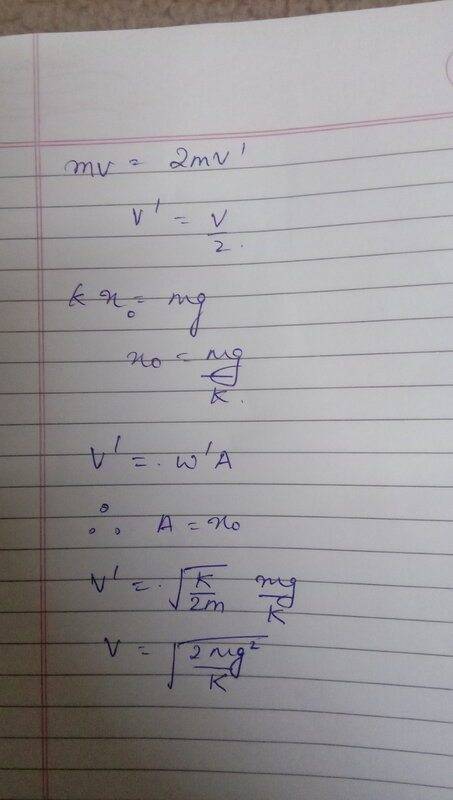
I first got the velocity of the combined mass with conservation of momentum and as it was in the mean position the velocity can be written as v = wA ( w= angular frequency , A = amplitude ) as we have to take it back to natural length i put A as the initial extension but i am getting a wrong ans can someone please tell me what i did wrong . Please refer to my work in the attachment below
IMG-20200718-WA0001.jpeg
 

Attachments

  • Screenshot_20200718_015323.jpg
    Screenshot_20200718_015323.jpg
    31.9 KB · Views: 194
Physics news on Phys.org
As soon as the second mass coalesces with the first, the new mass starts to perform simple harmonic motion about a new equilibrium position. Determine the position of this new equilibrium and then use that ##\frac{v}{2} = \omega_2 \sqrt{A_2^2 - x^2}## for the necessary new amplitude ##A_2## so that it just reaches natural length at the top of the motion.
 
etotheipi said:
As soon as the second mass coalesces with the first, the new mass starts to perform simple harmonic motion about a new equilibrium position. Determine the position of this new equilibrium and then use that ##\frac{v}{2} = \omega_2 \sqrt{A_2^2 - x^2}## for the necessary new amplitude ##A_2## so that it just reaches natural length at the top of the motion.
Thanks a lot man i got the answer
 
  • Like
Likes   Reactions: etotheipi

Similar threads

  • · Replies 18 ·
Replies
18
Views
2K
  • · Replies 2 ·
Replies
2
Views
1K
Replies
24
Views
4K
Replies
7
Views
3K
  • · Replies 10 ·
Replies
10
Views
2K
Replies
10
Views
3K
Replies
10
Views
2K
  • · Replies 3 ·
Replies
3
Views
2K
  • · Replies 4 ·
Replies
4
Views
2K
Replies
7
Views
1K