Understanding Neutron Star Formation Through Feynman Diagrams

Click For Summary
SUMMARY

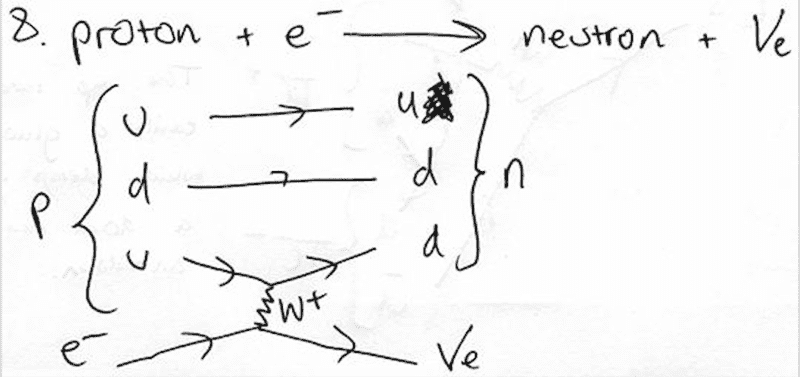
This discussion centers on the formation of neutron stars and the role of Feynman diagrams in illustrating particle interactions during gravitational collapse. The specific interaction involves the conversion of protons and electrons into neutrons and neutrinos, represented by the equations: $$p+e^{-} \rightarrow n + \nu_e$$ and $$uud+e^{-} \rightarrow udd + \nu_e$$. It is clarified that the W+ boson is exchanged between the electron/neutrino and the up/down quarks, with no definitive emitter. The timing of particle decay in the diagram does not affect the underlying physics, as the diagram represents an infinite number of possible spacetime configurations.

PREREQUISITES
  • Understanding of Feynman diagrams and their representation of particle interactions
  • Basic knowledge of particle physics, specifically quark and lepton interactions
  • Familiarity with the concept of boson exchange in weak interactions
  • Knowledge of neutron star formation and gravitational collapse processes
NEXT STEPS
  • Study the principles of weak nuclear interactions and W boson exchange
  • Explore advanced Feynman diagram techniques and their applications in particle physics
  • Research neutron star formation mechanisms and the role of particle interactions
  • Learn about the mathematical formalism behind Feynman diagrams and their infinite series representation
USEFUL FOR

Students and researchers in theoretical physics, particularly those interested in particle interactions, astrophysics, and the mathematical frameworks of Feynman diagrams.

doggydan42
Messages
169
Reaction score
18
Hello,

I recently watched a video as an introduction to Feynman diagrams for my own self-interest. The video gave a link to practice problems, and one of them was as follows:

In a neutron star gravitational collapse causes valence electrons to combine with protons. Draw a Feynman diagram representing this interaction.
$$p+e^{-} \rightarrow n + \nu_e
\\ uud+e^{-} \rightarrow udd + \nu_e$$

I understood most of the interaction and that there would be a W+ boson between the up quark and electron, though would the electron or up quark emit the boson, and why?

Thank you in advance
Screen Shot 2017-11-20 at 1.02.29 PM.png
 

Attachments

  • Screen Shot 2017-11-20 at 1.02.29 PM.png
    Screen Shot 2017-11-20 at 1.02.29 PM.png
    47.9 KB · Views: 823
Physics news on Phys.org
doggydan42 said:
would the electron or up quark emit the boson

Neither. The boson is exchanged between the electron/neutrino and the up quark/down quark, but neither one can be said to be the "emitter". You just have a Feynman diagram (at lowest order) with two interaction vertices.
 
PeterDonis said:
Neither. The boson is exchanged between the electron/neutrino and the up quark/down quark, but neither one can be said to be the "emitter". You just have a Feynman diagram (at lowest order) with two interaction vertices.

So to the diagram, it does not matter if the curve drawn for the W boson is further left at the vertex with the electron, being that time increases to the right?

Or to rephrase the question, does it matter which particle, up quark or electron, decays first?
 
doggydan42 said:
to the diagram, it does not matter if the curve drawn for the W boson is further left at the vertex with the electron, being that time increases to the right?

The diagram does not tell you where in spacetime the two vertexes are; the fact that it seems to when you draw it is misleading. In the actual math, this diagram corresponds to an infinite number of terms, one for each possible pair of spacetime locations for the vertexes.
 
PeterDonis said:
The diagram does not tell you where in spacetime the two vertexes are; the fact that it seems to when you draw it is misleading. In the actual math, this diagram corresponds to an infinite number of terms, one for each possible pair of spacetime locations for the vertexes.

Okay, thank you very much.
 

Similar threads

  • · Replies 2 ·
Replies
2
Views
2K
  • · Replies 15 ·
Replies
15
Views
2K
  • · Replies 3 ·
Replies
3
Views
3K
  • · Replies 4 ·
Replies
4
Views
2K
  • · Replies 3 ·
Replies
3
Views
6K
  • · Replies 6 ·
Replies
6
Views
2K
  • · Replies 10 ·
Replies
10
Views
4K
  • · Replies 1 ·
Replies
1
Views
2K
  • · Replies 3 ·
Replies
3
Views
2K
  • · Replies 5 ·
Replies
5
Views
4K