I don't understand this Feynman Diagram

Click For Summary

Discussion Overview

The discussion revolves around understanding the lowest-order Feynman diagrams for the process e+e- --> W+W. Participants are exploring the interpretation of a specific t-channel diagram and its implications in particle interactions, particularly focusing on the roles of virtual particles and the nature of the interactions depicted.

Discussion Character

  • Exploratory, Technical explanation, Debate/contested

Main Points Raised

  • One participant questions the interpretation of a t-channel Feynman diagram, expressing confusion about how an electron can decay into a neutrino and a W boson, and how a positron and a neutrino can combine to form a W boson.
  • Another participant clarifies that there are no decays involved in the process, stating that an electron, a virtual neutrino, and a W boson couple, and that the coupling is allowed without requiring real particles.
  • A different participant suggests that the confusion arises from ordering time in the intermediate states of the diagram, proposing that the Feynman diagram represents a combination of several time-ordered diagrams.
  • This participant also emphasizes that the neutrino in question is virtual, which allows for the described interactions to occur without contradiction.
  • Another contribution notes that Feynman diagrams should not be viewed too literally as processes, but rather as terms in a full amplitude's Taylor expansion.

Areas of Agreement / Disagreement

Participants express differing interpretations of the Feynman diagram, with some emphasizing the role of virtual particles and others focusing on the ordering of interactions. There is no consensus on a single interpretation of the diagram.

Contextual Notes

The discussion highlights the complexity of interpreting Feynman diagrams, particularly regarding the nature of virtual particles and the implications of time ordering in particle interactions. The nuances of these interpretations are not fully resolved.

11thHeaven
Messages
48
Reaction score
0
Question:
Draw the lowest-order Feynman diagrams for the e+e- --> W+W-process

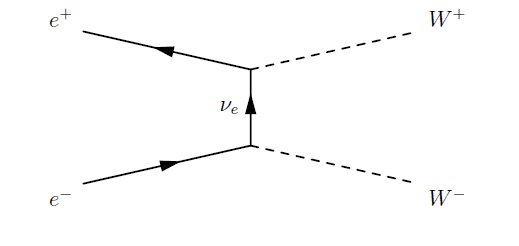
The answer gives three diagrams. I understand the first two, but the third makes no sense to me. Here it is:
WeirdFeynmanDiagram.png
So this is a t-channel Feynman diagram. As far as I can tell regarding how these types of Feynman diagrams are read, the following processes are taking place:

e- --> ve + W-
e+ + ve- --> W+

But this makes no sense to me. How can an electron decay into a neutrino and a W boson? And how can a positron and a neutrino combine to form a W boson?

Am I simply reading this wrongly?
 
Physics news on Phys.org
There are no decays involved. An electron, a (virtual) neutrino and a W boson couple. That coupling is allowed. For a decay the W and the neutrino would have to be real (leave the Feynman diagram).

Splitting the diagram into those subprocesses doesn't work well because you assign particle properties to things that are not actual particles.
 
11thHeaven said:
Question:
Draw the lowest-order Feynman diagrams for the e+e- --> W+W-process

The answer gives three diagrams. I understand the first two, but the third makes no sense to me. Here it is:

View attachment 108644So this is a t-channel Feynman diagram. As far as I can tell regarding how these types of Feynman diagrams are read, the following processes are taking place:

e- --> ve + W-
e+ + ve- --> W+

But this makes no sense to me. How can an electron decay into a neutrino and a W boson? And how can a positron and a neutrino combine to form a W boson?

Am I simply reading this wrongly?
well, the best way to think about it is to not order the time in the intermediate states because a Feynman diagram is really a combination of several time ordered diagrams. If you insist in thinking of it this way, then this Feynman diagram is a combination of what you described (where you put the vertex e^- W^- vertex occurs first) plus the time ordered diagram for which the other vertex occurs first.

But there is no contradiction here. You ask "how can an electron decay into a neutrino and a W boson?" We are dealing with an off-shell neutrino here (it is a virtual neutrino) so there is no problem with that reaction.
 
Just to add: Maybe you look upon these Feynmandiagrams too literally as processes. The actual process is given by the full amplitude. Feynmandiagrams are terms in its Taylor expansion.
 

Similar threads

Replies
2
Views
3K
  • · Replies 1 ·
Replies
1
Views
3K
  • · Replies 6 ·
Replies
6
Views
2K
  • · Replies 10 ·
Replies
10
Views
4K
  • · Replies 2 ·
Replies
2
Views
3K
  • · Replies 9 ·
Replies
9
Views
4K
  • · Replies 2 ·
Replies
2
Views
2K
  • · Replies 1 ·
Replies
1
Views
2K
  • · Replies 6 ·
Replies
6
Views
3K
  • · Replies 4 ·
Replies
4
Views
5K