Understanding P-values in Statistical Analysis

  • Thread starter Thread starter whitehorsey
  • Start date Start date
  • Tags Tags
    P-value
Click For Summary
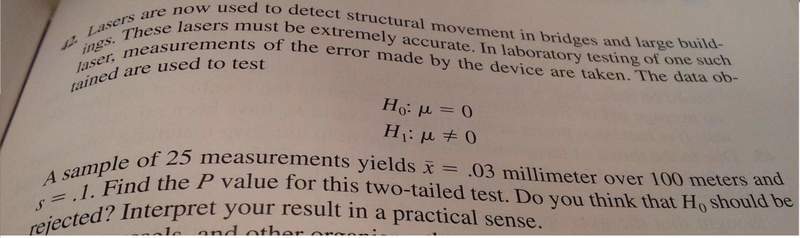
The calculation of the t distribution yielded a p-value of 0.882, which is greater than the typical significance level of 0.05, leading to a failure to reject the null hypothesis (H0). This indicates that the observed result is consistent with the predictions made under H0. The discussion highlights the interpretation of the p-value as the probability of obtaining a test statistic at least as extreme as the one observed, assuming H0 is true. Additionally, there is some confusion regarding the lack of units for the standard deviation (s) in the calculations. Understanding these concepts is crucial for accurate statistical analysis and interpretation.
whitehorsey
Messages
188
Reaction score
0
1.
question.jpg


3. I solved for t distribution = (.03 - 0)/(.1/√25) = .15
P - Value = 2P(T ≥ .15) = 2(.441) = .882. So I got No but instead we fail to reject H0 because 0.882 > .05 (.005 is the typical significance level). Is this correct and would it be a correct interpretation?
 
Physics news on Phys.org
I am surprised that s does not have a unit.

0.882 > 0.05 (or whatever you want to use), so we don't reject H0.
The large p-value shows that the result is very close to the "prediction" based on H0.
 
mfb said:
I am surprised that s does not have a unit.

0.882 > 0.05 (or whatever you want to use), so we don't reject H0.
The large p-value shows that the result is very close to the "prediction" based on H0.

Thank You!
 
And do you know in words what that p-value means?
 
abeliando said:
And do you know in words what that p-value means?

The probability of attaining a test statistic.
 
Question: A clock's minute hand has length 4 and its hour hand has length 3. What is the distance between the tips at the moment when it is increasing most rapidly?(Putnam Exam Question) Answer: Making assumption that both the hands moves at constant angular velocities, the answer is ## \sqrt{7} .## But don't you think this assumption is somewhat doubtful and wrong?

Similar threads

  • · Replies 5 ·
Replies
5
Views
2K
  • · Replies 24 ·
Replies
24
Views
6K
  • · Replies 5 ·
Replies
5
Views
3K
  • · Replies 8 ·
Replies
8
Views
2K
  • · Replies 2 ·
Replies
2
Views
2K
Replies
4
Views
2K
  • · Replies 28 ·
Replies
28
Views
2K
  • · Replies 10 ·
Replies
10
Views
2K
  • · Replies 4 ·
Replies
4
Views
2K
  • · Replies 7 ·
Replies
7
Views
8K