- 1,098
- 1,385
I'd appreciate some clarification of this passage in the paper Spinning test particles in general relativity by Papapetrou,
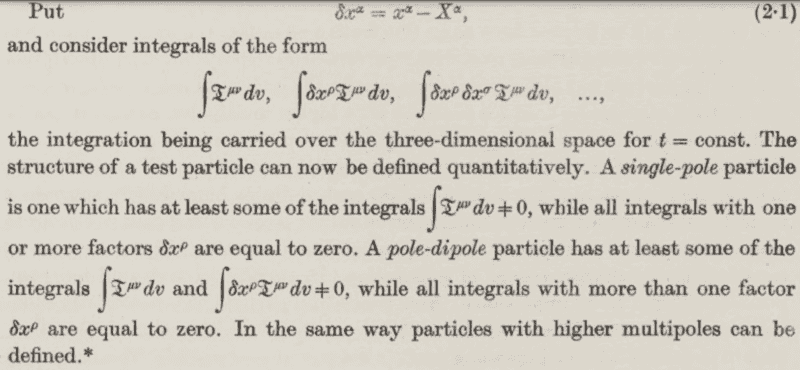
The definition is easy enough to understand, but what's the motivation? ##X^{\alpha}## are the coordinates of points on the worldline whilst ##x^{\alpha}## are presumably arbitrary spacetime coordinates (of points near the worldline).
n.b. ##\mathfrak{T}^{\mu \nu} = \sqrt{-g} T^{\mu \nu}## and\begin{align*}
\nabla_{\nu} T^{\mu \nu} = \partial_{\nu} T^{\mu \nu} + \Gamma^{\nu}_{\sigma \nu} T^{\mu \sigma} + \Gamma^{\mu}_{\sigma \nu} T^{\sigma \nu} &= 0 \\ \\
\implies \dfrac{1}{\sqrt{-g}} \partial_{\nu} \left( \sqrt{-g} T^{\mu \nu} \right) + \Gamma^{\mu}_{\sigma \nu} T^{\sigma \nu} &= 0\\
\partial_{\nu} \left( \sqrt{-g} T^{\mu \nu} \right) + \Gamma^{\mu}_{\sigma \nu} \sqrt{-g} T^{\sigma \nu} &= 0 \\
\partial_{\nu} \mathfrak{T}^{\mu \nu} + \Gamma^{\mu}_{\sigma \nu}\mathfrak{T}^{\sigma \nu} &= 0
\end{align*}
The definition is easy enough to understand, but what's the motivation? ##X^{\alpha}## are the coordinates of points on the worldline whilst ##x^{\alpha}## are presumably arbitrary spacetime coordinates (of points near the worldline).
n.b. ##\mathfrak{T}^{\mu \nu} = \sqrt{-g} T^{\mu \nu}## and\begin{align*}
\nabla_{\nu} T^{\mu \nu} = \partial_{\nu} T^{\mu \nu} + \Gamma^{\nu}_{\sigma \nu} T^{\mu \sigma} + \Gamma^{\mu}_{\sigma \nu} T^{\sigma \nu} &= 0 \\ \\
\implies \dfrac{1}{\sqrt{-g}} \partial_{\nu} \left( \sqrt{-g} T^{\mu \nu} \right) + \Gamma^{\mu}_{\sigma \nu} T^{\sigma \nu} &= 0\\
\partial_{\nu} \left( \sqrt{-g} T^{\mu \nu} \right) + \Gamma^{\mu}_{\sigma \nu} \sqrt{-g} T^{\sigma \nu} &= 0 \\
\partial_{\nu} \mathfrak{T}^{\mu \nu} + \Gamma^{\mu}_{\sigma \nu}\mathfrak{T}^{\sigma \nu} &= 0
\end{align*}
Last edited: