Understanding Potential Dividers in Circuit Analysis

Join the discussion
Registration is free. Ask a follow-up in this thread, or start your own.
33 replies · 3K views
suv79
Messages
65
Reaction score
0

Homework Statement


upload_2016-2-7_0-19-43.png

how did they get this ?? it is like a potential divider, can anyone explain...

Homework Equations

The Attempt at a Solution


this is what i got[/B]
upload_2016-2-7_0-23-1.png
 
Physics news on Phys.org
cnh1995 said:
Are you familiar with node voltage method?
yes i know about node voltage, i want the node at V_
 
You can write the node voltage equations and rearrange them to get V_. There will be 3 principal nodes.Assume ground node at the bottom wire and proceed.
 
so this

how can i rearrange this to equal this
upload_2016-2-7_17-41-48.png
 

Attachments

  • upload_2016-2-7_17-40-15.png
    upload_2016-2-7_17-40-15.png
    1.4 KB · Views: 637
when adding fractions why does the denominator for the Z1 Z2 become Z1*Z2 ?
 
upload_2016-2-7_18-4-47.png

i don't really understand the last step here
 
suv79 said:
View attachment 95455
i don't really understand the last step here
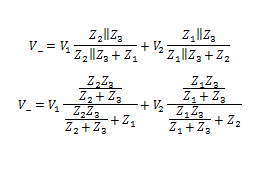
How will you write this term in the denominator
Z1+Z2Z3/(Z2+Z3) using cross multiplication? It is used to make the denominators same. It is basic algebra.
e.g 3/4+2/3=[( 3×3)+(4×2)]/(3×4)=17/12.
You can not directly cancel the terms like you did there.
 
upload_2016-2-7_17-47-24-png.95451.png

Consider only the first term i.e. the term before + sign. Apply the cross product rule in its denominator. What will you get?
Similarly proceed for the next term. It is a matter of only one step.
 
now i got this but still need to move Z3
 

Attachments

  • upload_2016-2-7_20-24-53.png
    upload_2016-2-7_20-24-53.png
    929 bytes · Views: 469
suv79 said:
I think you are making it unnecessarily complicated. Just apply the cross multiplication rule to the denominator of each term separately. It is just one step and you'll be done.
upload_2016-2-7_17-47-24-png.95451.png
 
upload_2016-2-7_21-13-17.png

this is better but what happens to Z3^2
 
cnh1995 said:
I think you are making it unnecessarily complicated. Just apply the cross multiplication rule to the denominator of each term separately. It is just one step and you'll be done.
upload_2016-2-7_17-47-24-png.95451.png
Let the two terms be A and B.
So, V_=A+B
(I can't use LaTex on my phone, so this is the best format I can write in..)
Denominator of A is Z1+(Z2Z3)/(Z2+Z3)
=[Z1.(Z2+Z3)+Z2.Z3]/(Z2+Z3)
=[z1z2+z2z3+z1z3]/(z2+z3)
This is the denominator of A. Now write A and see what you can cancel out. It is one of the basic algebraic manipulations.
 
Wow. That's a lot of algebra.:))

If I might make a suggestion? If you begin with a nodal equation at the junction the whole thing becomes much more straightforward.
 
  • Like
Likes   Reactions: cnh1995
suv79 said:
yes please :)
Um, that was my suggestion...

Have you been introduced to node voltage analysis ("nodal analysis") method yet?
 
Good. Now since the whole thing is set equal to zero you can discard the denominator. With the numerator only now, expand the terms and then gather them by voltage variable. You should see daylight pretty quickly.