Understanding Potential Dividers in Circuit Analysis

33 replies · 3K views · last reply
suv79
Messages
65
Reaction score
0

Homework Statement


Circuit schematic labelled FIG. 4 showing impedances Z1 and Z2 in series across the top, Z3 in a shunt branch to ground, input V1 on the left, output V2 on the right and node voltage V- at the centre; equation (5) gives V- = Z3((Z1V2 + Z2V1)/(Z1Z2 + Z1Z3 + Z2Z3)).

how did they get this ?? it is like a potential divider, can anyone explain...

Homework Equations

The Attempt at a Solution


this is what i got[/B]
Equation: V_- = V1 Z2/(Z1||Z2) + V2 Z1||Z3/(Z1||Z3 + Z2), where || denotes parallel combination of impedances.
 
cnh1995 said:
Are you familiar with node voltage method?
yes i know about node voltage, i want the node at V_
 
You can write the node voltage equations and rearrange them to get V_. There will be 3 principal nodes.Assume ground node at the bottom wire and proceed.
 
View attachment 95408
this is what i got
Your second term is correct involving V2, and if you had been consistent you'd have a corresponding correct expression involving V1. The method you are using for this is called Superposition.
 
so this

how can i rearrange this to equal this
Equation (5): V₋ = Z₃ × (Z₁V₂ + Z₂V₁) / (Z₁Z₂ + Z₂Z₃ + Z₁Z₃)
 
Attachments
  • Two stacked equations for V_ in terms of V1 and V2 with parallel impedance combinations Z1||Z3 and Z2||Z3, the second expanding the nested fractions in Z1, Z2 and Z3.
    upload_2016-2-7_17-40-15.png
    1.4 KB · Views: 656
suv79 said:
Using cross multiplication, you will be able to cancel out Z2+Z3 in the denominator with that in the numerator. Then take Z3 common from the numerators and you are done.
 
when adding fractions why does the denominator for the Z1 Z2 become Z1*Z2 ?
 
suv79 said:
View attachment 95455
i don't really understand the last step here
How will you write this term in the denominator
Z1+Z2Z3/(Z2+Z3) using cross multiplication? It is used to make the denominators same. It is basic algebra.
e.g 3/4+2/3=[( 3×3)+(4×2)]/(3×4)=17/12.
You can not directly cancel the terms like you did there.
 
Two-line equation for V_ as V1 times Z2 Z3 over (Z2 parallel Z3 plus Z1), plus V2 times Z1 parallel Z3 over (Z1 parallel Z3 plus Z2), followed by a rewritten form with the parallel combinations expanded into fractions.

Consider only the first term i.e. the term before + sign. Apply the cross product rule in its denominator. What will you get?
Similarly proceed for the next term. It is a matter of only one step.
 
now i got this but still need to move Z3
 
Attachments
  • Equation for V_ as a fraction: numerator (V1 Z2 + V2 Z1); denominator a complex fraction of (Z2 Z3)/(Z2 + Z3) + Z2 + Z1 Z2 + Z1 (Z3/(Z1 + Z3)).
    upload_2016-2-7_20-24-53.png
    929 bytes · Views: 488
suv79 said:
I think you are making it unnecessarily complicated. Just apply the cross multiplication rule to the denominator of each term separately. It is just one step and you'll be done.
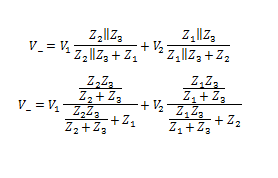
Two-line handwritten-style derivation of V_ = V1 (Z2||Z3)/(Z2||Z3 + Z1) + V2 (Z1||Z3)/(Z1||Z3 + Z2), followed by a rewritten form V_ = V1 (Z2Z3/(Z2+Z3))/(Z2Z3/(Z2+Z3) + Z1) + V2 (Z1Z3/(Z1+Z3))/(Z1Z3/(Z1+Z3) + Z2), with parallel combinations written as fractions.
 
cnh1995 said:
I think you are making it unnecessarily complicated. Just apply the cross multiplication rule to the denominator of each term separately. It is just one step and you'll be done.
Two equations for V_ written as sums of two terms: V_ = V1 (Z2||Z3)/(Z2||Z3+Z1) + V2 (Z1||Z3)/(Z1||Z3+Z2), then rewritten with nested fractions in Z1, Z2 and Z3.
Let the two terms be A and B.
So, V_=A+B
(I can't use LaTex on my phone, so this is the best format I can write in..)
Denominator of A is Z1+(Z2Z3)/(Z2+Z3)
=[Z1.(Z2+Z3)+Z2.Z3]/(Z2+Z3)
=[z1z2+z2z3+z1z3]/(z2+z3)
This is the denominator of A. Now write A and see what you can cancel out. It is one of the basic algebraic manipulations.
 
Wow. That's a lot of algebra.:))

If I might make a suggestion? If you begin with a nodal equation at the junction the whole thing becomes much more straightforward.
 
  • Like
Likes   Reactions: cnh1995
suv79 said:
yes please :)
Um, that was my suggestion...

Have you been introduced to node voltage analysis ("nodal analysis") method yet?
 
Good. Now since the whole thing is set equal to zero you can discard the denominator. With the numerator only now, expand the terms and then gather them by voltage variable. You should see daylight pretty quickly.