Undergrad Understanding Quantum Cascade Lasers

Click For Summary
Quantum cascade lasers operate by applying voltage across alternating layers of high- and low-bandgap materials, causing electrons to tunnel through quantum wells and barriers, which leads to photon emission. The band energy decreases with each layer due to this applied voltage, facilitating electron movement and energy loss in discrete amounts. The squiggly lines in diagrams represent electron wavefunctions and tunneling behavior. Population inversion occurs as electrons are pumped to higher energy levels, often involving phonon interactions. Understanding the bandgap differences between materials, such as InGaAs and AlInAs, is crucial for grasping the laser's operation.
Karl330
Messages
6
Reaction score
1
Hello I am struggling to understand the concept of Quantum cascade lasers. I am doing research on a 20 period In0.33Ga0.67As (3.1 nm)/Al0.90In0.10As (7.2 nm) superlattice and would like to fully understand how a quantum cascade laser works. I also have not taken quantum mechanics yet so I might be a little slow to understand. Here is the question

I keep seeing images like this for a quantum cascade laser. Why does the band energy (y-axis) go down for every layer as shown here and what do the squiggly lines mean (I know these are the electron wavefunctions but I'm not entirely sure I get what is going on)?
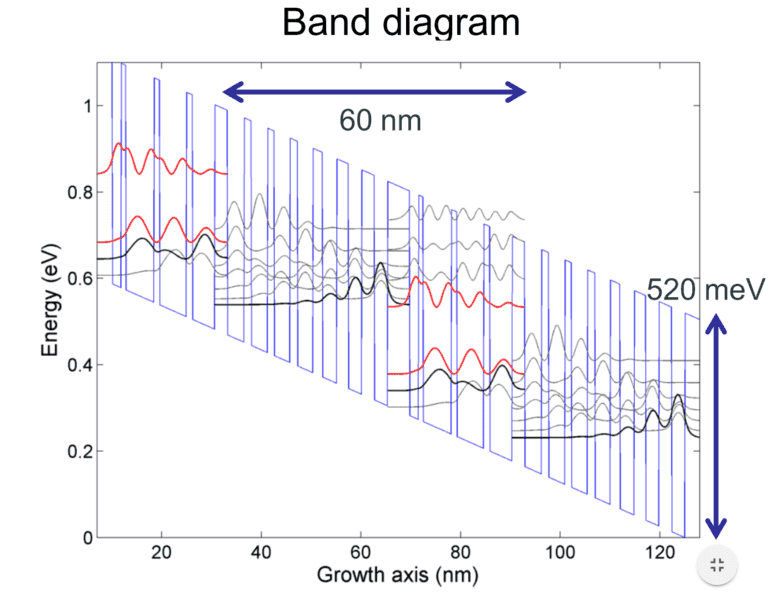
upload_2017-9-5_13-52-52.png


In addition to this how does population inversion happen with each active layer for each electron to get to the highest energy level. Is it some type of pumping from phonons?

Here is what a laser physics book says
The electron leaves the lowest subband by spatial escape to the neighboring conducting region.
 
Physics news on Phys.org
QC lasers are subtle beasts. Let's start with "Why does the band energy (y-axis) go down for every layer as shown here". The answer is that a voltage is applied across an alternating series of high- and low-bandgap materials. The squiggly lines represent electrons tunneling from one well to the next (intraband tunneling), losing energy in discrete amounts as it goes and emitting large numbers of (typically mid-wave IR) photons.

Does that help?
 
I understand that a voltage is applied which sends electrons tunneling through barriers and quantum wells but I am confused on what you mean by high and low bandgap materials. For example a 20 period In0.33Ga0.67As (3.1 nm)/Al0.90In0.10As (7.2 nm) is a superlattice that I am studying and I am confused on how the bandgap changes from layer to layer. I have found this online and also trying to understand it because I thought a quantum well was an area between two thin semiconducting material and here it just says the white InGaAs is a quantum well and the black AlInAs is a barrier.
?temp_hash=515144f176973886e3c339617a486b76.png
 
Karl330 said:
I understand that a voltage is applied which sends electrons tunneling through barriers and quantum wells but I am confused on what you mean by high and low bandgap materials. For example a 20 period In0.33Ga0.67As (3.1 nm)/Al0.90In0.10As (7.2 nm) is a superlattice that I am studying and I am confused on how the bandgap changes from layer to layer. I have found this online and also trying to understand it because I thought a quantum well was an area between two thin semiconducting material and here it just says the white InGaAs is a quantum well and the black AlInAs is a barrier.
View attachment 210434

Your InGaAs material has a bandgap energy of about 0.95 eV (http://www.batop.com/information/Eg_InGaAs.html), and your InAlAs badgap energy is about 1.5 eV. Does that help?
 
Time reversal invariant Hamiltonians must satisfy ##[H,\Theta]=0## where ##\Theta## is time reversal operator. However, in some texts (for example see Many-body Quantum Theory in Condensed Matter Physics an introduction, HENRIK BRUUS and KARSTEN FLENSBERG, Corrected version: 14 January 2016, section 7.1.4) the time reversal invariant condition is introduced as ##H=H^*##. How these two conditions are identical?

Similar threads

  • · Replies 2 ·
Replies
2
Views
3K
  • · Replies 3 ·
Replies
3
Views
2K
  • · Replies 2 ·
Replies
2
Views
2K
  • · Replies 15 ·
Replies
15
Views
4K
  • · Replies 5 ·
Replies
5
Views
2K
  • · Replies 4 ·
Replies
4
Views
3K
  • · Replies 3 ·
Replies
3
Views
5K
  • · Replies 16 ·
Replies
16
Views
2K
  • · Replies 1 ·
Replies
1
Views
2K
  • · Replies 5 ·
Replies
5
Views
2K