Understanding Refraction and Reflection in Silvered Lenses

  • Thread starter Thread starter dhtikna
  • Start date Start date
  • Tags Tags
    Lenses Optics
Click For Summary
SUMMARY

This discussion focuses on the optical behavior of silvered lenses, specifically addressing the refraction and reflection processes involved. The key formula presented is μ2/v - μ1/u = μ2-μ1/R, which relates to the refraction at the lens surfaces. Participants clarify that light refracts upon entering the lens, reflects off the silvered surface, and refracts again upon exiting. The confusion arises from the interpretation of refraction and reflection at the silvered surface, with emphasis on understanding the roles of refractive indices and distances in the context of lens optics.

PREREQUISITES
  • Understanding of lens optics, specifically refraction and reflection principles.
  • Familiarity with the formula μ2/v - μ1/u = μ2-μ1/R and its components.
  • Knowledge of refractive indices and their significance in optical media.
  • Basic concepts of light behavior at curved surfaces.
NEXT STEPS
  • Study the derivation and application of the lens maker's formula.
  • Explore the principles of ray tracing in optical systems.
  • Learn about the impact of silvering on lens performance and light behavior.
  • Investigate the differences between plano-convex and concave lenses in terms of refraction and reflection.
USEFUL FOR

Students of optics, optical engineers, and anyone interested in the detailed behavior of light in silvered lenses will benefit from this discussion.

dhtikna
Messages
4
Reaction score
0
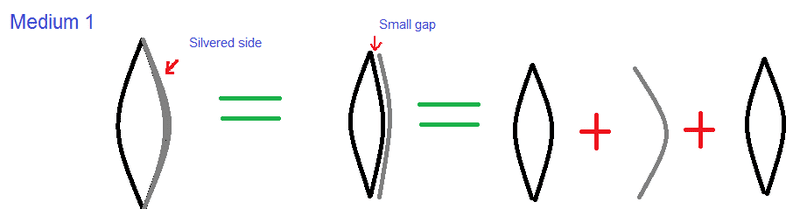
When dealing with lenses which have one curved/flat surface silvered why do we consider light to refract twice before hitting the silver side? This diagram should show what i mean:
2e54f2e.png


The way it appears to me is that after light enters the un-silvered surface it refracts then it does not refract but directly hits the silver surface and reflects. In this case we need to use the following formula:

μ2/v - μ1/u = μ21/R

at the two refractions, instead of the lens formula. What's wrong in my thinking?

P.S. This is my first post, sorry that i didn't use the template, i don't see how i can format my question like that
 
Physics news on Phys.org
The light must come back through the lenses after reflection, refracting a second time. You formula is not very helpful since you did not explain the meaning of the symbols. I can't tell whether it's correct or not. what's μ1? What's μ2? What's v? What's u? What's R?
 
sorry,
μ = refractive index on medium
u = object distance
v = image distance
r = radius of curvature of spherical surface

Let me rephrase my question:

For a lens:
Refraction at first surface follow by refraction on second surface;
For a silver lens:
What i have been taught:
Refraction at first surface,again refraction at the second surface(which has been painted with silver),reflection at the second surface,refraction at second surface and finally refraction at first surface

But it look like to me that at the second surface ONLY reflection should take place no refraction

P.S. Can't you edit the original post?
 

Similar threads

  • · Replies 15 ·
Replies
15
Views
2K
  • · Replies 3 ·
Replies
3
Views
1K
  • · Replies 3 ·
Replies
3
Views
1K
  • · Replies 1 ·
Replies
1
Views
4K
Replies
1
Views
2K
  • · Replies 1 ·
Replies
1
Views
2K
  • · Replies 5 ·
Replies
5
Views
5K
  • · Replies 1 ·
Replies
1
Views
2K
  • · Replies 3 ·
Replies
3
Views
1K
  • · Replies 2 ·
Replies
2
Views
2K