Understanding Resonance in AC Circuits

Click For Summary

Discussion Overview

The discussion revolves around understanding resonance in AC circuits, focusing on the mathematical expressions related to impedance and the conditions for resonance. Participants are sharing their attempts at solutions, discussing the presentation of their work, and addressing issues with image clarity and readability.

Discussion Character

  • Technical explanation
  • Debate/contested
  • Homework-related

Main Points Raised

  • One participant attempts to provide a solution but notes issues with image quality in their post.
  • Another participant suggests using LaTeX for better presentation and clarity, emphasizing the importance of clear images and readable handwriting.
  • There are multiple expressions for the imaginary part of impedance, with one participant simplifying it to a specific condition for resonance.
  • Participants express difficulty in deciphering handwritten work and suggest improvements for future posts.
  • One participant acknowledges their inexperience with LaTeX and expresses a willingness to learn for better presentation.

Areas of Agreement / Disagreement

Participants generally agree on the need for clearer presentation of work, but there is no consensus on the specific mathematical expressions or the best approach to solving the problem at hand.

Contextual Notes

Limitations include the unclear presentation of mathematical expressions and the reliance on handwritten notes, which may hinder understanding and discussion.
Toky
Messages
3
Reaction score
1
Homework Statement
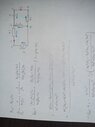
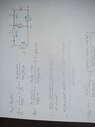
Hello. So, I have an AC circuit in front of me. What I need to do is pull out the formula for inductance of the inductor as L = f(C, R2, w0) and w0 =f(C, R2, L) by calculating the total impedance of the circuit. It's a voltage resonance example so it is supposed to be done by using the term Im(Z)=0. I'm not sure if I did it correctly so I'm asking for help.
Relevant Equations
XL = w0*L
XC = 1/(w0*C)
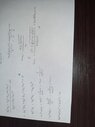
Here's my attempt at a solution.
 

Attachments

  • IMG-20210714-WA0009.jpeg
    IMG-20210714-WA0009.jpeg
    28.3 KB · Views: 196
  • IMG-20210714-WA0009.jpeg
    IMG-20210714-WA0009.jpeg
    28.3 KB · Views: 180
Physics news on Phys.org
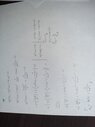
For some reason, some of the images didn't load properly while constructing the thread, so I'm leaving the full solution in the replies.
 

Attachments

  • IMG-20210714-WA0009.jpeg
    IMG-20210714-WA0009.jpeg
    28.3 KB · Views: 168
  • IMG-20210714-WA0010.jpeg
    IMG-20210714-WA0010.jpeg
    28.7 KB · Views: 185
  • IMG-20210714-WA0011.jpeg
    IMG-20210714-WA0011.jpeg
    27.5 KB · Views: 188
  • IMG-20210714-WA0012.jpeg
    IMG-20210714-WA0012.jpeg
    21 KB · Views: 209
Well, the images are coming out small, dim and sideways. It's better to post a PDF file attachment showing the problem statement, and type your work into the forum using LaTeX. See the LaTeX Guide link in the lower left of the Edit window.

While you are learning LaTeX, can you at least post much better/bigger versions of the schematic drawings and separately post pictures of your work? Be sure to post them upright instead of sideways, and when you attach them, select "Full Size" instead of "Thumbnail". Thanks.
 
  • Like
Likes   Reactions: Toky, hutchphd and SammyS
Hard to "decipher" your hand writing. I can only tell you what I get. I get a quite complex expression for Im(Z), but at the end of the day the condition ##Im(Z)=0## simplifies to $$L=C(\frac{1}{C^2\omega^2}+R_2^2)$$ from which I get that $$\omega=\frac{1}{\sqrt{C(L-CR_2^2)}}$$
 
Delta2 said:
Hard to "decipher" your hand writing. I can only tell you what I get. I get a quite complex expression for Im(Z), but at the end of the day the condition ##Im(Z)=0## simplifies to $$L=C(\frac{1}{C^2\omega^2}+R_2^2)$$ from which I get that $$\omega=\frac{1}{\sqrt{C(L-CR_2^2)}}$$
Yeah, I cleaned up his last page, and his final result for L looks similar to yours. Can you tell if it is the same? Also, did he work out the expression for ##\omega## ?

1626358065604.png


dim_sideways last page.jpg
 
Last edited:
berkeman said:
Well, the images are coming out small, dim and sideways. It's better to post a PDF file attachment showing the problem statement, and type your work into the forum using LaTeX. See the LaTeX Guide link in the lower left of the Edit window.

While you are learning LaTeX, can you at least post much better/bigger versions of the schematic drawings and separately post pictures of your work? Be sure to post them upright instead of sideways, and when you attach them, select "Full Size" instead of "Thumbnail". Thanks.
I apologise if I've caused any anger or inconveniences. All of my professors ask for 100% hand-written assignments, probably because I'm still only on the 1st year of college, so I never even tried writing in LaTeX, or anything similar, though it seems very convenient. I'll try to learn is ASAP, thanks for the kind advice.
 
  • Like
Likes   Reactions: berkeman
Toky said:
I apologise if I've caused any anger or inconveniences. All of my professors ask for 100% hand-written assignments, probably because I'm still only on the 1st year of college, so I never even tried writing in LaTeX, or anything similar, though it seems very convenient. I'll try to learn is ASAP, thanks for the kind advice.
It's really about making your work easy to read. Good handwriting and good photos are also OK.

LaTeX isn't necessary, but it is an good way to solve the readability problem. Whether it's here, in school, or in your career, you'll get better results if you make it easy for the people reviewing your work. Look at your posts and imagine that it's you that is being asked to help out; how much effort is in helping, and how much in reading the question.

It isn't unusual for me, and I suspect others, to simply not comment on a thread that I could help with because it's just too hard to figure out the information I need to assist.
 
  • Like
Likes   Reactions: Toky

Similar threads

  • · Replies 7 ·
Replies
7
Views
2K
  • · Replies 2 ·
Replies
2
Views
1K
  • · Replies 4 ·
Replies
4
Views
2K
  • · Replies 8 ·
Replies
8
Views
3K
  • · Replies 26 ·
Replies
26
Views
3K
  • · Replies 6 ·
Replies
6
Views
4K
  • · Replies 4 ·
Replies
4
Views
1K
  • · Replies 5 ·
Replies
5
Views
3K
  • · Replies 27 ·
Replies
27
Views
4K
  • · Replies 1 ·
Replies
1
Views
2K