Understanding Reynold's Number & Characteristic Length

  • Thread starter Thread starter nanunath
  • Start date Start date
  • Tags Tags
    Reynold's number
Click For Summary

Discussion Overview

The discussion revolves around the concept of Reynolds Number and the determination of characteristic length in fluid dynamics, particularly in the context of flow through pipes and heat exchangers. Participants explore the implications of choosing different characteristic lengths and their effects on the classification of flow types (laminar, transient, turbulent).

Discussion Character

  • Exploratory
  • Technical explanation
  • Debate/contested
  • Mathematical reasoning

Main Points Raised

  • Some participants express confusion about how to choose the characteristic length for different flow scenarios, noting that it is often conventionally defined but can vary.
  • There is a discussion about the implications of using diameter versus radius as the characteristic length, with some arguing that using radius would introduce a factor of two difference in calculations.
  • Participants mention that the choice of characteristic length does not change the physics of the flow but is necessary for non-dimensionalization.
  • One participant questions why the outer diameter of tubes is used for calculating Reynolds Number in shell and tube heat exchangers, suggesting that it relates to the geometry of the flow.
  • Concerns are raised about the applicability of standard Reynolds Number criteria for classifying flow types when using non-conventional characteristic lengths.
  • Some participants suggest that experimental methods or computational fluid dynamics (CFD) could be used to determine flow characteristics for non-standard cases.
  • There is a discussion about how flow patterns can help identify flow types, with laminar flow exhibiting a parabolic velocity distribution.

Areas of Agreement / Disagreement

Participants generally agree that the choice of characteristic length can vary and that it is important for non-dimensionalization. However, there is no consensus on the best approach to determine characteristic length in all scenarios, and multiple competing views remain regarding its implications on flow classification.

Contextual Notes

The discussion highlights the ambiguity in defining characteristic length and its dependence on the specific flow geometry. There are unresolved questions about how to apply standard Reynolds Number criteria to non-standard cases and the effects of using different characteristic lengths on flow classification.

Who May Find This Useful

This discussion may be useful for students and professionals in fluid dynamics, mechanical engineering, and related fields who are exploring the implications of Reynolds Number and characteristic length in various flow scenarios.

nanunath
Messages
68
Reaction score
0
Hello...
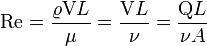
Reynold's Number is given by:
ac2c887be96d0bf8650dc466333d9727.png


where:
is the mean fluid velocity (SI units: m/s)
L is a length of the object that the flow is going through or around (m)
μ is the dynamic viscosity of the fluid (Pa·s or N·s/m² or kg/m/s)
ν is the kinematic viscosity (ν = μ / ρ) (m²/s)
is the density of the fluid (kg/m³)
Q is the volumetric flow rate (m³/s)
A is the pipe cross-sectional area (m²)
{Taken from wikipedia:http://en.wikipedia.org/wiki/Reynolds_number" }

What I don't get is "Characteristic Length"...how do I decide it for a particular flow??
Wikipedia says its just conventionally taken..diff people can take diff chacteristic lengths...
Why??How?

-----------------------------------------------------------------------------------------

Also...does choice of characteristic length have any connection with the nature of viscous forces...if yes how?
Plz help me on this ... I have bee through few boooks ... but unable to understnd how to decide the "Characteristic length"...I mean why we should take "diameter" only for a tube...why not radius??..and if I take radius[the non-conventional way]...what is the effect...what am I exactly doin?

-----------------------------------------------------------------------------------------

Thirdly...
For a shell and tube heat exchanger ...how do I decide the characteristic length...because I had been through a paper on Shell and tube Heat exchangers..in which the Reynold's number[Shell side flow!] is given by:
Re=[density]*[mean velocity of flow]*[outer diameter of tubes!{not the shell!...why?}]/[mu]

Why is that the tubes outer diameter is considered for the shell side flow??
----------------------------------------------------------------------------------------

In short my main question is : "How to decide the most suitable Characteristic Length"...
Plz help me on Heat exchanget question also...

Lastly:
Any views are most welcome...waiting for your relpies...
Thankssss in advance!
 
Last edited by a moderator:
Engineering news on Phys.org
There is some ambiguity in choosing L, but in any context where the value of Re is used, the symbol should be defined. Since flow in circular pipes is so common, you can assume they always mean the diameter in this context. Obviously, if you used the radius, you would be off by a factor of 2. There is no reason that the diameter is better than the radius, if the radius was the convention, then things like the onset of turbulent flow would just be a factor of two different.

There are definitely situations you could imagine where it is not at all clear what to choose. If there is some formula for such a situation that uses Re, it must define what L is or the formula is not useful.

Still, most of the time you can figure out what L should be to within a factor of 2. Generally, there is some characteristic length for the geometry where the flow occurs. If there is a sphere in a large channel, it is the diameter of the sphere. It there is a narrow duct, where one dimension of the duct (perpendicular to the flow) is much much larger than the other, it is the smaller dimension.
 
Characteristic length can be anything you want. It doesn't change the physics of the flow. You need a length when nondimensionalizing. It doesn't matter what characteristic length is used. If you're using performance data from a table, you have to use their convention of characteristic length for the data to be physically meaningful.
 
Thanks a lot Cyrus & LeonhardEuler!..:smile:..

Characteristic length can be anything you want. It doesn't change the physics of the flow. You need a length when nondimensionalizing. It doesn't matter what characteristic length is used. If you're using performance data from a table, you have to use their convention of characteristic length for the data to be physically meaningful

Thanks...that definitely answers my "Heat exchanger" question...
In fact that also tells why mostly a certain dimension is used as a characteristic length...

Generally, there is some characteristic length for the geometry where the flow occurs. If there is a sphere in a large channel, it is the diameter of the sphere. It there is a narrow duct, where one dimension of the duct (perpendicular to the flow) is much much larger than the other, it is the smaller dimension

Thanks...
I think I get the point...
but would really be happy if you guide me as to if "Viscous forces" play a role here...
please.gif


Thanks a lot...:smile:
 
Last edited:
The role of viscos forces depends on the Reynolds number and the setup.
 
Hmmm...thanks a lot once again...Cyrus...:smile:

I think this is going to be my last question on this:...
Question:
So when we learn from textbooks that the flow is laminar when Re is less than 2000...similarly the transient and turbulent flow ranges for Re...
What are the restrictions on using the above stated criteria for identifying a flow as laminar/transient/turbulent...[I think that range is specified for flow through pipe only..with diameter as characteristic length but not so sure...so please correct me]
as if I choose a certain characteristic length the non-conventional way this range for classifying the type of flow ,it won't be necessarily true...Right?..[It may sound dumb..and I'm so sorry for that...:shy:]

Also...
If I'm calculating Re for some non common,non standard case...like shell side flow through a Shell-and-Tube-Heat-exchanger with a completely new type of baffle...that means...this flow is going to have its own range of Re for classifying it into 1 of the 3 types of flow...so How do I decide this range for Laminar,transient,laminar flows for my non-standard case?...:confused:
 
Last edited:
nanunath said:
Hmmm...thanks a lot once again...Cyrus...:smile:

I think this is going to be my last question on this:...
Question:
So when we learn from textbooks that the flow is laminar when Re is less than 2000...similarly the transient and turbulent flow ranges for Re...
What are the restrictions on using the above stated criteria for identifying a flow as laminar/transient/turbulent...[I think that range is specified for flow through pipe only..with diameter as characteristic length but not so sure...so please correct me]

You answered your own question.

as if I choose a certain characteristic length the non-conventional way this range for classifying the type of flow ,it won't be necessarily true...Right?..[It may sound dumb..and I'm so sorry for that...:shy:]

Right.

Also...
If I'm calculating Re for some non common,non standard case...like shell side flow through a Shell-and-Tube-Heat-exchanger with a completely new type of baffle...that means...this flow is going to have its own range of Re for classifying it into 1 of the 3 types of flow...so How do I decide this range for Laminar,transient,laminar flows for my non-standard case?...:confused:

Experiment or CFD (If this setup has never been done before)

You need to realize that the Re number is really just a nondimensionalization. That is to say, it has existence but not uniqueness. Look at the case of a pipe:

Re < 2000 = \frac{\rho V D}{\mu}

if we use a different characteristic length (holding all else constant), then the flow with this characteristic length will be laminar provided:

Re < 2000 \frac{D_{new}} {D}
 
Last edited:
Exactly...thats what I had thought of..[thanks to you!]...:smile:
So that means...
Laminar/turbulent/transient flow will be decided by observing the flow patterns...
Like...if its through a circular pipe...the velocity distribution will be parabolic in laminar flow ...that would decide the range of the non-conventional Re calculated for Laminar flow...followed by transient..then turbulent...right??
Which more factors [like velocity above]...would help me in deciding these ranges for Re?...:confused:
 
Last edited:
nanunath said:
Exactly...thats what I had thought of..[thanks to you!]...:smile:
So that means...
Laminar/turbulent/transient flow will be decided by observing the flow patterns...
Like...if its through a circular pipe...the velocity distribution will be parabolic in laminar flow ...that would decide the range of the non-conventional Re calculated for Laminar flow...followed by transient..then turbulent...right??
Which more factors [like velocity above]...would help me in deciding these ranges for Re?...:confused:

I think you need to go back and reread what I wrote.
 
  • #10
Ya...I Re-read it...
I understood that we got to use CFD[/experiment] for that...
But I don't know what CFD exactly does...so could you please tell me very specifically what factors [Which results from CFD...very specifically]...would help me in concluding about the type of flow...followed by range of Re??

[It may sound that I'm asking repeated questions...but I'm doing so to get rid of the slimmest chance of interpreting your well-thought statements in the wrong way...I think]

I hope that question wasn't dumb enough..if it is..I'm sorry once again!
 
  • #11
I don't think you caught on to what I was saying. If you use a different characteristic length, then transition will occur at a different Reynolds number. The only reason why this transition number is different is because of the difference in chracteristic length that was used. The difference is the ratio I gave above.

CFD and/or experiment is used when you don't already have data to look up. http://en.wikipedia.org/wiki/Computational_fluid_dynamics" solves for the flow. If you care about transition and boundary layers, you have to look at the time histories of the pressure at the walls. If they vary with time the boundary layer is turbulent. If they are constant, the boundary layer is laminar because the flow has low shear stresses.

Which book are you using for fluid dynamics? This should all be in there if your trying to do any kind of fluid analysis.
 
Last edited by a moderator:
  • #12
If you care about transition and boundary layers, you have to look at the time histories of the pressure at the walls. If they vary with time the boundary layer is turbulent. If they are constant, the boundary layer is laminar because the flow has low shear stresses

Thanks..thats what I was seeking for...:smile:
I have used some local book for our subject "Fluid Mechanics" Academic course...but this all wasn't mentioned in there...the only thing I remember that was stressed on in that book was Re expressed in the form of Inertia force/Viscous force...and velocity distribution in laminar flows...and some standard experimental relations for turbulent flow...
whats more surprising is that it never mentioned anything of Re having no physical significance actually...nothing of the things you about Re you enlightened upon me ...was mentioned in there...

Anyways..can you please recommend me a good Fluid Dynamics book...I think my book doesn't have all this...probably because the syllabus didnt have it[it was a local book specially compiled for our university syllabus]

If you use a different characteristic length, then transition will occur at a different Reynolds number. The only reason why this transition number is different is because of the difference in chracteristic length that was used. The difference is the ratio I gave above.
I think..I did get that ... u explained that from your very first reply very clearly...Thanksss...:smile:

Thanks a lot ...for all your help...
notworthy.gif
 
  • #13
nanunath said:
Thanks..that what I was seeking for...:smile:
I have used some local book for our subject "Fluid Mechanics" Academic course...but this all wasn't mentioned in there...the only thing I remember that was stressed on in that book was Re expressed in the form of Inertia force/Viscous force...and velocity distribution in laminar flows...and some standard experimental relations for turbulent flow...
whats more surprising is that it never mentioned anything of Re having no physical significance actually...nothing of the things you about Re you enlightened upon me ...was mentioned in there...

Anyways..can you please recommend me a good Fluid Dynamics book...I think my book doesn't have all this...probably because the syllabus didnt have it[it was a local book specially compiled for our university syllabus]I think..I did get that ... u explained that from your very first reply very clearly...Thanksss...:smile:

Thanks a lot ...for all your help...
worthy.gif

Get https://www.amazon.com/gp/product/0470067225/?tag=pfamazon01-20 book.
 
Last edited by a moderator:
  • #14
Just for semantics here, since we're discussing the importance of specifying the characteristic length. Nanunath, when we write Reynolds number, both the capital R and lower case e are regular script. The subscript used then is often used to denote the characteristic length used. For example:
<br /> \begin{equation}<br /> \begin{split}<br /> Re_l &amp;= \frac{Vl}{\nu} \\<br /> Re_D &amp;= \frac{VD}{\nu}<br /> \end{split}<br /> \end{equation}<br />
...just something that was slightly bothering me.
 
  • #15
Thanks for correcting me..mginger...
Ok..I think that brings the thread to an end...
Final thanks to Cyrus..for valuble help...
 

Similar threads

  • · Replies 10 ·
Replies
10
Views
3K
  • · Replies 1 ·
Replies
1
Views
1K
Replies
14
Views
6K
  • · Replies 2 ·
Replies
2
Views
8K
Replies
6
Views
16K
  • · Replies 17 ·
Replies
17
Views
5K
  • · Replies 2 ·
Replies
2
Views
3K
  • · Replies 5 ·
Replies
5
Views
2K
  • · Replies 7 ·
Replies
7
Views
10K
  • · Replies 2 ·
Replies
2
Views
2K