Understanding rigid-body equilibrium problem

Click For Summary

Homework Help Overview

The discussion revolves around a rigid-body equilibrium problem involving forces acting on a metal pole and the interpretation of a diagram related to the problem. Participants are exploring the components of reaction forces and the implications of the problem's setup.

Discussion Character

  • Conceptual clarification, Assumption checking, Mixed

Approaches and Questions Raised

  • Participants discuss the meaning of vertical and horizontal components of reaction forces, question the necessity of trigonometry for solving the problem, and explore the implications of the problem's wording regarding the height of a nail.

Discussion Status

The conversation includes clarifications about the components of forces and the interpretation of the problem's requirements. Some participants express uncertainty about the information provided and its sufficiency for solving specific parts of the problem, while others suggest that certain aspects can be approached without trigonometry.

Contextual Notes

There is a noted ambiguity regarding the height of the nail and the direction of forces, which some participants believe could have been clarified in the problem statement. The choice of angle in the problem is also discussed as a potential simplification for calculations.

Kolika28
Messages
146
Reaction score
28
Homework Statement
I don't understand the forces ## F_h## and ##F_v##
Relevant Equations
##\sum F_x=0##
##\sum F_y=0##
##\sum \tau =0##
So I have this problem
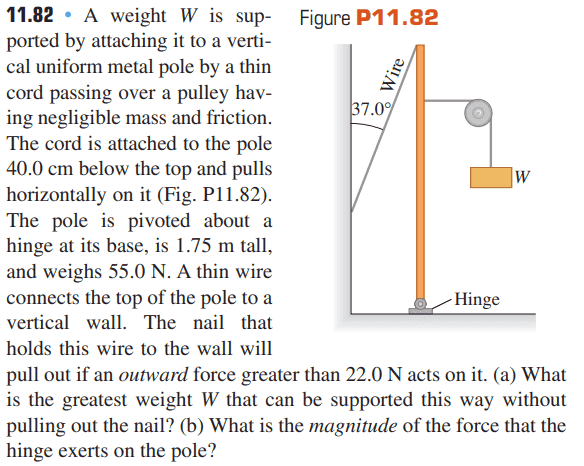
1591197597563.png

The soultion to the problem gives me this drawing
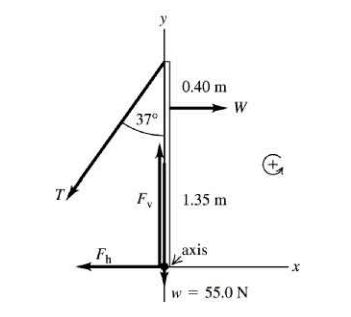
1591197708186.png

But I don't understand what ##F_h## and ##F_v## is
 
  • Like
Likes   Reactions: Delta2
Physics news on Phys.org
Those are the vertical and horizontal components of the reaction force that the pivot exerts over the the metal pole.
 
  • Like
Likes   Reactions: Delta2 and Kolika28
Ohh, that makes sense! Thank you so much!
 
This can be solved without trigonometry.
 
Halc said:
This can be solved without trigonometry.
... except to find the height of the nail?

Btw, @Kolika28 , problem setters often choose 37 degrees because it is a close approximation to an angle in a 3,4,5 triangle. Knowing that will make the trig trivial.
 
  • Like
Likes   Reactions: Lnewqban
haruspex said:
... except to find the height of the nail?
They don't ask for the height of the nail, and don't give enough information to compute it if they did ask, but I still stand corrected.
Part (a) does not require trig but computing fV, part of the (b) answer requires a bit of trig, which as you point out, can be done in your head due to the choice of angle.
 
Halc said:
They don't ask for the height of the nail, and don't give enough information to compute it
You’re right, there's not enough information for that, which means I misinterpreted "outward" force. I would have banged the nail in pointing up into the wall, but then the question would would make no sense, so I took it to be horizontal. Outward from the wall is then also horizontal, but then you would need to be able to find the height of the nail.
This leaves only that the nail was inserted in the same straight line as the cable. Not only is that an incompetent installation, but the question could simply have specified a maximum tension in the cable and avoided the ambiguity.
 
Kolika28 said:
Ohh, that makes sense! Thank you so much!
You are welcome :smile:
 

Similar threads

  • · Replies 3 ·
Replies
3
Views
2K
  • · Replies 10 ·
Replies
10
Views
2K
  • · Replies 14 ·
Replies
14
Views
2K
Replies
4
Views
2K
  • · Replies 2 ·
Replies
2
Views
5K
  • · Replies 7 ·
Replies
7
Views
1K
  • · Replies 19 ·
Replies
19
Views
2K
Replies
6
Views
2K
  • · Replies 6 ·
Replies
6
Views
3K
  • · Replies 13 ·
Replies
13
Views
2K