Understanding Scattered Radiation in Photon Beams

Click For Summary
SUMMARY

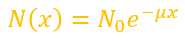
This discussion focuses on the concept of "scattered radiation" in photon beams, specifically in the context of interactions with materials. The primary interactions identified include the photoelectric effect, Compton effect, pair production, and coherent scattering, all contributing to scattered radiation. The attenuation coefficient (μ) is crucial for calculating the number of photons passing through a material without interaction, represented by the formula N(x) = N₀e^{-μx}. For accurate estimates of total photon counts, including scattered radiation, correction terms must be applied, and simulations using Geant4 software are recommended for detailed analysis.

PREREQUISITES
  • Understanding of photon interactions, including photoelectric effect, Compton effect, pair production, and coherent scattering.
  • Familiarity with the attenuation coefficient (μ) and its dependence on photon energy.
  • Basic knowledge of exponential decay formulas in physics.
  • Experience with simulation software, specifically Geant4.
NEXT STEPS
  • Research the Geant4 simulation toolkit for modeling photon interactions in materials.
  • Study the mathematical derivation and applications of the attenuation coefficient (μ) in radiation physics.
  • Explore advanced topics in photon scattering and its implications in medical imaging and radiation therapy.
  • Learn to use LaTeX for writing scientific equations and enhancing clarity in technical discussions.
USEFUL FOR

Physicists, medical imaging professionals, radiation safety officers, and anyone involved in the study or application of photon interactions and radiation transport in materials.

eneacasucci
Messages
69
Reaction score
18
TL;DR
scattered radiation of photons when passing through a material
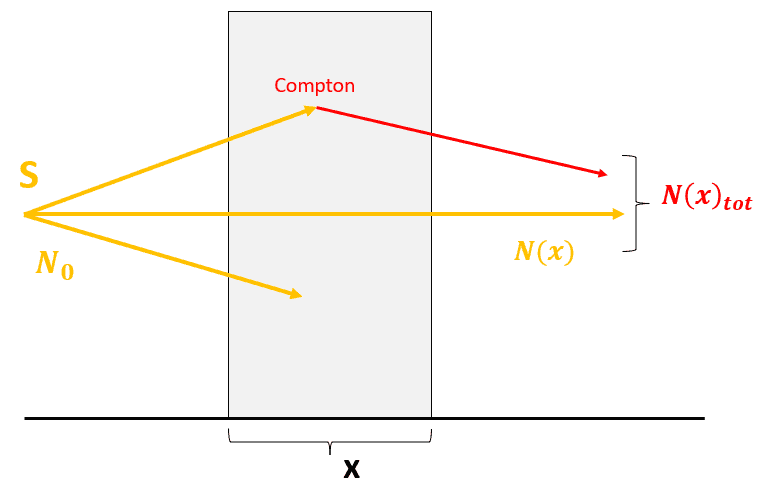
Consider a source emitting a beam of photons. These photons pass through x thickness of material. The attenuation coefficient of the beam \mu is known.
We can write this formula
1683192752250.png

1683189958516.png

If I'm not wrong, this formula tells us the number of photons that passed through the material of thickness x without interacting with it (
1683190403717.png
), but it does not tell us the "real" total number of photons that we should expect to see beyond this material (
1683190424672.png
) given by the sum of the first ones and the "scattered radiation".
My question is about what do we mean with "scattered radiation"?.
This is what I think about: "scattered radiation" are the photons resulting from the interaction of the primary beam with matter, that can happen in these ways:
1)photoelectric effect: with characteristic x-ray emission
2)Compton effect: in which the original photon loses energy, which is transferred to an electron
3)pair production: in which additional photons may be emitted if positron-electron annihilation occurs
4)coherent scattering: photon undergoes deflection but does not lose energy


Are these photons (1,2,3,4) the ones constituting the so-called "scattered radiation"? is there something else?P.S. To get a correct estimate of the photons passing through the material, thus also considering scattered photons, I should add a correction term, how is it estimated?
 
Last edited:
Physics news on Phys.org
There is also possibility of no interaction at all, right?
 
  • Like
Likes   Reactions: eneacasucci
malawi_glenn said:
There is also possibility of no interaction at all, right?
Yes I think so, as I've written, the number of photons that pass through the material without interacting should be given by this formula
1683192734489.png
 
That formula does not take into account "rescattering" because it is assumed that the in coming radiation is monoenergetic. Keep in mind that ##\mu## depends on the photon energy. For a more detailed treatment you need to perform simulations use e.g. Geant4 software
 
@eneacasucci, could you please use Latex for your equations instead of embedding images? For example ##N(x)=N_0e^{-\mu x}## - there’s a Latex guide linked right below where you type posts/replies.
 
  • Like
Likes   Reactions: eneacasucci
malawi_glenn said:
That formula does not take into account "rescattering" because it is assumed that the in coming radiation is monoenergetic. Keep in mind that ##\mu## depends on the photon energy. For a more detailed treatment you need to perform simulations use e.g. Geant4 software
yes sure, ##\mu## depends on the energy of the photon.
Could I ask if it is possible to have an answer for the green questions in the original post? :) thank you so much for your time
 
Last edited:
  • Like
Likes   Reactions: vanhees71
Nugatory said:
@eneacasucci, could you please use Latex for your equations instead of embedding images? For example ##N(x)=N_0e^{-\mu x}## - there’s a Latex guide linked right below where you type posts/replies.
Unfortunately I can't edit my original post but I'll try to write everything in latex in future messages and posts, sorry
 
  • Like
Likes   Reactions: berkeman
eneacasucci said:
Yes I think so, as I've written, the number of photons that pass through the material without interacting should be given by this formula
1683192734489-png.png
This follows from assuming that any "scattering" removes the particle from the incident beam, never to be seen again. This is often a good approximation for open geometries and collimated beams. Also it is very easy to apply.
Particles being returned to the beam after repeat scattering are rare although some devices (lasers for instance) rely on this effect , so you need to understand the system. These problems are typically much more difficult to calculate.
 
  • Like
Likes   Reactions: vanhees71 and eneacasucci
eneacasucci said:
Unfortunately I can't edit my original post but I'll try to write everything in latex in future messages and posts, sorry
That's good enough, no problem.
 

Similar threads

  • · Replies 21 ·
Replies
21
Views
3K
  • · Replies 1 ·
Replies
1
Views
3K
  • · Replies 4 ·
Replies
4
Views
1K
  • · Replies 2 ·
Replies
2
Views
2K
  • · Replies 5 ·
Replies
5
Views
4K
  • · Replies 3 ·
Replies
3
Views
1K
  • · Replies 1 ·
Replies
1
Views
2K
  • · Replies 25 ·
Replies
25
Views
13K
  • · Replies 52 ·
2
Replies
52
Views
6K
  • · Replies 8 ·
Replies
8
Views
3K