Understanding the Dynamics of Acceleration in the Wedge Problem

  • Thread starter Thread starter vaibhav garg
  • Start date Start date
  • Tags Tags
    Dynamics Wedge
Click For Summary

Homework Help Overview

The discussion revolves around the dynamics of acceleration in a wedge problem involving two masses, M and m, where M is a wedge moving horizontally and m is a block sliding down the wedge. Participants are analyzing the relationships between the accelerations of these masses in different directions and questioning their assumptions regarding the setup.

Discussion Character

  • Exploratory, Assumption checking, Mathematical reasoning

Approaches and Questions Raised

  • Participants explore the relationship between the accelerations of the block and the wedge, questioning how to derive the acceleration of m with respect to the ground. They discuss different components of acceleration and how they relate to each other, including horizontal and vertical components.

Discussion Status

There is an ongoing exploration of the relationships between the accelerations, with some participants suggesting that the accelerations are equal while others express uncertainty about their calculations. Multiple interpretations of the problem are being discussed, and participants are sharing their results and questioning potential errors in the problem statement.

Contextual Notes

Participants note the complexity of the problem due to the movement of the wedge and the block's motion along it, which leads to discussions about the implications of these movements on the accelerations involved. There are mentions of potential typos in the problem text that could affect the interpretations.

vaibhav garg
Messages
16
Reaction score
0
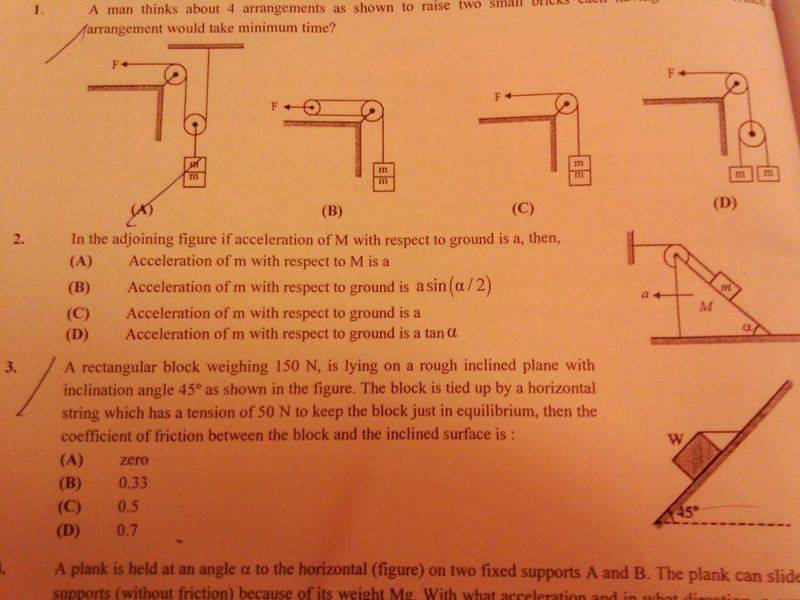
In the adjoining figure if acceleration of M with respect to ground is a, then
A) Acceleration of m with respect to M is a
B) Acceleration of m with respect to ground is asin(α/2)
C) Acceleration of m with respect to ground is a
D) Acceleration of m with respect to ground is atan(α)

The 2nd question in the image below
IMG_20160406_231223460.jpg

The acceleration of m in the vertical direction should be atan(α) by using length constant relation and in the horizontal direction it should be same as the wedge that is a. therefore the resultant should be asec(α), what am i doing wrong here ?
 
Last edited:
Physics news on Phys.org
vaibhav garg said:
In the adjoining figure if acceleration of M with respect to ground is a, then
A) Acceleration of m with respect to M is a
B) Acceleration of m with respect to ground is asin(α/2)
C) Acceleration of m with respect to ground is a
D) Acceleration of m with respect to ground is atan(α)

The 2nd question in the image below
View attachment 98702
The acceleration of m in the vertical direction should be atan(α) by using length constant relation and in the horizontal direction it should be same as the wedge that is a. therefore the resultant should be asec(α), what am i doing wrong here ?
Are you sure? The wedge moves horizontally and the block slides down along it, so it moves both horizontally and vertically with respect to the ground.
 
ok I get what you are saying, so if we take A to be the acceleration of the block wrt to M. therefore it's acceleration with respect to the ground will be
(a - Acosα) horizontally and Asinα vertically. But now how do I find a relation between A and a
 
vaibhav garg said:
ok I get what you are saying, so if we take A to be the acceleration of the block wrt to M. therefore it's acceleration with respect to the ground will be
(a - Acosα) horizontally and Asinα vertically. But now how do I find a relation between A and a
If the wedge moves by x to the left, the length of the rope between the wall and pulley becomes shorter by x.So the other piece along the wedge becomes longer by the same length x. What does it mean for the accelerations a and A?
 
that they are both equal. so when we add the the two components it would give the answer to be B. Thanks ehlid :)
 
vaibhav garg said:
that they are both equal. so when we add the the two components it would give the answer to be B. Thanks ehlid :)
I got a bit different result, but it might have been my error, or a typo in the problem text. Show your work, please.
 
the horizontal component would be (a-acosα) which is equal to 2asin2α/2 the vertical component 2asin(α/2)cos(α/2) the resultant would be 2asin(α/2)... I am sorry :P but this doesn't matches any of the options
 
I got the same result, and I do not see any flaw. Sometimes there are typos in the written texts.
 

Similar threads

  • · Replies 37 ·
2
Replies
37
Views
3K
Replies
3
Views
2K
  • · Replies 2 ·
Replies
2
Views
2K
  • · Replies 13 ·
Replies
13
Views
6K
  • · Replies 24 ·
Replies
24
Views
4K
  • · Replies 4 ·
Replies
4
Views
2K
  • · Replies 4 ·
Replies
4
Views
2K
Replies
13
Views
2K
  • · Replies 1 ·
Replies
1
Views
2K