Swamp Thing
- 1,075
- 841
Ref: https://s3.wp.wsu.edu/uploads/sites/44/2015/12/VortexTubeOptimizationTheory.pdf
The above paper says that the initial separation of hot and cold air is complete once the flow is partly deflected backwards at the left hand side (HOT) end. See Fig. 1 in the paper.
It also says that the further interaction of the two streams is actually undesirable, and that one would want that process to be like a "weak" or "bad" heat exchanger. So ideally we would want the cooled air (inner stream) to make its way back to the right hand side (COLD) end without any interaction with the outer stream.
So the process of returning the cold air to the right hand side, passing all the way through the tube, actually degrades the performance due to unwanted heat exchange between the inner and outer streams. This idea is elaborated in Fig. 3 of the paper.
My first question is -- is it true that the actual cooling of the cold stream happens entirely during the inward / backward deflection at the far end of the tube, and that all further interaction between the streams is merely an undesired dilution of performance?
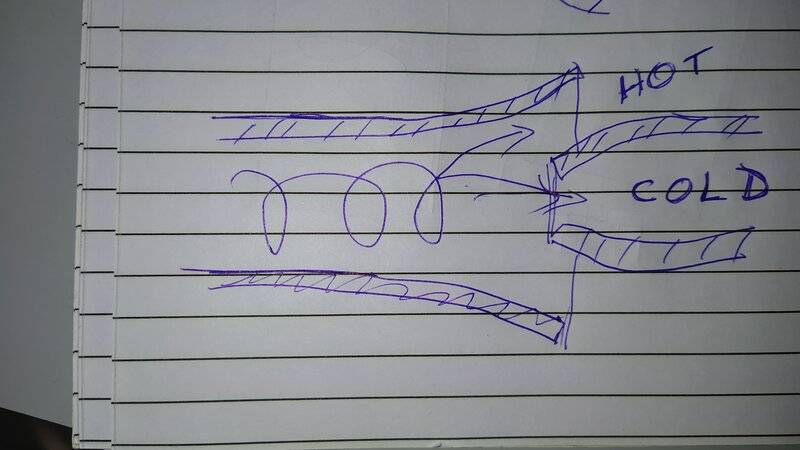
Second question -- If the above is true, won't it be better to skim off the cold air in some other way that will keep it more isolated from the warm stream? For example:
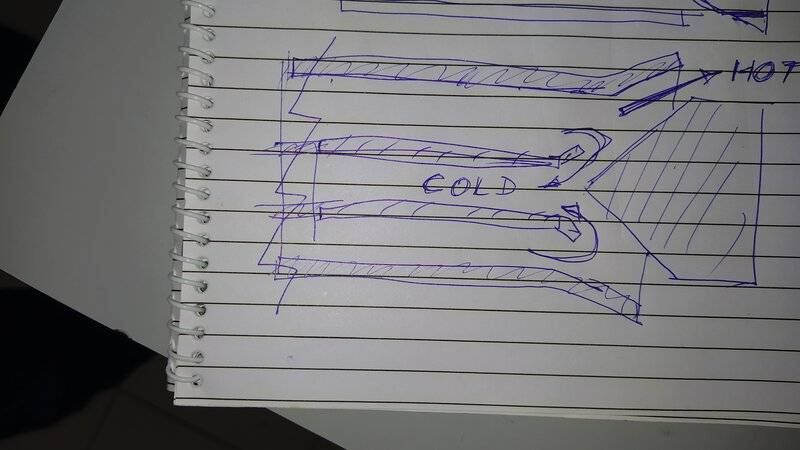
Or maybe like this:
The above paper says that the initial separation of hot and cold air is complete once the flow is partly deflected backwards at the left hand side (HOT) end. See Fig. 1 in the paper.
It also says that the further interaction of the two streams is actually undesirable, and that one would want that process to be like a "weak" or "bad" heat exchanger. So ideally we would want the cooled air (inner stream) to make its way back to the right hand side (COLD) end without any interaction with the outer stream.
So the process of returning the cold air to the right hand side, passing all the way through the tube, actually degrades the performance due to unwanted heat exchange between the inner and outer streams. This idea is elaborated in Fig. 3 of the paper.
My first question is -- is it true that the actual cooling of the cold stream happens entirely during the inward / backward deflection at the far end of the tube, and that all further interaction between the streams is merely an undesired dilution of performance?
Second question -- If the above is true, won't it be better to skim off the cold air in some other way that will keep it more isolated from the warm stream? For example:
Or maybe like this: