Understanding the Purpose of Charts in Differential Geometry

Click For Summary

Discussion Overview

The discussion revolves around the purpose and function of charts in differential geometry, particularly in the context of differential manifolds. Participants explore the relationship between coordinate functions, their inverses, and the mapping between subsets of manifolds.

Discussion Character

  • Technical explanation
  • Conceptual clarification
  • Exploratory

Main Points Raised

  • One participant questions the role of the inverse of a coordinate function and how the product of two coordinate functions relates to mapping between subsets.
  • Another participant explains that charts serve as locally Euclidean maps of curved manifolds, drawing an analogy to street maps and emphasizing the need for overlapping charts to be identical on their intersections.
  • A participant clarifies that the mapping between subsets is defined by the coordinate transformation, which is required to be infinitely differentiable for the manifold to be considered differentiable.
  • There is a discussion about parameterization, with examples provided to illustrate how it assigns points on a manifold to parameters in Euclidean space, contrasting it with the function of a coordinate chart.
  • Further insights are shared regarding the construction of smooth manifolds from pieces of Euclidean space and the role of charts in defining smooth functions, curves, and vector fields.

Areas of Agreement / Disagreement

Participants express various viewpoints on the definitions and roles of charts and parameterizations, with no clear consensus reached on the interpretations of these concepts. The discussion remains exploratory and open-ended.

Contextual Notes

Some assumptions about the definitions of charts and parameterizations are not explicitly stated, and the discussion includes references to specific conditions for differentiability that may require further clarification.
Fgard
Messages
15
Reaction score
1
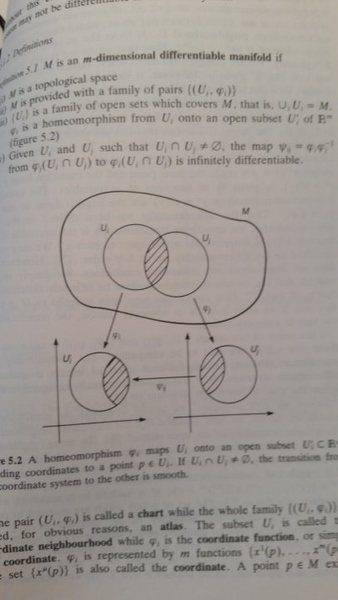
I am studying differential geometry and I stumbled on something that I don't understand. When we have a m- dim differential manifold, with U_i and U_j open subsets of M with their corresponding coordinate
20160125_093821.jpg

function phi. As can be seen in the figure.

If I understand it correctly phi_j of a point gives us a coordinate of that point. So what does the inverse of a coordinate function do? And how come the product of phi_i * phi_j = psi takes us between subsets?
 
  • Like
Likes   Reactions: Math Amateur
Physics news on Phys.org
The idea behind is that charts are a locally Euclidean map (coordinates) of the (curved) manifold. Just as street maps in an atlas are. Earth isn't flat, but locally we can pretend it is. This concept requires that overlapping charts are identical on their intersection.
The image in the textbook says ##φ_i|_{U_i ∩ U_j} = Ψ_i \cdot φ_j|_{U_i ∩ U_j}##.
 
  • Like
Likes   Reactions: Math Amateur
It is ##\phi_i\phi_j^{-1}## which maps a subset of ##U'_j## to a subset of ##U'_i##, as is written on the page you scanned near the right margin on the upper half.
 
  • Like
Likes   Reactions: Math Amateur
So that $\Psi$[\tex] maps between different subsets comes from a definition?
 
Fgard said:
So that $\Psi$[\tex] maps between different subsets comes from a definition?
<br /> Yes.<br /> Set ##U_{ij}=U_i \cap U_j##, and assume that ##U_{ij}\neq \varnothing##<br /> ##\Psi_{ij}## by definition maps ##\phi_j(U_{ij})## to ##\phi_i(U_{ij})##.<br /> ##\Psi_{ij}## being infinitely differentiable is the condition imposed in (iv) for M to be an m-dimensional differentiable manifold.<br /> <br /> As said above you can view ##\Psi_{ij}## as a coordinate transformation. Point (iv) in the definition requires these transformations to be infinitely differentiable.<br /> <br /> The book explains it better than I could, actually:<br /> <div class="bbImageWrapper js-lbImage" title="nakahara.jpg" data-src="https://www.physicsforums.com/attachments/nakahara-jpg.94883/" data-lb-sidebar-href="" data-lb-caption-extra-html="" data-single-image="1"> <img src="https://www.physicsforums.com/attachments/nakahara-jpg.94883/" data-url="" class="bbImage" data-zoom-target="1" style="" alt="nakahara.jpg" title="nakahara.jpg" width="548" height="287" loading="lazy" decoding="async" /> </div>
 
Last edited:
Okej. Thank you very much for all the help.
 
Fgard said:
If I understand it correctly phi_j of a point gives us a coordinate of that point. So what does the inverse of a coordinate function do? And how come the product of phi_i * phi_j = psi takes us between subsets?

The inverse of a coordinate chart is called a "parameterization". It assigns points on the manifold to parameters in a domain in Euclidean space.

Example:

## φ(u,v) = (sin(u)cos(v),sin(u)sin(v),cos(u))## parameterizes a region of the sphere. (u and v need to be restricted so that the map is 1 to 1).

Another Example:

##φ(u,v) = (cos(u),sin(u),cos(v),sin(v))## parameterizes a torus in four dimensional Euclidean space.

A parameterization generalizes the idea of a parameterized curve,##c(t)##, to more than one parameter.

- A coordinate chart goes in the other direction. It assigns a domain in Euclidean space to points on a manifold.

Example: Project the northern hemisphere (minus the equator) of the unit sphere onto the open unit disk in the xy-plane by dropping the z-coordinate.

- A parameterization followed by a coordinate chart maps a domain in Euclidean space into another domain in Euclidean space. If ##ψ## and ##φ## are two coordinate charts then ##φψ^{-1}## is a parameterization followed by a coordinate chart.

For smooth manifolds,##φψ^{-1}## is required to be a smooth map.
 
Last edited:
Here's a bit of intuition about charts. An n-manifold M is a space that is locally like Euclidean space of dimension n. If M is a smooth n-manifold — the nicest kind — then it makes sense to talk about smooth functions

f: M →

on it, smooth curves

α: [a,b] → M​

on it, smooth vector fields

V: M → T(M)​

on it, etc. (Here T(M) is the tangent space of M, a concept that your course will soon introduce, which consists of all tangent vectors at all points of M.)

In order to achieve this, we can always construct M by taking pieces (open sets) of Euclidean space n and "gluing them together smoothly". The idea of charts with their smooth transition functions is the right way to make this idea of smooth glueing precise, and allows for definition of smooth functions, curves, vector fields, etc. associated with M.
 
  • Like
Likes   Reactions: jim mcnamara

Similar threads

  • · Replies 20 ·
Replies
20
Views
5K
  • · Replies 25 ·
Replies
25
Views
5K
  • · Replies 9 ·
Replies
9
Views
2K
  • · Replies 7 ·
Replies
7
Views
5K
  • · Replies 8 ·
Replies
8
Views
2K
  • · Replies 2 ·
Replies
2
Views
2K
  • · Replies 8 ·
Replies
8
Views
3K
  • · Replies 5 ·
Replies
5
Views
2K
  • · Replies 4 ·
Replies
4
Views
2K
  • · Replies 3 ·
Replies
3
Views
3K