Math Amateur
Gold Member
MHB
- 3,920
- 48
I am reading "An Introduction to Differential Topology" by Dennis Barden and Charles Thomas ...
I am focussed on Chapter 1: Differential Manifolds and Differentiable Maps ...
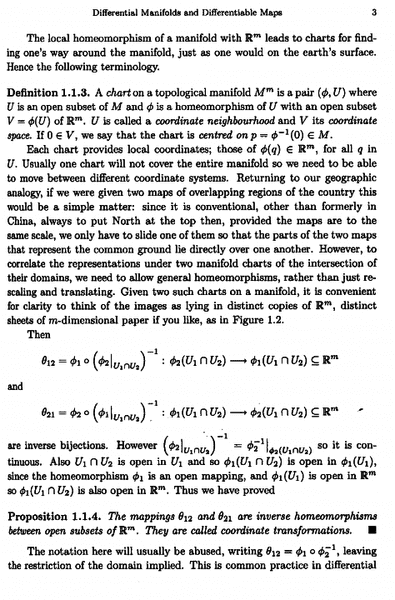
I need some help and clarification on an apparently simple notational issue regarding the definition of a chart (Definition 1.1.3) ...
Definition 1.1.3 reads as follows:
 My question regarding this definition is as follows:
What is the meaning of [itex]M[/itex] and how does it differ from [itex]M^m[/itex]?
Surely the relationship between [itex]M[/itex] and [itex]M^m[/itex] is not the same as the relationship between [itex]R[/itex] and [itex]R^m[/itex] ... ?
I am not even sure what [itex]M[/itex] is ... ?
Can someone clarify the above issue for me ...?
Hope someone can help ...
Peter===========================================================
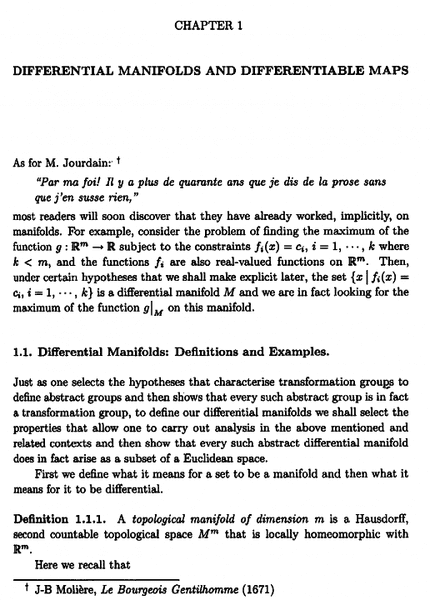
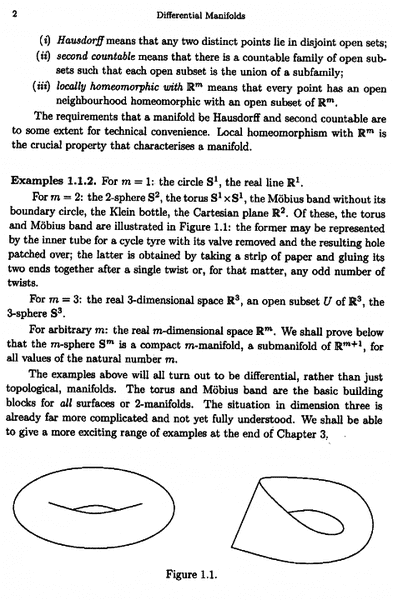
So that readers can understand the context and notation of Barden and Thomas, I am providing the pages of the text leading up to and including the definition referred to above ... ... as follows ... ...
I am focussed on Chapter 1: Differential Manifolds and Differentiable Maps ...
I need some help and clarification on an apparently simple notational issue regarding the definition of a chart (Definition 1.1.3) ...
Definition 1.1.3 reads as follows:
What is the meaning of [itex]M[/itex] and how does it differ from [itex]M^m[/itex]?
Surely the relationship between [itex]M[/itex] and [itex]M^m[/itex] is not the same as the relationship between [itex]R[/itex] and [itex]R^m[/itex] ... ?
I am not even sure what [itex]M[/itex] is ... ?
Can someone clarify the above issue for me ...?
Hope someone can help ...
Peter===========================================================
So that readers can understand the context and notation of Barden and Thomas, I am providing the pages of the text leading up to and including the definition referred to above ... ... as follows ... ...
Attachments


