Understanding thermodynamic equilibrium

Click For Summary
SUMMARY

This discussion focuses on understanding thermodynamic equilibrium, particularly in systems with multiple isolated bodies exchanging energy. The final temperature of the ensemble is determined by the heat capacities of the bodies, while the time to reach equilibrium is influenced by heat conductivity and temperature differences, as outlined by Newton's law of cooling. Key references include Schroeder's "Thermal Physics," Callen's "Thermodynamics and an Introduction to Thermostatistics," and W. J. Thomson's "Introduction to Transport Phenomena." The discussion clarifies that temperature is only applicable in thermodynamic equilibrium and emphasizes the importance of energy characterization in non-equilibrium states.

PREREQUISITES
  • Understanding of thermodynamic principles and concepts
  • Familiarity with heat transfer mechanisms, including conduction, convection, and radiation
  • Basic knowledge of fluid dynamics and temperature profiles
  • Ability to interpret and apply Newton's law of cooling
NEXT STEPS
  • Study "Thermal Physics" by Schroeder for foundational thermodynamic concepts
  • Explore "Thermodynamics and an Introduction to Thermostatistics" by Callen for advanced thermodynamic principles
  • Learn about heat transfer in fluids through "Introduction to Transport Phenomena" by W. J. Thomson
  • Investigate "Physical Fluid Dynamics" by D. J. Tritton to understand convection and its role in thermodynamic systems
USEFUL FOR

Students and professionals in physics, engineering, and applied sciences who are studying thermodynamics, fluid mechanics, and heat transfer processes.

phoenix95
Gold Member
Messages
81
Reaction score
23
My thermodynamics is rusty and my current endeavors demand me to wield it, so here we go: I need a good starting point and/or references to study physical systems in thermodynamic equilibrium. Any references which address the fluid mechanics perspective of said systems are welcome too. Let me state the problem at hand:

Suppose there are N bodies with temperatures T1, T2, T3..... Tn all are isolated from each other. And at t=0 the isolations are removed and the bodies are allowed to exchange information and reach thermal equilibrium. Then what would be the final temperature of the ensemble? What is the time taken to reach that equilibrium? How would you model the energy and entropy exchange between the bodies?

While framing this question, I noticed something else: you only assign a temperature to a system, if it is in thermodynamic equilibrium. So at t=0, when the isolations are removed, the system as a whole is not in thermal equilibrium (am I correct?). And until this ensemble reaches that equilibrium, it makes no sense to say 'temperature' (is it correct?). If so, how would you characterize a system, which is not in thermal equilibrium? What would you use, in place of 'temperature' to describe the system?

I know the question seems a bit too simplistic and vague. But any answers with a couple of references for further reading will be greatly appreciated.
 
Science news on Phys.org
There are lots of good textbooks on thermodynamics. Considering your question, I think you would be well served by the pedagogical approach of Schroeder's Thermal Physics, or by an old-school text like Callen's Thermodynamics and an Introduction to Thermostatistics. Once the basics have been acquired, application to fluids can be found in a textbook such as W. J. Thomson, Introduction to Transport Phenomena.

phoenix95 said:
Suppose there are N bodies with temperatures T1, T2, T3..... Tn all are isolated from each other. And at t=0 the isolations are removed and the bodies are allowed to exchange information and reach thermal equilibrium. Then what would be the final temperature of the ensemble? What is the time taken to reach that equilibrium? How would you model the energy and entropy exchange between the bodies?
That should be "exchange energy," not "exchange information." The final temperature will depend on the heat capacity of each system. Time taken to reach equilibrium will depend on heat conductivity and the difference in temperature, see https://en.wikipedia.org/wiki/Newton's_law_of_cooling.

The exact way to model this will depend on the systems. For realistic cases, this requires computer simulations.

phoenix95 said:
While framing this question, I noticed something else: you only assign a temperature to a system, if it is in thermodynamic equilibrium. So at t=0, when the isolations are removed, the system as a whole is not in thermal equilibrium (am I correct?).
Correct.
phoenix95 said:
And until this ensemble reaches that equilibrium, it makes no sense to say 'temperature' (is it correct?). If so, how would you characterize a system, which is not in thermal equilibrium? What would you use, in place of 'temperature' to describe the system?
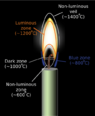
For the entire system, it is characterized by energy. But you can still have local equilibrium and talk of the temperature at a given point. This is done all the time in fluid dynamics. This is how you get something like flame temperature profiles:
https://en.wikipedia.org/wiki/File:Anatomy_of_a_candle_flame.svg
Anatomy_of_a_candle_flame.svg.png
 
  • Like
Likes   Reactions: Lord Jestocost and phoenix95
DrClaude said:
That should be "exchange energy," not "exchange information."
When I was thinking of the example above, I thought that the primary means of heat exchange between the said bodies would be through radiation (of course, conduction and convection were possible, but the focus of my study is the radiative heat transfer). And I thought that the photons would carry information (synonymous with entropy), in addition to heat. Could I be wrong in describing so? That is to say, the word 'information' carries no meaning in the context?
DrClaude said:
For the entire system, it is characterized by energy. But you can still have local equilibrium and talk of the temperature at a given point. This is done all the time in fluid dynamics. This is how you get something like flame temperature profiles:
https://en.wikipedia.org/wiki/File:Anatomy_of_a_candle_flame.svg
This was exactly what I was looking for. Do the same references you mentioned above cover this as well? Or are there any others I should take note of?
 
phoenix95 said:
Could I be wrong in describing so? That is to say, the word 'information' carries no meaning in the context?
I wouldn't use information in this context.

phoenix95 said:
This was exactly what I was looking for. Do the same references you mentioned above cover this as well? Or are there any others I should take note of?
It is covered in Thomson's book. The basics should be found in textbooks on fluid dynamics, such as D. J. Tritton, Physical Fluid Dynamics. Look for "convection."
 
  • Like
Likes   Reactions: phoenix95 and Lord Jestocost

Similar threads

  • · Replies 135 ·
5
Replies
135
Views
8K
  • · Replies 5 ·
Replies
5
Views
3K
  • · Replies 15 ·
Replies
15
Views
3K
  • · Replies 3 ·
Replies
3
Views
2K
  • · Replies 7 ·
Replies
7
Views
3K
  • · Replies 2 ·
Replies
2
Views
2K
  • · Replies 1 ·
Replies
1
Views
2K
Replies
5
Views
656
  • · Replies 3 ·
Replies
3
Views
2K
  • · Replies 3 ·
Replies
3
Views
2K