phantomvommand
- 287
- 39
- Homework Statement
- This is the electricity problem from 1983 IPhO. I am confused about a small part of the answer, and understand the rest of the solution, so you guys do not have to go through the entire solution. I am only asking about part b.
- Relevant Equations
- Q = CV,
Kirchoff's laws
The problem is shown below: (I am only asking about part b)
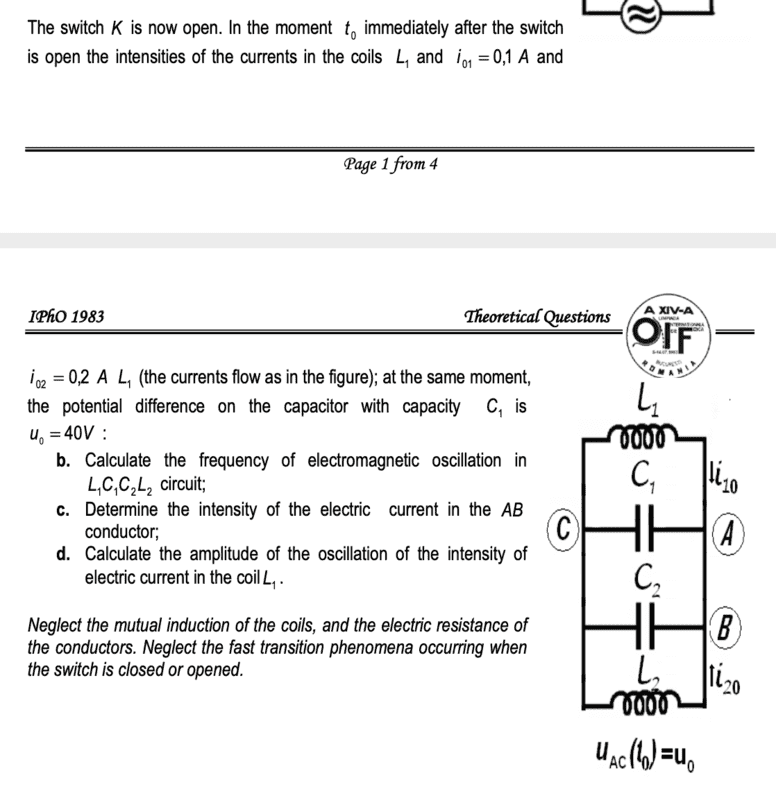
^Above is the problem.
Below is the solution to part b. They have claimed that we can set potential at C = D = u(t), and A=B=0. Why is this claim true?
What I realize:
By applying Kirchoff's across ACDB, Voltage across C1 = Voltage across C2. But the claim that Voltage at C = Voltage at D seems impossible to me. How can there still be a current flowing through CD (denoted by i5), if Vc = Vd? Likewise, how can i5 exist between AB if Va = Vb = 0?
You may refer to the full solution here: https://www.jyu.fi/tdk/kastdk/olympiads/problems.html#83prob (if I have not given enough context).
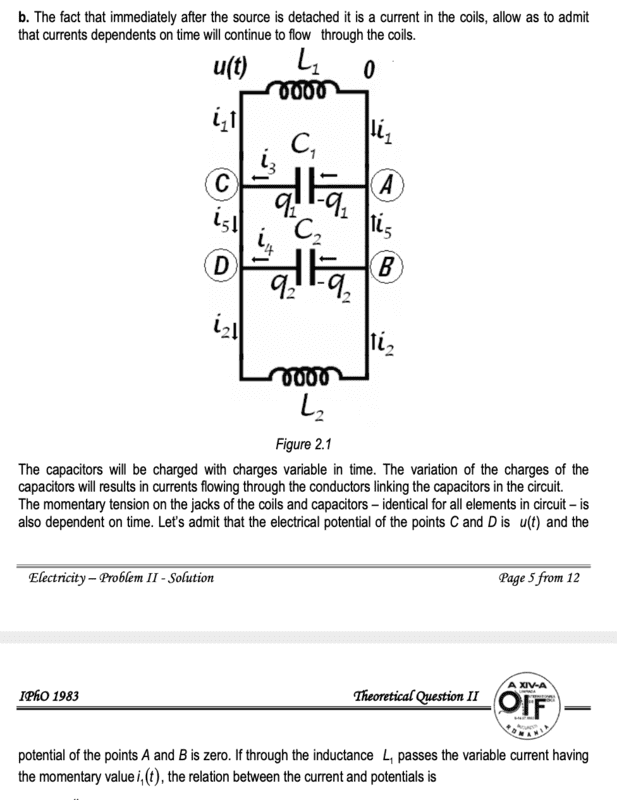
Thank you!
^Above is the problem.
Below is the solution to part b. They have claimed that we can set potential at C = D = u(t), and A=B=0. Why is this claim true?
What I realize:
By applying Kirchoff's across ACDB, Voltage across C1 = Voltage across C2. But the claim that Voltage at C = Voltage at D seems impossible to me. How can there still be a current flowing through CD (denoted by i5), if Vc = Vd? Likewise, how can i5 exist between AB if Va = Vb = 0?
You may refer to the full solution here: https://www.jyu.fi/tdk/kastdk/olympiads/problems.html#83prob (if I have not given enough context).
Thank you!