Understanding why πr^2 works for different area calculations

  • Context: High School 
  • Thread starter Thread starter paulb203
  • Start date Start date
  • Tags Tags
    Area Circle Radius
Click For Summary
SUMMARY

The discussion explores the mathematical concept of area calculations using the formula πr², extending it to squares and regular polygons. The user introduces a new term, "sqi ar²," to represent the area of a square, demonstrating that for a square with a side length of 4 cm, the area calculated using this formula equals 16 cm², consistent with traditional methods. The conversation further delves into the area of a regular hexagon, introducing "hxi ar²" and calculating the area using two different formulas, leading to slightly varying results. The importance of consistent definitions for diameter and apothem in these calculations is emphasized.

PREREQUISITES
  • Understanding of basic geometry concepts, including area and perimeter.
  • Familiarity with the properties of circles and polygons.
  • Knowledge of mathematical ratios and their applications.
  • Ability to apply geometric formulas, such as those for area and perimeter of polygons.
NEXT STEPS
  • Research the derivation and applications of the area formula for regular polygons.
  • Learn about the concept of apothem and its significance in polygon area calculations.
  • Explore the relationship between perimeter and area as the number of polygon sides increases.
  • Investigate the mathematical properties of π and its relevance in various geometric contexts.
USEFUL FOR

Mathematicians, geometry students, educators, and anyone interested in understanding area calculations for different geometric shapes.

paulb203
Messages
196
Reaction score
76
TL;DR
A kind of personal 'proof' to help me grasp πr^2
I know there are videos etc explaining why but I thought I would try to find a way to understand this myself.

Imagine a version of πr^2, but instead of being for the area of a circle, it’s for the area of a square.
Call it sqi ar ^2
sqi = the ratio of the ‘diameter’ of the square to the square’s ‘circumference’ (the ‘diameter’ of the square being a vertical or horizontal line through the square’s centre, and the ‘circumference’ being its perimeter).
So, sqi=4 (like π=3.14...)
ar = the ‘radius’ of the square (half it’s ‘diameter’, just like with a circe and it’s radius)

Now take a square 4 cm by 4cm
And apply sqi ar ^2
Which gives us 4x2^2
Which = 16cm^2
Which matches with the 16cm^2 we would get from the conventional way of finding the area of the square.

This helps make sense of πr^2, for me at least
Any thoughts?
 
Mathematics news on Phys.org
That is a start in the understanding. Of course, one example does not make a proof. Try some other examples, such as regular hexagon, octagon, etc.

See how the ratio changes as the limit of number of sides increases.
 
  • Like
Likes   Reactions: paulb203 and jim mcnamara
The coincidence you are wondering about may be due to the similarity of the figure in the X and Y axis. If you consider the area of a rectangle or an ellipse, the pattern is broken.
 
  • Like
Likes   Reactions: paulb203
Your proof has determined that the value of the perimeter/diameter ratio (aka π for circumferences) for a square (which "radius" has been defined by you) is 4.

Please, see:
https://www.mathsisfun.com/geometry/circle.html

https://www.mathsisfun.com/geometry/circle-area-lines.html

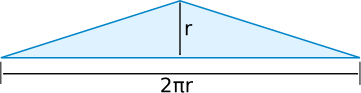
circle-area-lines.svg


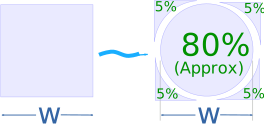
circle-area-vs-square.svg


Area circle-square.jpg
 
Last edited:
  • Like
Likes   Reactions: paulb203
scottdave said:
That is a start in the understanding. Of course, one example does not make a proof. Try some other examples, such as regular hexagon, octagon, etc.

See how the ratio changes as the limit of number of sides increases.
Thanks, Dave.

First challenge, for me; draw a regular hexagon. I had to dig out my protractor, and think about how to go about that. Got there in the end.
Drew a regular hexagon, sides 6cm.
Wondered what would count as the 'diameter'. Thinking corner to furthest away corner, so 12cm (that was interesting; twice the length of the sides).
Then realised I'd never considered what the area of a hexagon might be, what the formula for that might be. Found 2 online. 3√3/(2)(a^2) where a=side
This gave the area as approx 93.53
And,
A=0.5ap where a=apothem and p=perimeter
Once I'd Googled 'apothem' I applied the formula and got 90, which sounded right as I had approximated the apothem as 5

So now to apply a version of sqi ar ^2
Call it hxi ar ^2
hxi being the ratio of the perimeter of the hexagon (36 in this case) to the 'diameter' of the hexagon (12 in this case, if I'm correct in thinking that corner to furthest corner counts as the 'diameter'?).
And 36:12 = 3:1
So hxi ( 'pi for a hexagon' )= 3?

I'm knackered after that :)
 
paulb203 said:
the ‘diameter’ of the square being a vertical or horizontal line through the square’s centre,
paulb203 said:
if I'm correct in thinking that corner to furthest corner counts as the 'diameter'?).
You are being inconsistent here. You should either use the side midpoints or the corners. One method approaches pi from above, the other from below, as you increase the number of sides.
 
  • Like
Likes   Reactions: scottdave, SammyS and paulb203
A.T. said:
You are being inconsistent here. You should either use the side midpoints or the corners. One method approaches pi from above, the other from below, as you increase the number of sides.
Thanks, A.T.
I'll use the side midpoints as that's what made sense for me with a square.
And now I've found out that is the apothem I can dispense with calling it 'ar' and call it 'a' for apothem instead
But I've got two different answers.
Using [3√3/(2)](a^2) for the area (where a=length of side) which gives 93.5 I get 3.09 for 'hxi'
hxi(a^2)=93.5 (a=apothem) (apothem = 5.5)
hxi=93.5/5.5^2
hxi=3.09

And, using Area=0.5aP where a=apothem and P=perimeter I get 99 for the area (?I?!)
Which gives me;
hxi(a^2)=99
hxi=99/5.5^2
hxi=3.27 (the 27 recurring)

?I?!
 

Similar threads

  • · Replies 4 ·
Replies
4
Views
4K
  • · Replies 37 ·
2
Replies
37
Views
9K
Replies
28
Views
4K
  • · Replies 5 ·
Replies
5
Views
2K
Replies
1
Views
3K
  • · Replies 24 ·
Replies
24
Views
3K
  • · Replies 9 ·
Replies
9
Views
3K
  • · Replies 11 ·
Replies
11
Views
4K
Replies
6
Views
3K
  • · Replies 6 ·
Replies
6
Views
2K