Union & Set Rules - Learn the Basics Now!

  • Context:
  • Thread starter Thread starter TinaSprout
  • Start date Start date
  • Tags Tags
    Rules Set Union
Join the discussion
Ask a follow-up here, or get your own question answered by working scientists, mathematicians and engineers — people, not an autocomplete.
Real named experts · corrections over time · the nuance an AI answer skips
3 replies · 2K views
TinaSprout
Messages
2
Reaction score
0
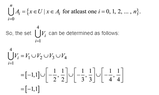
I am going over some of my notes, and I cannot understand unions, here is the selection I am having trouble with
View attachment 7601

How does the union of four different sets equal just one of the sets? Should the union of 4 sets be the four different sets instead of one.
I am missing something fundamental to unions and intersections.
Thanks for your help!
 

Attachments

  • math help.PNG
    math help.PNG
    4.5 KB · Views: 165
Physics news on Phys.org
TinaSprout said:
I am going over some of my notes, and I cannot understand unions, here is the selection I am having trouble with


How does the union of four different sets equal just one of the sets? Should the union of 4 sets be the four different sets instead of one.
I am missing something fundamental to unions and intersections.
Thanks for your help!

Hi TinaSprout! Welcome to MHB! (Smile)

The union of 2 sets is the set that contains all elements that those 2 sets contain.
So e.g. $\{a,b,c\} \cup \{a,d\}=\{a,b,c,d\}$.
That is the combination of all elements.
Note that the element $a$ that is part of both sets, is included once in the union.The notation $[-1,1]$ means that we have a set of infinitely many elements.
Those are all real numbers between -1 and +1.
The union of $[-1,1] \cup [-\frac 12, \frac 12]$ is $[-1,1]$, because it contains all elements of both sets.
That is, it all real numbers between $-\frac 12$ and $\frac 12$ are contained in the interval $[-1,1]$.
 
In this case, if you make a drawing of the four intervals, I think it already becomes clearer.
However, we can also strictly use the definition in your first equation. We are asked to prove that
\[
V_1 \cup V_2 \cup V_3 \cup V_4 = [-1,1], \qquad (\ast)
\]
where $V_i = \left[-\frac{1}{i}, \frac{1}{i}\right]$ for $i = 1,\ldots,4$.

1. First consider $x \in [-1,1]$. Then $x \in V_1$ so, by your definition of "union", $x \in V_1 \cup V_2 \cup V_3 \cup V_4$.

2. Next, consider $x \in V_1 \cup V_2 \cup V_3 \cup V_4$. Then $x$ must be in at least one of the $V_i$. No matter in which $V_i$ it is, note that always $x \ge -1$ and $x \le 1$, but this just means that $x \in [-1,1]$.

So, we have established $(\ast)$.

Note that we could also have considered the sets $W_i = \{V_i\}$ for $i = 1,\ldots,4$. That is, each $W_i$ is a set that has exactly one element, and this element is itself a set: $V_i \in W_i$ for $i = 1,\ldots,4$. Try to understand that in this case,
\[
W_1 \cup W_2 \cup W_3 \cup W_4 = \{V_1, V_2, V_3, V_4\},
\]
which is a set consisting of four elements, each element being a set by itself. In particular, the union of the $W_i$ is not equal to the interval $[-1,1]$.
 
In brief, all of those intervals, [math]\left[-\frac{1}{2}, \frac{1}{2}\right][/math], [math]\left[-\frac{1}{3},\frac{1}{3}\right][/math], etc. Are subsets of [-1, 1]. Every member of each interval is already in [-1, 1].