Gear300
- 1,209
- 9
When it is referred that the Universe is expanding/accelerating outward, do they mean to say that space is expanding or that matter is accelerating outward through space?
The forum discussion centers on the nature of the universe's expansion, specifically whether it is space itself that is expanding or if matter is moving outward through space. The consensus is that, according to Einstein's General Relativity, it is space that is expanding, which can be illustrated by the analogy of an expanding balloon. The discussion also clarifies the distinction between two explanations for cosmological redshift: one based on the movement of objects and the other on the expansion of space itself, with the latter being the correct interpretation in the context of General Relativity. Additionally, the conversation touches on the complexities of defining motion and the implications of space not being an absolute reference frame.
PREREQUISITESAstronomers, physicists, and students of cosmology who seek to deepen their understanding of the universe's expansion and the fundamental principles of General Relativity.
russ_watters said:There is no such thing as "moving through space"...
Civilized said:I'm not totally sure what Russ is getting at, but from a spacetime perspective, moving through space without moving at all through time would correspond to infinite velocity, and that is impossible in relativity.
Space is not an object nor an absolute reference frame, so there is nothing for one to measure a velocity relative to. Velocity is measured between objects.Gear300 said:Then what is there?
russ_watters said:Space is not an object nor an absolute reference frame, so there is nothing for one to measure a velocity relative to. Velocity is measured between objects.
Gear300 said:Then what is space and what is meant by it expanding?
Yes, that's what one can say and usually does say.Since everything is moving further from everything else (on sufficiently large scales) you can equally say that the space between everything (on sufficiently large scales) is increasing.
sylas said:I think the notion that matter is "carried by" the expansion of space is a bit misleading. (Reply #2 above.)
I like this definition: space is that which is measured by rulers and clocks. This is the converse of Einstein's operational definition of time: that which is measured by clocks. Spacetime is that which is measured by rulers and clocks.
Expanding space means that distances between things are increasing. We speak of expansion of the universe because on sufficiently large scales, the distance between any two objects is increasing. Since everything is moving further from everything else (on sufficiently large scales) you can equally say that the space between everything (on sufficiently large scales) is increasing. But I think it may be slightly better to say that space is expanded by the motions of objects, rather than objects are carried by the expansion of space. It's a bit like noting that spacetime is curved by massive objects.
You can also say that volumes are increasing. If you try to define a volume for a region of space, on sufficiently large scales, that volume is increasing.
Cheers -- sylas
Ich said:Yes, that's what one can say and usually does say.
The unambiguous meaning of it is that distances increase with time (with some subtleties concerning definitions and exact values). Every statement that goes beyond this fact, like space dragging objects with it or otherwise, is necessarily interpretation or mental picture, not fact. Interpreations may be useful or not, and one may pick in each event the one that is least misleading.
Chronos said:General relativity is not so easily understood as special relativity. GR forces you to divorce many principles of SR when you look at the big picture. SR is only a special case of GR. Does that help? Nothing in SR forbids an expanding universe. Pretty much everything in GR demands it. The speed of expansion is irrelevant.
sylas said:But I think it may be slightly better to say that space is expanded by the motions of objects, rather than objects are carried by the expansion of space. It's a bit like noting that spacetime is curved by massive objects.
Gear300 said:From all this, it seems that there is no stable definition for motion...
If I'm right, SR implies that all motion is evaluated relative to some reference that is also evaluated relative to another reference and so on. So then, as Ich said, there isn't too much against this interpretation:
Still...if space is the one expanding...shouldn't it need to expand through a higher-dimensional medium and is that implied anywhere in GR or is it just interpretation?
I'd say Gear300 is correct: there is no undisputable definition of "motion" in GR, if the concerned objects are at some distance.As for motion having no stable definition; I think it is more correct to say that when we describe things with conventional language or analogies, descriptions are incomplete.
Ich said:...
In GR, even relative velocity between distant objects depends on how you define it. Even worse, relative velocities are not easy to calculate, so it's common to take some coordinate values and call them velocity.
But, of course, if you pick one definition and stick to it, everything will work out mathematically.
Chronos said:Arp is the short answer. Cosmologists are no less surprised than anyone else about the existence of dark energy. At present, there is no other viable explanation.
yogi said:Who was it that said: "Cosmologists are frequently wrong, but never in doubt"
George Jones said:Lev Landau. When he said this, there was a paucity of good cosmological data. The situation today is much different, as Weinberg indicates in the preface of his new cosmology book,
"The new excitement in cosmology came as if on cue for elementary particle physicists. By the 1980s the Standard Model of elementary particles and fields had become well established. Although significant theoretical and experimental work continued, there was now little contact between experiment and new theoretical ideas, and without this contact, particle physics lost much of its liveliness. Cosmology now offered the excitement that particle physicists had experienced in the 1960s and 1970s."
Chronos said:The Legacy Supernova Survey is the best and only significant observational evidence for dark energy. It is difficult to dispute. See
http://www.kqed.org/quest/blog/2008/04/08/supernova-legacy/
http://mr.caltech.edu/press_releases/12767
http://www.gemini.edu/create-content/pio-websplash/the-last-supernova-legacy-survey-spectrum
Science plods along like a turtle, Turtles live for a very long time, not unlike science done properly.
Rymer said:I've seen it. Worked with it for the last few years. I do DISPUTE that it shows anything like 'proof' for 'dark energy'. The so called 'acceleration' is ONLY seen when comparing to a known flawed model -- Milne or an empty model equivalent.
Close analysis of the limited data does indicate a systematic divergence consistent with a slower CONSTANT expansion velocity than an empty model. This is considered to be a normal departure of comparing an 'empty' universe and one containing matter. THERE IS NO CHANGE. Its the same departure as seen in more redshifted data.
sylas said:Flatly false. It is seeing in the fact that the rate of expansion is increasing rather than decreasing, as determined by the evidence. I have no idea how you can possibly claim to be "working" with this. Your answer doesn't make any sense at all. Prior to this evidence, the conventional model was a critical mass model; not the empty model.
No, it doesn't. The empty model would give a constant expansion rate. The evidence indicates that the rate is increasing.
Cheers -- sylas
Rymer said:Have you LOOKED at the simple image attachment to see what can happen with two slightly different data fits to data? And this assumes the data doesn't have a systemic error. It appears to have one in very low z -- (suspected that a small gravitational correction is needed). This only effects data below z<<0.2
The evidence is the data. Do your own analysis.
sylas said:I looked at it, and it didn't seem to use the data at all.
People have said above that the "only" evidence for dark energy is the supernova light curves. That's not strictly true. As with all science, cosmology uses all the available evidence together. If you use supernova light curves and nothing else, you might consider the empty model as credible. The data does actually indicate acceleration, as I indicated, rather than merely constant expansion as in the empty model, but the difference is small.
But the empty model has worse problems than a slightly worse fit with the supernova data... and that is that the universe ISN'T empty. There are multiple lines of evidence for dark matter, on top of all the baryonic matter around... and worse, the universe is FLAT. Empty model can't give you that at all.
So, as I said before, it's just nonsense to say that acceleration only shows up by comparison with the empty model. It shows up much more strongly, in fact, when compared with other flat models, with critical mass density. Which, of course, was the preferred model before the evidence for dark energy came in, because the empty model is ruled out by other data.
The whole question remains open, particularly in the light of the fact we don't really know what dark energy or dark matter really is. But it's just silly to say that acceleration is only apparent in comparison with the empty model.
If you REALLY want to look at data, then you need to look at the observation; not just the curves you provided for some of the models from some spreadsheet (I presume). You don't seem to be doing "data analysis" at all.
Here's a better way to look at data. I am simply giving some figures from New Constraints on ΩM, ΩΛ, and w from an Independent Set of Eleven High-Redshift Supernovae Observed with HST, by Kopp et al (2003) at astro-ph/0309368.
This is a comparison of magnitudes with redshift.
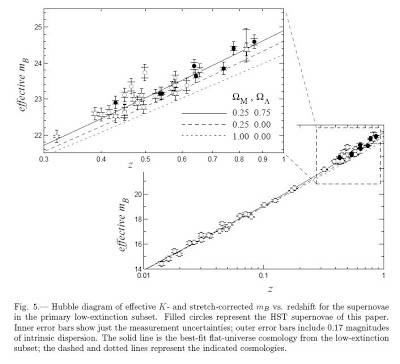
The thing to note here is the cosmologies. The lowest line is the critical mass case. The middle line is the sub-critical mass. The upper line is a dark energy. The empty model would be between the middle and upper lines, but it is not displayed here. As you've noted yourself, this is a falsified model in any case. Why would you bother to show it?
The fact is, the empty model... on THIS data... would be hard to separate from the dark energy model. But that ISN'T the right comparison. And it most definitely is not the case that the dark energy model only shows up by comparison with the flawed empty model! Dark energy actually shows up BETTER by comparison with the critical matter model... which is not flawed... at least, until the data for dark energy came along.
I don't mind if you are personally skeptical on your own behalf. The major objection I had was your claim that dark energy only shows up when comparing with the empty model. That's just silly.
My own position is that I don't think the case is closed. Dark energy is able to explain the data best, at present; and more recent data has only strengthened that case. But until we know more about what dark energy actually is, I'm keeping an open mind.
Cheers -- sylas


